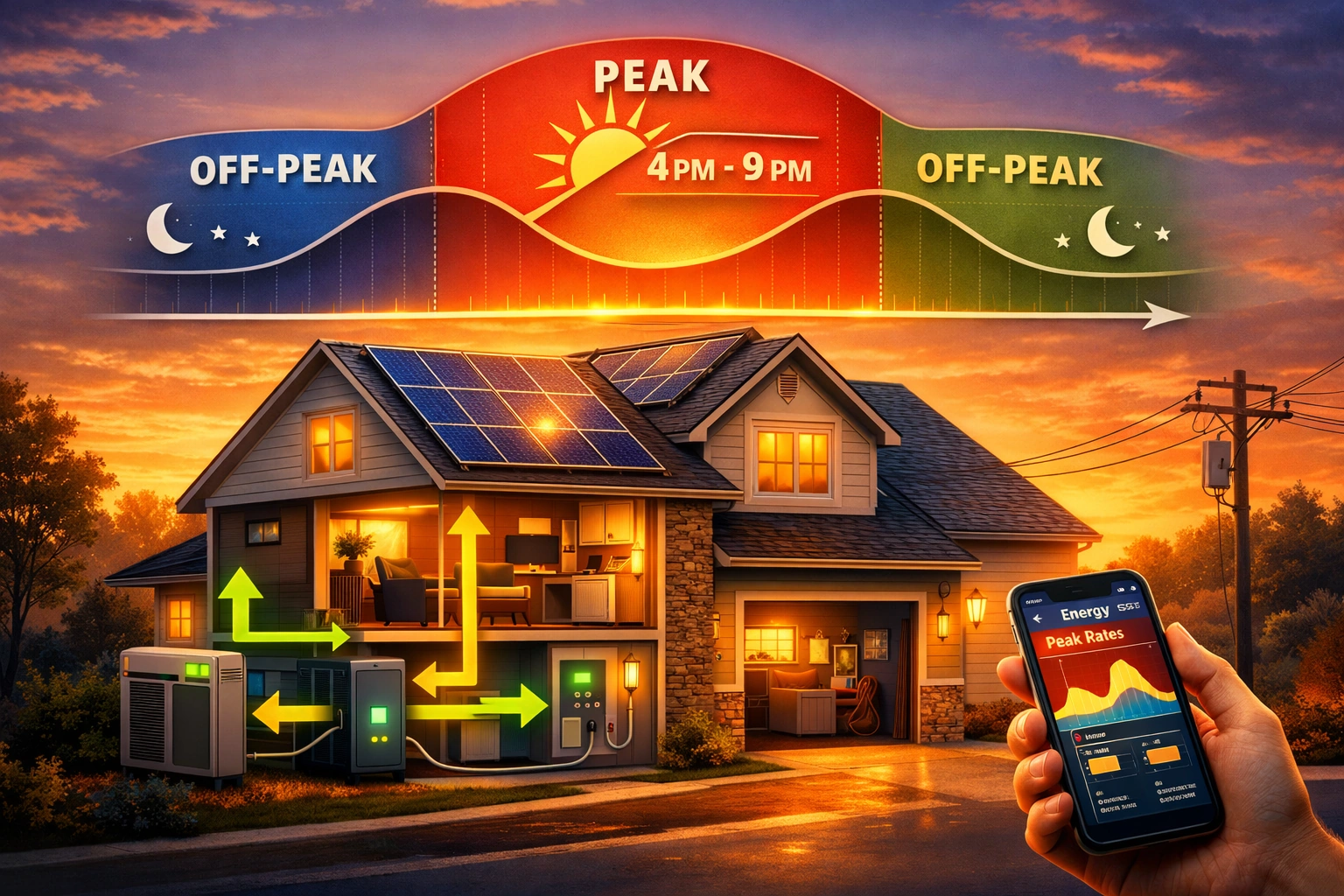

Quick takeaway: On a TOU plan, when you use electricity can matter more than how efficient your panels are. Solar produces most mid-day, but peak prices are often late afternoon/evening—so timing and load shifting become the big levers.
The 60-second answer (what TOU changes for solar)
A time-of-use (TOU) electric plan charges different prices depending on when you use electricity (usually higher during peak hours, lower off-peak). With solar, TOU matters because solar panels produce most in the middle of the day, while many TOU plans charge the most late afternoon/evening—when solar production is falling and homes often use more power.
That “timing mismatch” can cause two common surprises:
- You can produce plenty of kWh over a year and still owe money at true-up because you bought expensive peak kWh and exported lower-value mid-day kWh.
- You can often improve savings without changing your panels by increasing self-consumption (using more solar at home) through safe load shifting.
Safety note: This guide is for planning and behavior changes (settings, scheduling, questions to ask). For wiring, roof work, service panel upgrades, or battery/EV charger installation, use a licensed professional.
What TOU rates are (peak vs off-peak in plain English)
A TOU plan divides the day into price windows such as:
- Off-peak (cheapest)
- Mid-peak (medium)
- On-peak (most expensive)
TOU vs flat rate: what changes on your bill
With a flat rate, you pay roughly the same $/kWh anytime. With TOU, your bill depends on how many kWh you used in each time window (peak vs off-peak).
For a refresher on where TOU shows up on your bill, see: How to Read Your Electric Bill for Solar (Before & After Going Solar).
Why utilities price electricity by time (simple version)
Electricity is more expensive when the grid is stressed (high demand, constrained supply). TOU rates encourage customers to shift usage away from those expensive hours—so “load shifting” becomes a real savings lever.
Source: U.S. DOE/FEMP overview of utility rate options and rate structures.
The key solar idea: solar produces mid-day, peak prices are often late afternoon/evening
Solar output usually peaks around mid-day. But electricity demand (and often TOU peak pricing) frequently rises later in the afternoon and early evening. This is why timing matters so much for TOU + solar.
Source: U.S. EIA (Today in Energy) discussion of how PV output varies by orientation and the value of later-day production under TOU pricing.
Why that mismatch can raise true-up balances
If your home uses lots of electricity during expensive hours (often evenings), you may buy a lot of high-price peak kWh—even if you exported a lot of solar earlier. That’s why some homeowners feel like “solar didn’t work” when the real issue is timing + tariff rules, not panel performance.
Learn how true-up works here: Solar True-Up Explained.
When west-facing (or east/west split) can help
If your main goal is reducing peak-priced imports, a west-facing (or east/west split) production curve can better align with late-day pricing than a pure south-facing curve in many locations. This is most relevant for new installs or re-roof planning, and always depends on your roof and your tariff.
Related: Best Direction for Solar Panels (USA).
Step 1 — Identify your TOU plan and the “expensive hours”
Before you change habits (or buy equipment), collect these four items:
- Rate plan name (exact tariff / schedule)
- Peak hours (and whether they change by season)
- Weekend/holiday rules (some plans have different peak definitions)
- Export credit rules (net metering vs net billing, and whether export is time-differentiated)
Where to find peak windows + seasons + weekends
Your utility bill often shows your rate schedule or a link to it, and many bills include a breakdown of on-peak vs off-peak kWh.
Start with: How to Read Your Electric Bill for Solar.
Export credit rules: net metering vs net billing vs TOU export rates
TOU gets confusing without the credit rules. If you’re not 100% clear on these, read them first:
Key takeaway: With many modern programs, exported solar may be worth less than the retail peak price you pay later—so maximizing self-consumption often becomes more valuable than chasing small efficiency gains.
Step 2 — Measure your “timing problem” using your monitoring app
If you can measure it, you can improve it. Your goal is to understand:
- When do you import from the grid the most? (often evenings)
- When do you export solar the most? (often mid-day)
Use this guide: How to Read Your Solar Monitoring App.
Production vs consumption vs import/export (quick recap)
- Production: solar generated
- Consumption: your home used
- Import: pulled from the grid
- Export: sent to the grid
The #1 mistake: misaligned date windows (bill vs app)
Your utility bill might run mid-month to mid-month, while your monitoring app’s “monthly view” is often calendar-month. Misalignment creates fake confusion—especially when you’re trying to compare TOU periods or understand true-up.
Practical measurement goal for TOU: Over a week, try to reduce peak-hour imports (kWh) and increase mid-day self-consumption. Then check the same metrics again next week.
Step 3 — The homeowner-safe load-shifting playbook (big wins first)
The best TOU + solar strategy is usually: use more of your solar mid-day and avoid buying peak kWh later. Below are the high-impact moves that don’t require DIY electrical work.
1) EV charging (often the #1 controllable load)
If you have an EV, you have a large flexible load. Two common approaches:
- Mid-day charging: If you export a lot mid-day, schedule charging during solar hours to use your own energy.
- Off-peak charging: If off-peak is extremely cheap and export credits are decent, overnight charging might still win.
What to do today: Use your EV or charger’s scheduling feature to set a consistent window, then track whether mid-day exports drop and peak imports drop.
2) HVAC “pre-cool / pre-heat” (big lever, done safely)
Heating and cooling are often the biggest residential electric loads. The homeowner-safe idea is simple: adjust your thermostat earlier (when solar is producing) so your home coasts through peak pricing hours with less HVAC runtime.
- Summer: cool a bit more before peak begins; raise slightly during peak (comfort-first).
- Winter: warm a bit more before peak begins; lower slightly during peak (comfort-first).
Keep changes modest to protect comfort and health—especially for children, seniors, and anyone sensitive to heat/cold.
3) Water heating (turn your tank into “thermal storage”)
If you have an electric water heater or heat pump water heater, many models support scheduling so more heating happens mid-day. Even without smart features, a professional can advise on safe timer options.
Why it works: A water tank stores heat, so you’re effectively “storing” mid-day solar as hot water.
4) Laundry + dishwasher scheduling (small but easy)
These loads are usually smaller than EV/HVAC, but easy wins. If your goal is self-consumption, run them during strong solar hours (late morning to mid-afternoon).
5) Pool pump scheduling (if applicable)
Pool pumps can be large, schedulable loads. If you have a pump, try moving most runtime into solar hours and verify via import/export charts.
The guiding rule (keep it simple)
If your exported solar is worth less than what you pay during peak, shift flexible loads into solar hours to raise self-consumption and reduce peak imports.
Step 4 — When a battery helps (and when it doesn’t)
A battery can store mid-day solar and discharge during peak hours (reducing peak imports), and it can provide backup during outages. But batteries also introduce tradeoffs you should understand:
- Round-trip efficiency losses: you don’t get 100% of stored energy back.
- Warranty constraints: some warranties include throughput limits (how much energy is cycled over time).
- Backup reserve settings: keeping more for outages means less available for TOU shifting.
Related SolarBasicsHub guides:
Backup-first vs savings-first (reserve setting concept)
If you set a high backup reserve, you leave less capacity available for TOU savings. If you set a low reserve, you maximize TOU shifting but reduce outage coverage. There’s no “right” answer—choose based on your outage risk and comfort.
Quick “battery helps most” scenarios
A battery tends to help more when:
- Peak prices are high and long
- Export credits are low (net billing / low export rate)
- Your home’s usage is concentrated during peak hours
- You also value outage backup
Source: NREL reports on solar-plus and behind-the-meter storage value under time-varying rates.
Step 5 — Quick decision checklist: should you switch to TOU (or leave it)?
You often benefit from TOU if…
- You can shift big loads (EV, HVAC pre-cool/pre-heat, water heating)
- Your household is home mid-day (or you can automate mid-day loads)
- Your solar exports are low-value, making self-consumption more important
You may lose on TOU if…
- Your usage is heavily evening-focused and you can’t shift it
- Peak windows are long and expensive
- You don’t have flexible loads or automation
The simplest safe next step
- Gather one full bill cycle showing TOU period kWh (on-peak/off-peak)
- Compare to your monitoring import/export timing (aligned date range)
- Try 2–3 load-shifting moves for one week
- Re-check peak imports and mid-day exports
TOU + solar strategy table (what to do, why it helps, who it fits)
| Strategy | What you change (safe) | Why it helps on TOU | Best for |
|---|---|---|---|
| Midday EV charging | Schedule charging during solar hours (example: 10am–3pm) | Uses solar directly; reduces peak imports later | EV owners with midday solar surplus |
| HVAC pre-cool/pre-heat | Adjust setpoints before peak begins (comfort-first) | Lowers HVAC runtime during expensive hours | Homes where HVAC is the biggest load |
| Water heater scheduling | Heat water midday (ask a pro about timers/scheduling) | Turns solar into “thermal storage” | Electric/HPWH households |
| Shift laundry/dishwasher | Run during strong solar hours | Increases self-consumption | Almost anyone (small–medium impact) |
| Battery for TOU shifting | Store midday, discharge at peak (plus reserve settings) | Buys less peak kWh (but has losses + warranty tradeoffs) | High peak rates + low export value |
| West/east-west layouts (planning stage) | Compare azimuth options using PVWatts | Shifts production later (often more valuable under TOU) | New installs / re-roof planning |
PVWatts guide: PVWatts Solar Production Estimate.
FAQ
1) Are TOU rates always better with solar?
No. TOU can help or hurt depending on your load timing and your export credit rules. The same annual kWh can produce different bill outcomes under different tariffs.
Start here: Net Metering Explained (and What Net Billing Changes).
2) Why did I produce “enough” solar but still owe money?
Often because you bought expensive peak kWh and exported lower-value mid-day kWh (timing mismatch). True-up settlements can make that obvious all at once.
Read: Solar True-Up Explained.
3) What’s the best load to shift first?
Usually the biggest flexible load you have: EV charging, HVAC scheduling, then water heating. Smaller loads (laundry/dishwasher) help but are often secondary.
4) Do I need a battery for TOU savings?
Not always. Many households improve TOU outcomes with load shifting alone. Batteries can help more when peak prices are high and export credits are low—but they add cost, efficiency losses, and warranty tradeoffs.
Related: Solar Battery Round-Trip Efficiency.
5) How do I verify that my changes are working?
Use your monitoring app to track peak-hour imports and mid-day exports over comparable, aligned date windows.
Guide: How to Read Your Solar Monitoring App.
6) Does panel direction matter more on TOU?
It can. West-facing or east/west split can better match late-day value on TOU plans, even if south-facing maximizes total annual kWh in many locations. Validate with PVWatts and your plan rules.
Related: Best Direction for Solar Panels (USA).
7) What if my TOU plan changes by season?
That’s common. You may need seasonal schedules (summer vs winter) for EV charging and thermostat adjustments. Re-check your bill or utility tariff whenever seasons change.
Next to Read
- How to Read Your Electric Bill for Solar (Before & After Going Solar)
- How to Read Your Solar Monitoring App
- Solar Self-Consumption Explained
- Net Metering Explained (and What Net Billing Changes)
- Solar True-Up Explained
- Best Direction for Solar Panels (USA)
- PVWatts Solar Production Estimate
- Solar Battery Backup Reserve
- Solar Battery Round-Trip Efficiency
- Solar Battery Throughput Warranty