
Outline
- The solar tax credit in 2026: the short version
- What “placed in service” means (and how to prove it)
- Who qualifies (home + ownership rules)
- What costs count (and what usually doesn’t)
- How the credit is calculated (with examples)
- How to claim the credit (Form 5695 walkthrough)
- Carryforward rules: what if you don’t owe enough tax?
- Document checklist (save these before you file)
- Common mistakes that cause delays or lost credit
- Quick decision table + next steps
- FAQ
- Next to Read
The solar tax credit in 2026: the short version
If you’re searching “solar tax credit 2026,” you’re probably in one of these situations:
- You installed solar in 2025 and you’re filing taxes in 2026 and want to claim the credit correctly.
- You signed a contract in 2025 but you’re not sure whether your system “counts.”
- You added (or plan to add) a battery and want to know if it qualifies.
Here’s the key idea:
The federal residential solar credit is based on when your system is “placed in service,” not when you sign, order equipment, or make a deposit.
As of January 12, 2026, the IRS “Residential Clean Energy Credit” page states the 30% credit applies to installations from 2022 through December 31, 2025 and is not available for property placed in service after December 31, 2025.
Source: IRS — Residential Clean Energy Credit: https://www.irs.gov/credits-deductions/residential-clean-energy-credit
This guide focuses on:
- How to claim the credit in 2026 for systems placed in service in 2025, and
- How carryforward works if your credit is bigger than your tax bill.
Safety + accuracy note (USA): Tax rules and program timelines can change. Treat this as homeowner education, not tax advice. When in doubt, follow IRS definitions and/or consult a qualified tax professional.
What “placed in service” means (and how to prove it)
“Placed in service” is the phrase that decides whether your solar project qualifies.
In homeowner language, it generally means:
- Your solar system is installed and ready to operate for its intended use (producing electricity for your home), not just delivered or partially installed.
Source: IRS — Residential Clean Energy Credit: https://www.irs.gov/credits-deductions/residential-clean-energy-credit
Practical ways homeowners can document “placed in service”
Different installers and utilities document this differently. Helpful evidence often includes:
- Permission to Operate (PTO) letter/email from your utility (common for grid-tied systems)
- Commissioning/activation documentation from the installer
- Final inspection sign-off from the local authority having jurisdiction (AHJ)
- Inverter monitoring showing the system producing (supporting evidence)
Important: Don’t assume a contract date or “paid in full” date is enough. For tax timing, what matters is when the system is actually in service.
Who qualifies (home + ownership rules)
This section answers “Is my home and situation eligible?”
You generally need:
- A home located in the United States
- You (the taxpayer) own the home (or meet IRS rules for claiming the credit)
- Qualifying clean energy property that meets IRS requirements
Source: IRS — Residential Clean Energy Credit: https://www.irs.gov/credits-deductions/residential-clean-energy-credit
Primary home vs second home
Many homeowners ask if a second home counts. Rules can depend on your exact use and ownership details, so treat this as a “verify” item with IRS guidance or a tax pro if your situation is complicated.
Rentals (landlords) vs personal use
If the property is strictly a rental and not used as a residence by you, the homeowner credit rules may not apply the same way. That’s a common “don’t guess” scenario.
What costs count (and what usually doesn’t)
This is where most quote confusion happens. Solar invoices bundle many line items together.
The IRS instructions for Form 5695 describe what can be included, such as qualified solar electric property costs and labor costs properly allocable to onsite preparation, assembly, or original installation, including piping or wiring to interconnect the property to the home.
Source: IRS — Instructions for Form 5695: https://www.irs.gov/instructions/i5695
Costs that typically count (common examples)
- Solar panels (PV modules)
- Inverters (string, microinverters, optimizers as part of the PV system)
- Racking/mounting equipment required for installation
- Electrical balance-of-system required to interconnect (wiring, conduit, disconnects when part of installation scope)
- Installation labor directly tied to installing and commissioning the PV system
Source: IRS — Instructions for Form 5695: https://www.irs.gov/instructions/i5695
Do batteries qualify?
Battery rules can be a major money question. The federal clean energy credits framework includes battery storage technology; eligibility details can depend on the IRS rules and Form 5695 instructions.
Source: U.S. Department of Energy — Clean energy tax credits overview: https://www.energy.gov/policy/articles/making-our-homes-more-efficient-clean-energy-tax-credits-consumers
Safe homeowner rule: If you’re claiming a battery, keep the battery model, capacity, and invoice line item crystal clear, and follow the Form 5695 instructions.
Costs that often do NOT count (or are case-by-case)
These are common pitfalls:
- Roof replacement that’s not required solely for solar (often not eligible)
- Unrelated electrical upgrades (sometimes required for your home, but not always eligible under this specific credit)
- Tree removal, reroofing, or aesthetic improvements not strictly part of the solar property
If an installer claims “everything counts,” ask them to identify which items align with IRS rules and provide itemization.
How the credit is calculated (with examples)
At a high level, a tax credit is a dollar-for-dollar reduction in the federal income tax you owe (not a deduction).
Source: DOE — Homeowner’s Guide to the Federal Tax Credit for Solar PV (PDF): https://www.energy.gov/sites/default/files/2021-02/Guide%20to%20Federal%20Tax%20Credit%20for%20Residential%20Solar%20PV%20-%202021.pdf
The simple math
Credit = 30% × qualified costs (for qualifying property placed in service in the eligible window described by the IRS).
Source: IRS — Residential Clean Energy Credit: https://www.irs.gov/credits-deductions/residential-clean-energy-credit
Example 1: Solar-only
- Total qualified solar cost (from itemized invoice): $24,000
- Credit estimate: 30% × 24,000 = $7,200
Example 2: Solar + battery
- Solar qualified costs: $22,000
- Battery qualified costs: $12,000
- Total: $34,000
- Credit estimate: 30% × 34,000 = $10,200
Reality check: The credit reduces tax liability. If your total tax liability is smaller than the credit, carryforward may apply (next section).
How to claim the credit (Form 5695 walkthrough)
You don’t “ask your installer to file it.” You claim it on your federal return.
The form used
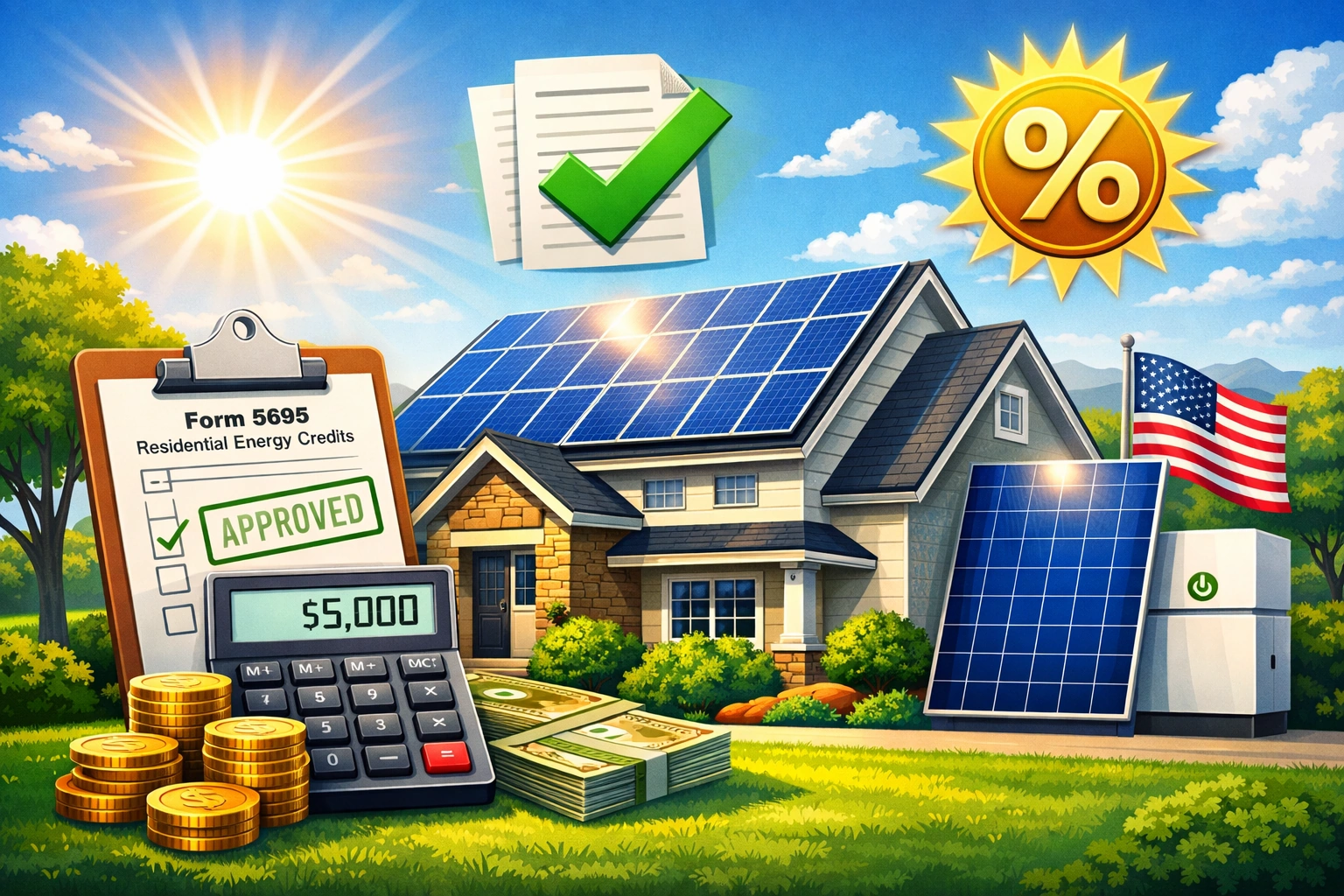
The IRS says Form 5695 is used to figure and take your residential energy credits (including the Residential Clean Energy Credit).
Source: IRS — About Form 5695: https://www.irs.gov/forms-pubs/about-form-5695
What to do (homeowner-friendly steps)
- Collect documents first (see the checklist section below).
- Total up qualified costs using your itemized invoice(s).
- Complete Form 5695 for the appropriate tax year.
- Transfer the resulting credit amount to your tax return as instructed by your tax software or preparer.
If you use tax software, you’ll usually enter:
- System type (solar PV, battery, etc.)
- Total qualified cost
- “Placed in service” year
- Any carryforward from prior year (if applicable)
Tip: Keep a PDF of the completed Form 5695 with your tax records.
Carryforward rules: what if you don’t owe enough tax?
Many homeowners expect a “refund check” equal to 30% of the system cost. That’s not how most nonrefundable credits work.
If your credit is larger than your tax liability for the year, you may be able to carry forward the unused portion to future tax years (subject to IRS rules).
Source: IRS — Residential Clean Energy Credit: https://www.irs.gov/credits-deductions/residential-clean-energy-credit
Simple carryforward example
- You qualify for a $7,200 solar credit.
- Your federal income tax liability for the year is $4,500.
- You can use $4,500 this year.
- The remaining $2,700 may carry forward.
Why this matters for planning: If your installer promises “you’ll get $7,200 back next April,” that’s a red flag. Your outcome depends on your tax situation.
Document checklist (save these before you file)
This section is designed to prevent the most painful homeowner scenario: the credit is legitimate, but your paperwork is weak.
Save:
- Final itemized invoice showing equipment + labor
- Proof of payment (receipts, financing agreement, etc.)
- Installer contract with scope of work
- Commissioning/activation proof (installer sign-off) and/or PTO from utility (if grid-tied)
- Equipment spec sheets / model numbers (especially for battery)
- Any rebate paperwork (utility/state/local) so you don’t double-count incorrectly
If you want the “cost categories” mindset for invoices, this SolarBasicsHub guide pairs perfectly with the checklist:
https://solarbasicshub.com/solar-cost-breakdown/
Common mistakes that cause delays or lost credit
1) Confusing “purchase date” with “placed in service”
If your system wasn’t actually in service in the eligible window, you can’t claim it for that year.
2) No itemization (everything is “one lump sum”)
You can still claim legitimate projects, but itemization makes it far easier to justify qualified costs.
3) Counting roof work automatically
Roof work is commonly misunderstood. Don’t assume it’s eligible just because it’s on the same invoice.
4) Overtrusting “savings math” from sales proposals
Sales estimates can be optimistic. Always compare quotes line-by-line and sanity-check assumptions.
Internal reads that help you avoid expensive confusion:
- Solar cost line items: https://solarbasicshub.com/solar-cost-breakdown/
- Quote comparison checklist: https://solarbasicshub.com/how-to-compare-solar-quotes-line-by-line/
- Bill + rate plan decoding: https://solarbasicshub.com/how-to-read-your-electric-bill-for-solar-before-after-going-solar/
- Net metering vs net billing: https://solarbasicshub.com/net-metering-explained-how-solar-credits-work-and-what-net-billing-changes/
Quick decision table + next steps
Decision table (fast)
| Your situation | Likely next step | What to gather |
|---|---|---|
| System was producing in 2025 (installed + operating) | Claim on your 2025 return (filed in 2026) | Invoice, proof of payment, PTO/commissioning |
| You signed in 2025 but system went live later | Verify “placed in service” date; don’t guess | Installer commissioning docs, utility PTO |
| Adding a battery (or already did) | Confirm battery capacity + itemization | Battery model/spec, invoice line item |
| You don’t owe much federal tax | Expect carryforward, not instant full refund | Prior-year return, estimated liability |
Next steps (homeowner checklist)
- Confirm your system’s placed-in-service year with your installer and utility docs.
- Gather paperwork and itemized costs.
- Use Form 5695 for the applicable tax year.
Source: IRS — About Form 5695: https://www.irs.gov/forms-pubs/about-form-5695
Source: IRS — Instructions for Form 5695: https://www.irs.gov/instructions/i5695
FAQ
1) Is the solar tax credit a rebate or a refund?
It’s a tax credit (reduces tax owed). It’s not the same as a cash rebate.
Source: DOE — Solar PV tax credit guide (PDF): https://www.energy.gov/sites/default/files/2021-02/Guide%20to%20Federal%20Tax%20Credit%20for%20Residential%20Solar%20PV%20-%202021.pdf
2) What year do I claim it?
Typically the year your system is placed in service (installed and ready to operate).
Source: IRS — Residential Clean Energy Credit: https://www.irs.gov/credits-deductions/residential-clean-energy-credit
3) Can I still claim in 2026?
Yes if your system was placed in service in 2025 and you’re filing your 2025 taxes in 2026 (and you meet eligibility).
Source: IRS — Residential Clean Energy Credit: https://www.irs.gov/credits-deductions/residential-clean-energy-credit
4) Does a solar battery qualify?
Battery storage can qualify under clean energy credits, but follow IRS Form 5695 instructions and keep itemized documentation.
Source: DOE — Clean energy tax credits overview: https://www.energy.gov/policy/articles/making-our-homes-more-efficient-clean-energy-tax-credits-consumers
Source: IRS — Instructions for Form 5695: https://www.irs.gov/instructions/i5695
5) What if my credit is bigger than my tax bill?
Carryforward may apply (unused credit can be applied to future years, subject to IRS rules).
Source: IRS — Residential Clean Energy Credit: https://www.irs.gov/credits-deductions/residential-clean-energy-credit
6) Do I need PTO to claim it?
Not always as a strict “must,” but PTO/commissioning proof is excellent evidence that the system was placed in service. Keep it.
7) Should I trust “we’ll handle the credit for you” from an installer?
Installers can help with documentation, but you claim it on your return using Form 5695.
Source: IRS — About Form 5695: https://www.irs.gov/forms-pubs/about-form-5695
Next to Read
- https://solarbasicshub.com/solar-cost-breakdown/
- https://solarbasicshub.com/how-to-compare-solar-quotes-line-by-line/
- https://solarbasicshub.com/how-to-read-your-electric-bill-for-solar-before-after-going-solar/
- https://solarbasicshub.com/net-metering-explained-how-solar-credits-work-and-what-net-billing-changes/
- https://solarbasicshub.com/solar-components-and-sizing-basics/