
Quick answer: what surge protection does for solar
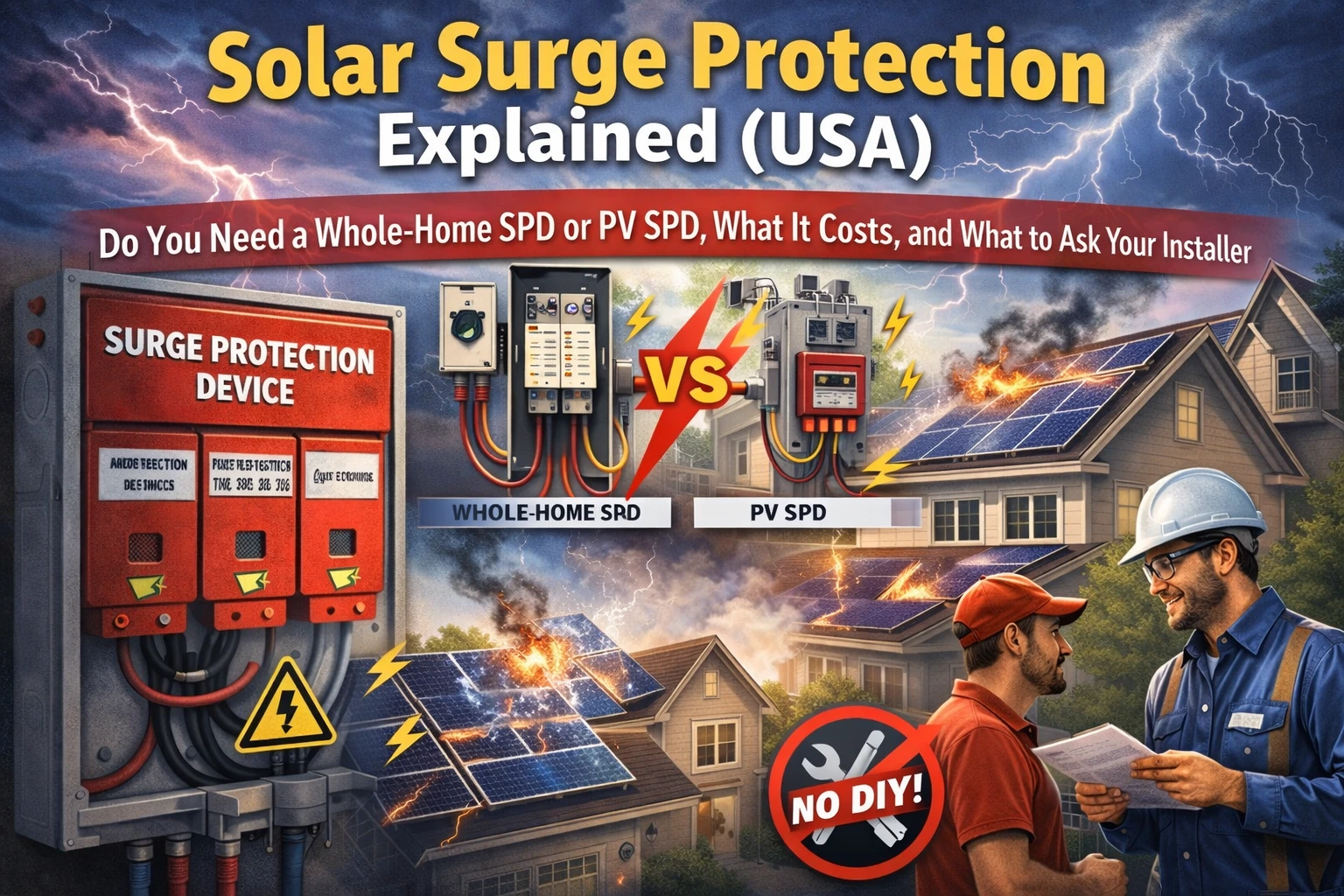
Solar surge protection is about reducing the chance that a sudden transient overvoltage (“surge”) damages your solar inverter, battery electronics, or other connected equipment. In homeowner terms: an SPD (surge protective device) is a sacrificial/defensive component that can limit a fast voltage spike and divert surge energy away from sensitive electronics.
Most homeowners encounter surge protection in two places:
- Whole-home (service panel) surge protection that protects many circuits in the home, including solar equipment connected on the AC side.
- Solar-specific SPDs placed at or near the inverter and, in some designs, on the PV DC side.
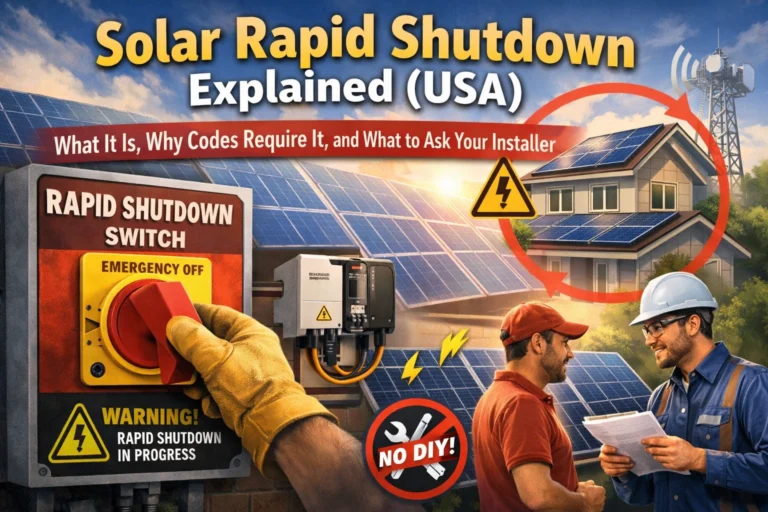
Safety note (USA): This article is for education and quote comparison only. Do not DIY electrical work. Any SPD, panel, inverter, or wiring work should be designed and installed by qualified professionals and approved by your local AHJ (Authority Having Jurisdiction).
What a “surge” is (lightning vs utility switching)
A surge is a brief, high-voltage event that can ride on power lines and wiring. Two common causes are:
- Lightning-related surges: not only direct strikes, but also nearby strikes that induce voltage/current transients.
- Grid/utility switching surges: transient overvoltages caused by switching operations, faults, or restoration events.
IEC standards describe SPDs as devices intended to protect against indirect and direct effects of lightning and other transient overvoltages. Source: IEC 61643 publications (scope statements). Source: https://webstore.iec.ch/en/publication/27917
Why solar can be vulnerable
Rooftop PV adds long conductor runs, roof exposure, and highly electronic power conversion equipment (inverters, optimizers/microinverters, battery inverters). These electronics are great for efficiency and monitoring—but they can be more sensitive to transients than purely resistive loads.
SolarBasicsHub already flags surge protection as a “hidden” balance-of-system reliability item—especially in lightning-prone areas. Source: https://solarbasicshub.com/solar-components-and-sizing-basics/
Whole-home surge protector vs “solar SPD” (what’s the difference?)
This is the part that confuses most homeowners: an SPD can be installed in multiple locations, and different placements protect different parts of your system.
1) Whole-home surge protection (service/main panel SPD)
A whole-home SPD is usually installed at (or very near) your main electrical panel or service equipment. Its job is to reduce the impact of surges coming from the utility side before they spread through your home’s circuits.
Why it matters for solar: your inverter ultimately connects to the home’s AC system. If a surge enters through the service conductors, a service-panel SPD may help clamp that surge before it reaches the inverter and other devices.
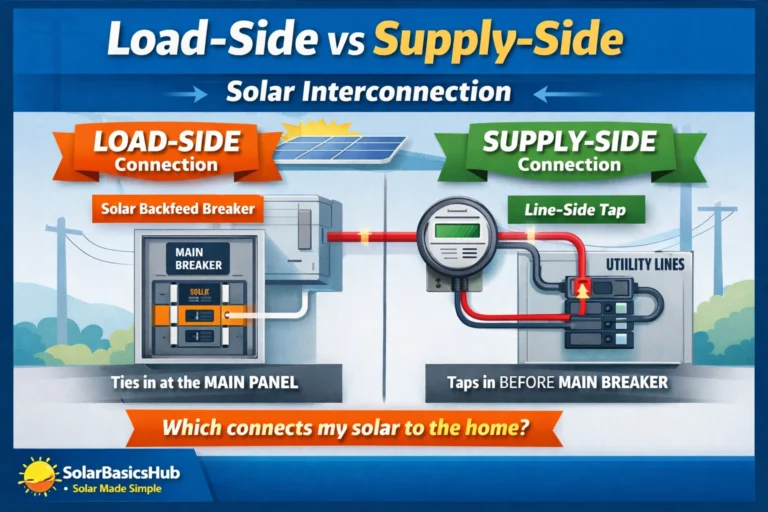
Related SolarBasicsHub context: If your solar project already involves main panel evaluation (120% rule, derates, supply-side connection), that’s a good time to discuss SPD options with the electrician. Source: https://solarbasicshub.com/main-panel-upgrade-for-solar/
2) Inverter-side SPDs (AC and/or DC, depending on system)
Many solar designs can include additional SPDs near the inverter:
- AC-side SPD near the inverter (protects inverter AC connection from surges on the building wiring).
- DC-side PV SPD (protects inverter PV input from DC-side transients induced on PV string conductors, where applicable).
In plain English: the closer the protection is to the sensitive device, the more directly it can protect that device in certain surge paths. However, the “best” design depends on your system architecture, grounding/bonding approach, conductor routing, and local code/inspection expectations.
3) Communications/monitoring surge protection (when relevant)
Some solar systems rely on Ethernet, data cabling, or long communication runs (especially in detached garages, outbuildings, or ground mounts). If you have long comms cable runs, ask your installer whether communications surge protection is appropriate for your design.
Monitoring basics (SolarBasicsHub): https://solarbasicshub.com/how-to-read-solar-monitoring-app/
Decision table: where SPDs go and what they protect
| SPD placement | What it mainly protects | Best for | Common limitation | What to ask for (paper check) |
|---|---|---|---|---|
| Main/service panel (whole-home SPD) | Home circuits + major connected equipment from utility-side surges | Most homes, especially with valuable electronics | May not address all surge paths on rooftop PV conductors | “Is it listed to UL 1449? What type/installation location? Provide datasheet/model.” |
| Near inverter (AC-side SPD) | Inverter AC electronics from building-wiring surges | Systems with long AC runs to inverter, or when inverter is in detached/remote location | Does not directly protect PV DC conductors | “Show where it mounts and how it’s coordinated with the main panel SPD (if any).” |
| PV DC-side SPD (string systems where applicable) | Inverter PV input from DC-side transients on PV conductors | String inverter systems with long rooftop DC runs | Architecture-dependent; not the same role for microinverter systems | “Which PV SPD standard/listing applies and what voltage rating is used for my system?” |
| Communications/data SPD (when used) | Monitoring gateway, Ethernet/data ports, comms lines | Long comms runs, outbuildings, or sensitive networking gear | Only protects that communication path | “What comms path is protected (Ethernet/coax/etc.) and where is it installed?” |
What standards and labels matter (homeowner version)
You don’t need to become an electrical engineer to compare SPDs. You just need to know which “stamp” and documentation to request.
UL 1449 (North America): the key “listed SPD” standard
In North America, UL 1449 is the major safety standard for surge protective devices. An overview of UL 1449’s scope notes it applies to SPDs used on 50/60 Hz power circuits and also covers PV applications up to certain DC voltages (as described in UL 1449 scope summaries). Source: UL 1449 overview/summary. Source: https://www.intertek.com/standards-updates/ul-1449-surge-protective-devices/
Homeowner takeaway: ask the installer to provide the exact SPD model and a datasheet showing it is listed to UL 1449 for the intended use.
IEC 61643 series (international context you’ll see on datasheets)
Many solar SPD datasheets reference IEC 61643 standards. IEC publications describe devices for surge protection against lightning effects and transient overvoltages, including devices intended for DC circuits up to 1,500 V DC in relevant parts. Source: IEC 61643-41 scope statement. Source: https://webstore.iec.ch/en/publication/27917
Homeowner takeaway: seeing IEC 61643 references is common on manufacturer literature, but for U.S. residential installations, the practical “paper check” is usually UL listing (UL 1449) plus AHJ acceptance.
Do you “need” surge protection for solar? A risk-based decision
There is no one-size-fits-all answer, but you can make a smart decision with a simple risk screen.
1) Lightning exposure and line type
If you live in a lightning-prone area or have overhead service lines (common in many regions), your surge exposure can be higher than a neighborhood with fully underground service. Lightning and surge protection references note PV systems can be exposed to surges from both lightning effects and the power grid, and that ground potential differences can matter. Source: NIST report on lightning and surge protection of photovoltaic installations. Source: https://www.nist.gov/document/photovoltaicpdf
2) Your equipment value and sensitivity
Surges can damage electronics, and the inverter (and battery inverter, if you have storage) is one of the most expensive “brains” of the system. If you’re adding a battery, EV charger, or other high-value electronics, an SPD conversation becomes more relevant.
3) Warranty and insurance reality
Surge events can become “grey zone” disputes if documentation is weak: was it a covered peril, was the damage internal/external, and who pays labor? A homeowner-safe approach is to make surge protection part of your paper trail:
- Put the SPD scope in your contract/quote.
- Confirm who warrants the SPD itself and who covers labor if it fails.
- Confirm how inverter warranty claims are handled if a surge is suspected.
Insurance checklist context (SolarBasicsHub): https://solarbasicshub.com/does-homeowners-insurance-cover-solar-panels/
Warranty framing (SolarBasicsHub): https://solarbasicshub.com/solar-panel-warranty-explained/
Typical costs (USA) and what changes the price
Installed costs vary widely by region and panel complexity, so use these as “order of magnitude” planning ranges only:
- Whole-home SPD (service panel): often a few hundred dollars installed, but can be higher if your panel is crowded, older, or needs additional electrical work.
- Inverter-side or PV-side SPDs: varies by architecture and installation details; may be bundled by some solar companies as a reliability add-on.
Cost drivers include: panel access, whether a main panel upgrade is already required, distance from inverter to panel, number of conductors/strings, and AHJ requirements.
Best practice for quotes: ask for a line item that includes the SPD model number(s), installation location(s), and any warranty terms.
Copy/paste checklist: what to ask your installer (surge protection edition)
Send this to every installer so you can compare apples-to-apples:
- 1) What surge protection is included by default? “List every SPD included (service panel, inverter AC side, PV DC side, comms).”
- 2) Provide exact models: “Provide the model number and datasheet for each SPD.”
- 3) Listing/standard confirmation: “Confirm the SPD is listed to UL 1449 for its intended application.”
- 4) Location & labeling: “Show where each SPD is installed (panel, inverter, combiner, etc.) and what labeling is provided.”
- 5) Coordination question: “If you install both a main-panel SPD and inverter/PV SPDs, how are they coordinated in your design?”
- 6) Warranty responsibility: “If an SPD fails or sacrifices itself during a surge, who pays for replacement labor and parts?”
- 7) What does your service plan do after a storm? “If the system throws faults after a storm, what’s the troubleshooting process and timeline?”
FAQ
1) Will surge protection guarantee my inverter never fails?
No. Surge protection reduces risk; it does not eliminate all possible damage paths. Your risk depends on local exposure, wiring layout, and system design.
2) Is a whole-home surge protector enough for solar?
For many homes it’s a strong baseline, but solar-specific placements may also be considered depending on architecture (string inverter vs microinverters), conductor routing, and local conditions. Use the checklist to force the design discussion and compare quotes.
3) What does “UL 1449 listed” mean in plain English?
It indicates the SPD meets UL 1449 safety testing and requirements for surge protective devices as applicable. Source: UL 1449 overview/scope summary. Source: https://www.intertek.com/standards-updates/ul-1449-surge-protective-devices/
4) I have microinverters—do I still care about surge protection?
You may. Microinverters are still electronics on a rooftop system, and the home/service wiring can still carry surges. The right approach depends on your installation and local conditions.
5) How would I know if a surge affected my system?
You might see inverter faults, communication dropouts, or a sudden change in production. Use monitoring to capture what happened, then contact your installer. Monitoring guide: https://solarbasicshub.com/how-to-read-solar-monitoring-app/
6) Does insurance cover surge damage to solar equipment?
Coverage depends on policy language, ownership, deductible, and the cause of loss. Use a checklist approach and confirm coverage in writing. SolarBasicsHub guide: https://solarbasicshub.com/does-homeowners-insurance-cover-solar-panels/