
Quick answer: what “solar self-consumption” means (and why it matters)
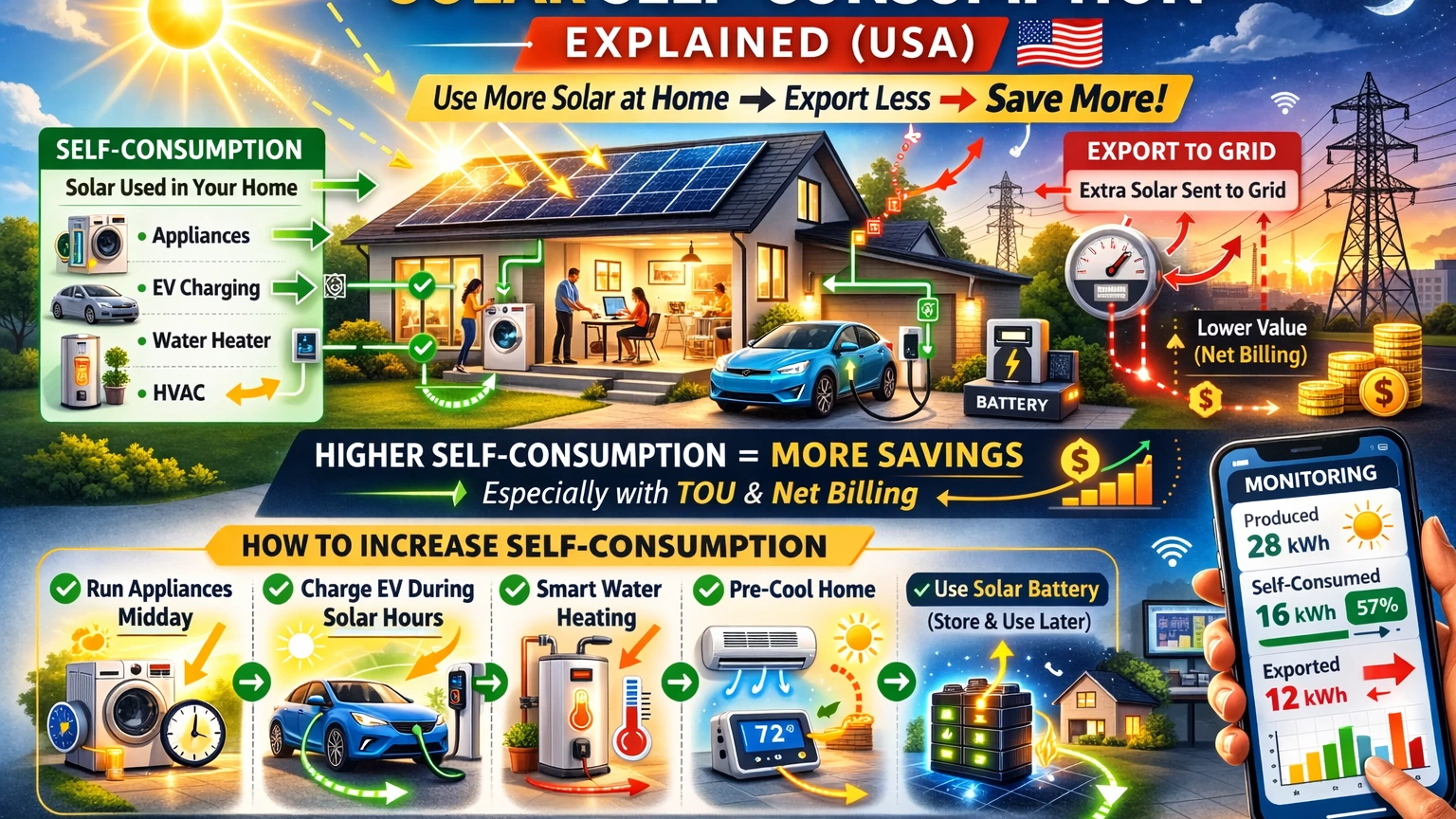
Solar self-consumption is the portion of your solar energy that your home uses directly, instead of sending it to the grid.
In most monitoring apps, your solar production is split into:
- Self-consumption (solar used by your home loads)
- Export (solar sent to the grid)
Why it matters: If exported energy is credited at a lower value than imported energy (common under many net billing designs) or if you’re on time-of-use (TOU), increasing self-consumption can increase savings—sometimes more than small differences in panel efficiency.
Source: SolarEdge Monitoring Portal User Guide (self-consumption vs export terminology): https://knowledge-center.solaredge.com/sites/kc/files/solaredge-monitoring-portal-user-guide.pdf
USA-safe note: This article is for education and planning. It does not provide wiring, panel, or roof work instructions. For electrical changes, use licensed professionals and follow local code and utility rules.
What “self-consumption rate” means (and what it doesn’t)
Self-consumption rate (the simple definition)
Your self-consumption rate is:
Self-consumption rate (%) = (Solar used by home ÷ Total solar produced) × 100
Example:
- Solar produced today = 30 kWh
- Solar used by home directly = 12 kWh
- Self-consumption rate = 12 ÷ 30 = 40%
Don’t confuse it with self-sufficiency
Self-sufficiency (sometimes called “solar coverage”) answers a different question:
Self-sufficiency (%) = (Solar used by home ÷ Total home consumption) × 100
Think of it this way:
- Self-consumption = “How much of my solar did I use myself?”
- Self-sufficiency = “How much of my home usage did solar cover?”
How to calculate self-consumption (3 practical ways)
Method 1 (best): use your solar monitoring app (import/export)
If your system has consumption monitoring enabled, your app may show:
- Production
- Consumption
- Import
- Export
- Self-consumption
Start here to decode these terms and graphs:
https://solarbasicshub.com/how-to-read-solar-monitoring-app/
If your portal shows: “Solar produced” and “Exported,” you can calculate:
Self-consumed (kWh) = Produced − Exported
Why some homeowners can’t see import/export: many systems require additional metering hardware to measure consumption and import/export.
Source: Consumption monitoring / metering overview: https://knowledge-center.solaredge.com/sites/kc/files/consumption_monitoring_na.pdf
Method 2 (good estimate): use your electric bill + a realistic assumption
If you don’t have consumption monitoring, you can still estimate directionally using your bill and your lifestyle.
First, learn how to pull your 12-month kWh usage and understand your rate plan:
https://solarbasicshub.com/how-to-read-your-electric-bill-for-solar-before-after-going-solar/
A practical estimate approach:
- If you’re away at work most weekdays and don’t have a battery, self-consumption is often lower because solar peaks midday when you’re not using much.
- If you work from home and have daytime loads (EV charging, heat pump water heater, pool pump), self-consumption is often higher.
This method won’t give a perfect percentage—but it will tell you which strategy matters most: shift daytime loads, change system design, or consider storage.
Method 3 (sanity check): PVWatts production + your load timing
PVWatts can estimate monthly solar production at your location based on system size, tilt, azimuth, and losses:
https://solarbasicshub.com/pvwatts-solar-production-estimate/
PVWatts also uses a “system losses” input. A common baseline default is 14% losses (starting point, not a guarantee).
Source: PVWatts v5 Manual: https://pvwatts.nrel.gov/downloads/pvwattsv5.pdf
How this helps self-consumption: You can compare the timing of production (usually midday) with your home’s load timing (often evenings). The bigger the timing mismatch, the higher your exports unless you shift load or use storage.
The 4 numbers that control self-consumption (the real drivers)
1) Your daytime load (often the biggest lever)
If most of your usage happens after 5 pm, you’ll usually export more solar midday and import more from the grid at night. If you can use more energy during daylight hours, self-consumption rises.
Examples of “solar-friendly” daytime loads:
- EV charging (scheduled)
- Pool pump or circulation pump
- Heat pump water heater running midday
- HVAC pre-cooling before peak TOU hours
2) System size vs your real usage
A larger system can reduce annual imports, but it can also increase midday exports if your home can’t use power when it’s produced. If export credits are low, exporting extra kWh may not help savings much.
3) Export credit value (net metering vs net billing)
Under classic net metering (varies by utility), exported kWh may offset imported kWh more strongly. Under net billing, exported kWh can be worth less—so self-consumption becomes more valuable.
Read this foundation guide:
4) TOU timing (when electricity is expensive)
Many TOU plans have higher prices late afternoon/evening—exactly when solar production is dropping. If your plan has a big TOU price spread, improving self-consumption (or shifting usage away from peak) can matter more.
How to calculate self-consumption rate (with examples)
Example A: You have monitoring data (best case)
Let’s say your monitoring app shows this for a month:
- Solar produced = 900 kWh
- Exported = 540 kWh
Then:
- Self-consumed = 900 − 540 = 360 kWh
- Self-consumption rate = 360 ÷ 900 = 40%
Example B: You don’t have export data (estimate with day/night behavior)
If you’re typically away 9 am–5 pm weekdays and your big loads are evening cooking + HVAC after sunset, assume your self-consumption is likely limited without load shifting.
In this case, the “best next move” is usually:
- Schedule 1–2 large flexible loads into solar hours (see next section), and/or
- Model a west-facing design if TOU makes late-day energy more valuable.
10 safe ways to increase self-consumption (ranked by practicality)
These are behavior, scheduling, settings, and planning steps—no wiring or electrical work instructions.
1) Solar load shifting: schedule flexible appliances midday
Move flexible loads into solar production hours (often late morning to mid-afternoon):
- Dishwasher
- Laundry
- Dehumidifier
- Cooking/baking (where practical)
This is usually the simplest “increase self consumption” win because it uses solar in real time.
2) Shift EV charging into solar hours (if it makes sense on your rate)
If you can charge between ~10 am–3 pm, an EV can absorb surplus solar. But check your TOU plan: sometimes off-peak overnight charging can still be cheaper than midday charging—even if you have solar.
3) Pre-cool or pre-heat your home before peak TOU (within comfort)
Instead of running HVAC hardest during expensive evening peak hours, pre-cool slightly earlier while solar is producing, then let temperature drift within comfort.
4) Schedule water heating for midday (big hidden lever)
Water heaters can be large loads. If you can run water heating during solar hours via safe scheduling controls, self-consumption often improves.
5) Reduce “always-on” waste, but don’t expect miracles
Lower standby loads help your bill, but the biggest self-consumption improvements usually come from shifting large loads.
6) Consider west-facing production if TOU makes evenings expensive
West-facing arrays can produce later in the day. This can better match late-day TOU peaks in some cases.
Guide:
https://solarbasicshub.com/best-direction-for-solar-panels-usa/
7) If you have a battery: decide the goal (backup vs savings) and set modes accordingly
Batteries can increase self-consumption by storing midday solar for evening use. But settings matter.
Start with reserve strategy:
https://solarbasicshub.com/solar-battery-backup-reserve/
8) Understand warranty reality: daily cycling can matter
If you plan to cycle a battery daily to raise self-consumption, understand throughput limits and warranty design.
https://solarbasicshub.com/solar-battery-throughput-warranty/
9) Account for battery round-trip efficiency
Batteries lose some energy during charge → store → discharge. This affects how much “saved solar” you really get.
https://solarbasicshub.com/solar-battery-round-trip-efficiency/
10) If export limits apply, self-consumption becomes a design strategy
Export limits can force curtailment (production reduced). In that case, using more solar on-site can protect value.
https://solarbasicshub.com/solar-export-limits-curtailment/
Should you size solar for 100% offset if export credits are low?
If exports are credited far below imports, the “best” system is not always the one that maximizes annual kWh.
Practical planning rule:
- Size to cover a strong share of your annual usage, but avoid large overproduction unless you have a plan to use it (EV, heat pump, battery, or meaningful daytime load shifting).
This is exactly why net billing changes sizing and strategy:
Self-consumption checklist for comparing solar quotes (copy/paste)
Use this checklist to avoid “great on paper” proposals that don’t match your rate plan or your daily load pattern:
- Am I on a flat rate or TOU plan?
- Are exports credited 1:1 (net metering), or lower (net billing)?
- What annual production (kWh) is estimated, and what assumptions were used (tilt, azimuth, losses)?
- What export credit value is assumed for midday exports?
- What self-consumption rate is assumed (if any), and why?
- If there’s a battery, what operating mode is assumed (backup-first vs TOU savings)?
- Will the system include consumption monitoring so import/export/self-consumption can be measured?
- If export limits apply, what is the cap and expected annual curtailment impact?
Key takeaways
- Self-consumption is solar you use at home instead of exporting. (Monitoring platforms commonly display self-consumption vs export.)
- It matters more when exports are worth less (net billing) and when TOU prices make evening imports expensive.
- The fastest improvements usually come from solar load shifting (scheduling big flexible loads) and sensible settings—then storage, if the economics fit.
Table(s)
Table 1: Key definitions and formulas
| Term | What it means | Simple formula |
|---|---|---|
| Self-consumed (kWh) | Solar energy used by your home | Produced − Exported |
| Self-consumption rate (%) | Share of solar production used on-site | (Self-consumed ÷ Produced) × 100 |
| Self-sufficiency (%) | Share of home use covered by solar | (Self-consumed ÷ Home use) × 100 |
Table 2: Safe ways to increase self-consumption (ranked)
| Method | What it does | Best for | Cost level | Notes (USA-safe) |
|---|---|---|---|---|
| Load shifting (dishwasher/laundry midday) | Uses solar in real time | Most homes | $ | Low risk; scheduling only |
| EV charging during solar hours | Absorbs surplus production | EV owners | $–$$ | Compare vs off-peak TOU pricing |
| Pre-cool/pre-heat (comfort-safe) | Moves HVAC load earlier | TOU plans | $ | Comfort-dependent; no wiring steps |
| Water heating schedule (timer/smart control) | Moves a large load to midday | Many homes | $–$$ | Use safe controls; avoid DIY electrical work |
| West-facing design (when TOU peaks late) | Produces later in the day | TOU households | $$ | Design choice; model with PVWatts |
| Battery (TOU/self-consumption mode) | Stores midday solar for evening | Net billing / TOU | $$$ | Consider round-trip efficiency + warranty |
| Consumption monitoring | Measures import/export/self-consumption | Anyone optimizing | $$ | May require extra metering hardware |
| Avoid oversizing without a plan | Reduces low-value exports | Net billing areas | $ | Depends on export credit rules |
FAQ
1) What is a good self-consumption rate for a home?
There isn’t one universal “good” number because it depends on your daytime usage, system size, and whether you have storage. The most useful benchmark is your measured self-consumption rate from monitoring, then improve it with scheduling and settings.
2) Is self-consumption the same as going off-grid?
No. You can have higher self-consumption and still rely on the grid nightly or seasonally. Off-grid requires enough storage and generation to meet your worst-case periods.
3) Why do I export a lot at noon but still pay a bill?
Many homes use more energy in the evening after solar production drops, so they still import power at night. On net billing or TOU, exports can also be credited differently than imports, which changes savings.
4) Does a battery always increase savings?
Not always. It depends on export credit value, TOU price spread, battery efficiency, and how you cycle it. Batteries can help savings most when evening imports are expensive and exports are low-value.
5) How do I know if my monitoring is missing import/export data?
If your app shows only production (no consumption/import/export/self-consumption), you may not have consumption monitoring enabled or installed. Some systems require additional meters.
Source: Consumption monitoring overview: https://knowledge-center.solaredge.com/sites/kc/files/consumption_monitoring_na.pdf
6) Can export limits affect self-consumption?
Export limits can force curtailment (reduced production), which changes how much energy is available to use or export. In those areas, improving self-consumption can protect value.
https://solarbasicshub.com/solar-export-limits-curtailment/
Next to Read (internal links with exact URLs)
- How to Read a Solar Monitoring App (Production, Consumption, Import, Export)
- Net Metering Explained: How Solar Credits Work (and What Net Billing Changes)
- How to Read Your Electric Bill for Solar (Before & After Going Solar)
- How to Use NREL PVWatts to Estimate Solar Production (USA)
- Solar Battery Backup Reserve: What It Means and How to Set It
- Solar Battery Throughput Warranty Explained (What It Really Limits)
- Solar Battery Round-Trip Efficiency Explained
- Solar Export Limits & Curtailment Explained (USA)
- Best Direction for Solar Panels (USA): South vs West vs East