
Solar payback period is the number of years it takes for your electricity-bill savings to add up to what you paid for your solar system (or what you’ll pay net over time if financed). Many “average payback” numbers online are oversimplified. This guide shows a homeowner-safe way to estimate payback using your electric bill + a quote—and the key reasons payback can be much faster or much slower.
Good news: you don’t need engineering software to get a realistic estimate. You just need the right inputs and a few “don’t-get-tricked” rules.
The 60-second answer (what payback really means)
Simple payback is the quick estimate:
Payback (years) = Net cost ÷ First-year savings
But “first-year savings” is where most estimates go wrong. Your savings depend on:
- How your utility prices electricity (flat rate vs TOU vs demand charges)
- How exports are credited (net metering vs net billing)
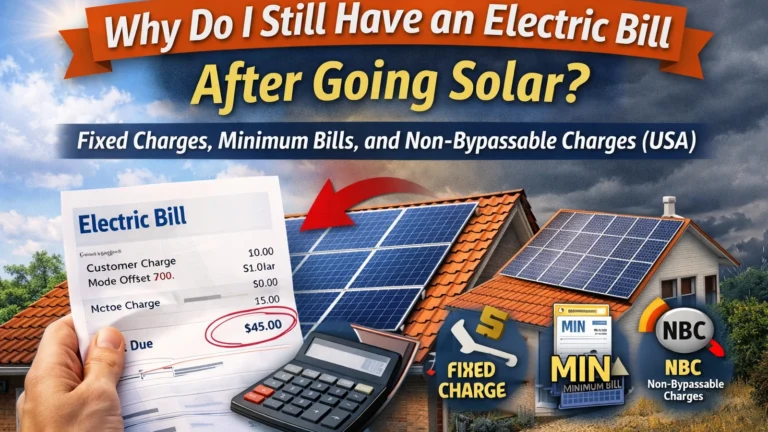
- Charges that remain even with solar (fixed charges / minimum bills)
- Whether the quote’s production estimate is realistic (sun + losses + shading)
- Panel degradation and year-to-year weather variability
Bottom line: payback is not just “system cost ÷ annual kWh.” It’s “system cost ÷ value of the kWh you avoid buying,” plus a few important adjustments.
Simple payback vs “real payback” (why the simple formula often lies)
The simple payback formula (fine for a first pass)
If your system costs $20,000 net and you save about $2,000/year, simple payback is about 10 years.
That’s a decent starting point, but it can mislead you if the savings number ignores TOU timing, export credit value, or fixed charges.
The 6 inputs that change payback the most
- Your all-in net cost (cash price minus any incentives you actually qualify for)
- Your annual kWh offset (how much grid energy solar truly replaces)
- Your avoided $/kWh (what you stop paying the utility for each kWh)
- Your export credit value (1:1 net metering vs lower net billing credits)
- Charges that don’t go away (fixed charges, minimum bills, program fees)
- Realism factors (degradation + production variability)
Important limitation (so you don’t over-trust calculators): PVWatts is excellent for estimating production (kWh), but NREL notes PVWatts does not have enough information to fully value electricity under fixed charges, TOU, or demand charges—because value depends on consumption and rate details.
Source: NREL PVWatts site notes/limitations.
Gather your numbers (no tools, no DIY)
From your electric bill (10 minutes)
You want:
- Last 12 months total kWh (or as close as possible)
- Last 12 months total $ (what you actually paid)
- Your rate plan type: flat, TOU, demand charges, or a mix
- Any fixed/minimum charges that appear every month
If you’re not sure where those live on the bill, use this guide first:
From your solar quote (or proposal)
- Cash price (before financing)
- Estimated annual production (kWh/year)
- System size (kW DC) (helpful for sanity checks)
- Any adders (battery, main panel work, roof work, etc.)
If you’re comparing multiple proposals, do this first so you normalize apples-to-apples:
From your rate plan (why TOU and demand charges can change payback)
Two rate structures can make “the same solar system” worth very different amounts:
- Time-of-Use (TOU): prices change by time of day; DOE describes TOU as a common form of time-variable pricing.
Source: U.S. DOE FEMP time-variable pricing overview. - Demand charges: some tariffs bill you based on your highest short-term kW spike; DOE summarizes multiple demand-charge designs (including TOU demand).
Source: U.S. DOE FEMP utility rate options overview.
Read these if they apply to your home:
Step-by-step: calculate your payback (homeowner-safe worksheet)
Step 1 — Estimate your “blended” cost of electricity (baseline $/kWh)
Compute:
Blended $/kWh = (Total $ paid over 12 months) ÷ (Total kWh over 12 months)
Important: Under TOU and demand charges, this blended number is only a baseline. It does not capture “when” you used electricity or whether a short kW spike created a big demand charge. Use it for your first pass, then refine with the TOU/demand guides linked above.
Step 2 — Estimate your first-year solar production realistically (avoid fantasy kWh)
Your quote provides an annual kWh estimate. Before you trust it, sanity-check it with PVWatts (NREL):
Source: PVWatts is provided by NREL. Source: https://pvwatts.nrel.gov/
Step 3 — Translate kWh into dollar savings (depends on your plan)
Case A: Flat-rate + 1:1 net metering (simplest)
A reasonable first pass is:
First-year savings ≈ (Solar kWh used to offset your bill) × (Blended $/kWh)
Case B: TOU or net billing (exports worth less, timing matters)
When exports are credited at a lower value than imports (net billing) or when TOU prices swing, the value of solar kWh depends on:
- How much you consume during solar hours (self-consumption)
- How much you export, and what exports are worth
- Whether expensive hours happen after solar production drops
These guides help you estimate value more honestly:
- Net Metering Explained: How Solar Credits Work (and What “Net Billing” Changes)
- Solar Self-Consumption Explained (USA): What It Is, How to Calculate It, and How to Increase It (Without Risky DIY)
Step 4 — Subtract charges that don’t go away (hidden payback extender)
Even if solar covers most of your kWh, many homes still pay:
- Fixed customer charges
- Minimum bills
- Program charges that solar credits don’t offset (plan/territory-specific)
If you want the plain-English explanation (and how to spot them on your statement):
Step 5 — Add realism: degradation + variability
Solar production varies year to year with weather. Panels also gradually degrade over time. A widely cited NREL review assembled nearly 2,000 measured degradation rates and reports a median around 0.5% per year.
Source: NREL (Jordan & Kurtz, “Photovoltaic Degradation Rates—An Analytical Review”).
A homeowner solar payback calculator (quick worksheet)
Use these inputs:
- A = Net system cost after any incentives you’re confident you qualify for
- B = Expected first-year solar production (kWh/year) (sanity-checked)
- C = Self-consumption fraction (0–1). If you don’t know, start with 0.35–0.60 as a planning range and refine later.
- D = Import value ($/kWh) (your blended $/kWh or your weighted estimate)
- E = Export credit value ($/kWh) (from your utility net metering/net billing terms)
- F = Annual fixed charges that solar does not eliminate ($/year)
Then estimate first-year savings:
First-year savings ≈ (B × C × D) + (B × (1 − C) × E) − F
And simple payback:
Payback (years) ≈ A ÷ First-year savings
Why this beats most online calculators: it separates self-consumed kWh (often worth closer to import price) from exported kWh (often worth less under net billing) and subtracts fixed charges.
Payback sensitivity table (most articles skip this)
Because inputs vary, run three scenarios: conservative, expected, optimistic.
| Scenario | Self-consumption (C) | Export value (E) | Production vs quote | What this does to payback |
|---|---|---|---|---|
| Conservative | 35% | Low (net billing / low FiT) | −8% (shade/soiling/assumptions) | Payback gets longer (often “surprise” true-up cases) |
| Expected | 50% | Medium | 0% (quote matches reality) | Most realistic planning estimate |
| Optimistic | 60% | Near import rate (strong net metering) | +3% (good siting + assumptions) | Payback gets shorter |
Tip: If your payback swings wildly between scenarios, that’s a clue your rate plan/export rules matter a lot. Re-check TOU periods, export credit value, and fixed charges.
What’s a “good” solar payback period in the USA?
Consumer-facing sources commonly cite broad payback ranges that vary by rates, location, and assumptions (for example, EnergySage discusses shopper averages and Tesla publishes a wide range based on internal assumptions). These are useful only as context—not a promise.
Instead of chasing an “average,” focus on this:
Does your estimate use honest assumptions about export value, TOU timing, fixed charges, and production?
Financing changes payback math (cash vs loan vs lease/PPA)
If you pay cash, payback is straightforward: cost vs savings.
If you finance with a loan, add a cash-flow check:
- Monthly loan payment
- Minus monthly bill reduction
- Plus any remaining fixed charges
If you lease or use a PPA, “payback” is less meaningful because you don’t own the asset—your decision is closer to: Do I save money vs the utility bill, and what are the contract risks?
Use this guide to choose safely:
Important note on incentives (keep your estimate safe)
Incentives and tax credits can change with policy. The safest approach is to treat incentives as a variable and verify current eligibility and deadlines with official sources and/or a tax professional.
- IRS Residential Clean Energy Credit page (current rules and “placed in service” language)
Source: IRS Residential Clean Energy Credit page. - IRS Form 5695 instructions (official filing guidance)
Source: IRS Instructions for Form 5695.
For SolarBasicsHub’s current explanation and homeowner framing, see:
Red flags: when a payback estimate is probably wrong
- “Your bill will be $0” without discussing fixed/minimum charges
- Exports assumed at full retail when your plan is net billing
- No TOU timing discussion even though your plan is TOU
- Production estimate looks “too high” vs PVWatts sanity check
- No mention of shading/curtailment/clipping when your roof has constraints
If you want a safe quote sanity-check flow, use:
Copy/paste checklist: questions to ask before you sign
- What rate plan assumptions did you use (flat vs TOU vs demand)?
- What export credit value did you assume (net metering vs net billing)?
- How much of my solar is expected to be self-consumed vs exported?
- What fixed/minimum charges remain on my bill after solar?
- Can you show shading assumptions and any production losses you used?
- What happens to payback if rates rise slower/faster than assumed?
- What warranties and service coverage protect me from surprise costs?
When to consult a professional
This article is for education and planning only. Consult qualified professionals if:
- You’re unsure which tariff/export program applies to your address
- Your home has demand charges, complex TOU, or multiple meters
- Your quote includes main-panel work, service upgrades, or critical-load backup design
- You need tax advice about credits, eligibility, or filing
FAQ
1) What is a solar payback period?
The solar payback period is the time it takes for your electricity savings to equal what you paid for the system (or what you’ll pay net over time).
2) How do I calculate solar payback quickly?
Start with net cost ÷ first-year savings. Then improve accuracy by separating self-consumed vs exported kWh and subtracting fixed charges.
3) Why do two homeowners get totally different payback from similar systems?
Rate design (TOU/demand), export credits (net metering vs net billing), and fixed/minimum charges can change the value of solar dramatically.
4) Does TOU make solar payback better or worse?
Either—TOU can help if your solar reduces usage during expensive hours, but it can hurt if most expensive hours occur after solar production fades.
Source: U.S. DOE FEMP time-variable pricing overview.
5) Do solar panels always eliminate your electric bill?
No. Many homes still pay fixed charges and sometimes minimum bills. See: Why Do I Still Have an Electric Bill After Going Solar?
6) Should I include degradation in my payback estimate?
Yes—at least as a realism check. NREL’s degradation review is commonly cited for a median around ~0.5%/year.
Source: NREL Jordan & Kurtz degradation review.
7) Is solar ROI the same as payback?
No. Payback is “time to break even.” ROI can mean several things (annual return, lifetime return, NPV). Payback is simpler, but can hide important cash-flow details under financing.
8) What’s the best next step after I estimate payback?
Normalize quotes line-by-line and sanity-check production assumptions with PVWatts.
Next to Read
- How to Compare Solar Quotes (Line by Line): A Safe, Apples-to-Apples Checklist
- How to Read Your Electric Bill for Solar (Before & After Going Solar)
- Net Metering Explained: How Solar Credits Work (and What “Net Billing” Changes)
- Time-of-Use (TOU) Rates and Solar (USA)
- Solar Cost Breakdown: What You’re Really Paying For