
The 30-second answer: what a “solar panel warranty” actually includes
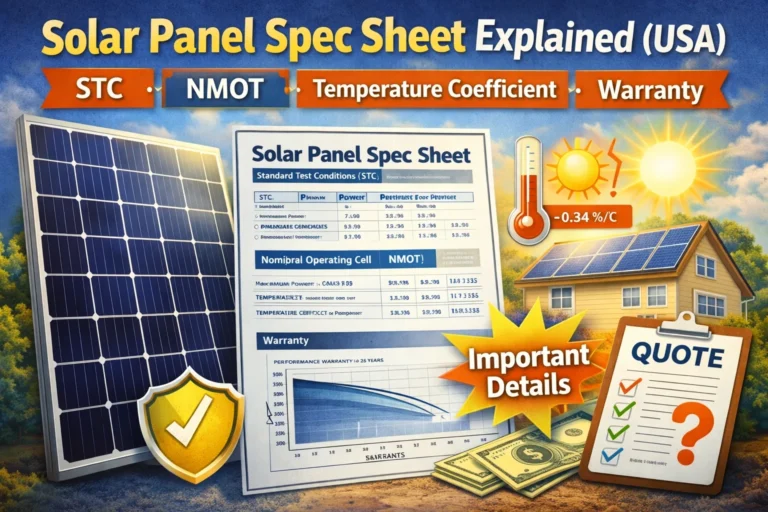
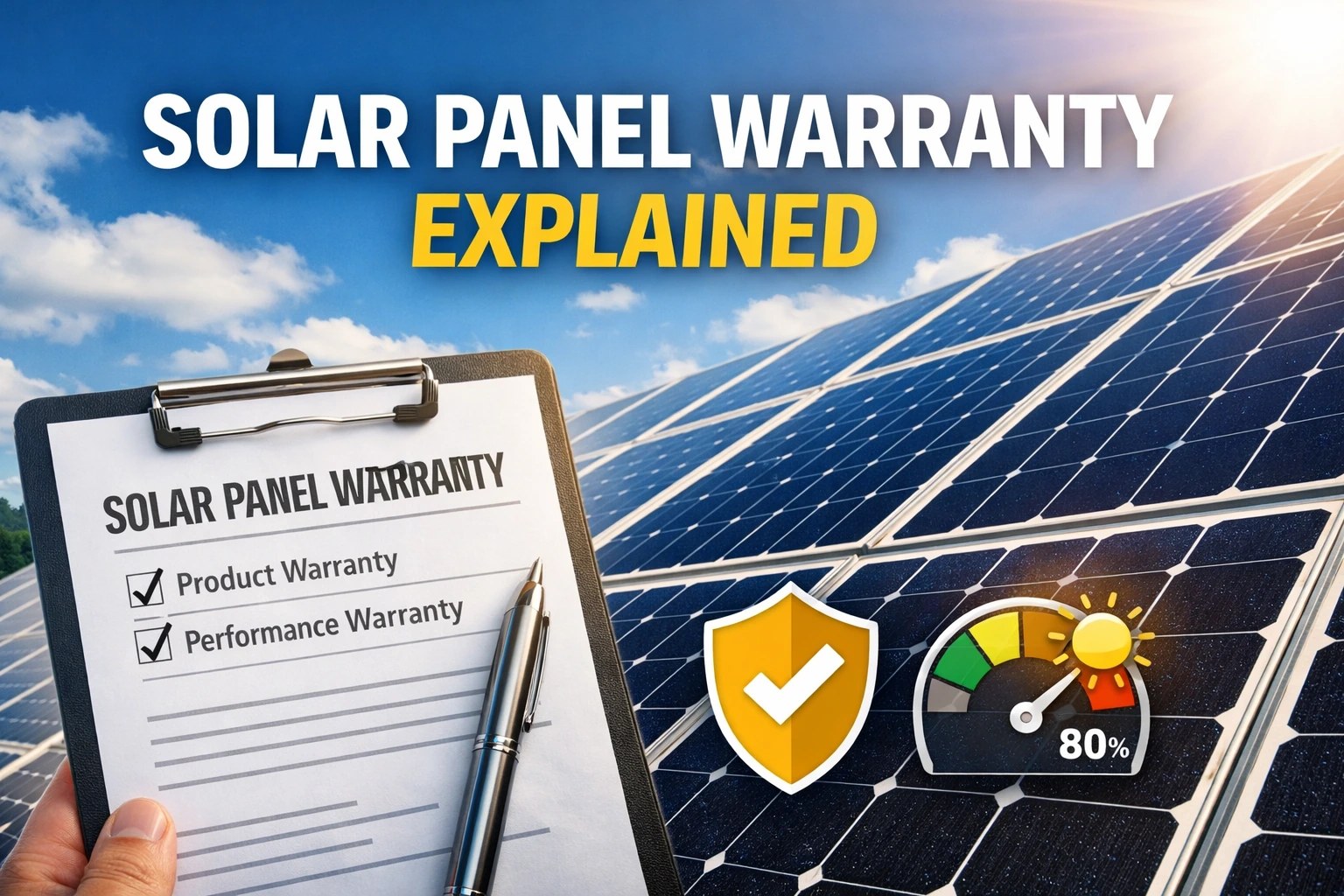
When a quote says “25-year solar panel warranty,” it’s usually talking about more than one warranty (and the exact terms vary by manufacturer and model—always confirm with the warranty PDF for your specific equipment).
For most homeowners, the practical coverage comes from three different buckets:
- Solar product warranty (manufacturer): covers defects in materials/manufacturing.
- Solar performance warranty (manufacturer): guarantees the panel won’t degrade past a stated threshold by certain years.
- Solar panel workmanship warranty (installer): covers installation issues (often roof penetrations, flashing, labor, and service process).
If you’re comparing proposals, treat warranties like you treat price: break them into parts, read the fine print, and normalize them across quotes. Start with this guide, then use the site’s line-by-line method here: compare solar quotes line by line.
The 3 warranties you must separate (most homeowners mix these up)
1) Solar product warranty (materials/defects)
The solar product warranty is the “defects” warranty. It typically covers failures caused by manufacturing or materials issues (not storms, misuse, or unauthorized modifications). If a panel has a manufacturing defect that causes abnormal failure, the product warranty is usually the warranty that gets used.
Important mindset: product warranty is about the panel being defective, not your system producing less because of shade, dirt, heat, or inverter settings.
2) Solar performance warranty (power output over time)
The solar performance warranty is about output. It does not promise your system will produce a specific number of kWh. Instead, it typically guarantees the panel will remain above a stated percentage of its original nameplate power after certain years (for example, year-25 output above a given threshold, with a maximum annual degradation rate).
Many warranties are structured around a maximum degradation rate (often expressed as a percent per year) and a final “year-25” percentage threshold. A common example pattern is “90% at year 10 and 80% at year 25,” though exact terms vary widely by brand and model. Source: Australian government overview of typical performance warranty structure. :contentReference[oaicite:27]{index=27}
3) Solar panel workmanship warranty (installer coverage)
The solar panel workmanship warranty is from the installer (not the panel manufacturer). This is the warranty that tends to matter most for real homeowner headaches like:
- Roof leaks around penetrations/flashing
- Loose wiring/conduit issues
- Racking/mounting issues
- Labor and truck-roll costs
A manufacturer can approve a panel replacement but still not pay the full labor cost to remove/reinstall it. Workmanship coverage is what reduces “surprise costs” years later.
Performance warranty math in plain English (degradation without confusion)
This section is the core skill most competitor articles skip. You don’t need engineering software. You just need to understand how the warranty defines the failure threshold.
Two common formats you’ll see in warranty PDFs
- Format A: Year-based thresholds (example pattern): “At year 10, power output will be at least X%; at year 25, at least Y%.”
- Format B: Max annual degradation (example pattern): “After year 1, maximum degradation is 0.4%–0.6% per year” (terms vary by manufacturer). A discussion of typical 25-year performance-warranty degradation caps appears in academic review literature. :contentReference[oaicite:28]{index=28}
A simple threshold formula you can use on any warranty
Most performance warranties can be translated into a “minimum allowed power” for a given year. The exact formula depends on the warranty’s structure, but a very common pattern looks like this:
Minimum warranted power in Year N = Nameplate power × (1 − allowed degradation in Year N)
If the warranty uses a per-year rate after a first-year drop, it often looks like:
Minimum warranted power in Year N = Nameplate power × (1 − first-year drop − (N − 1) × annual degradation rate)
Why this matters: if you understand the threshold, you can tell the difference between “my system produced less this month” (often normal) and “this panel is below its warranted power output under the warranty definition” (potential claim).
Example: does 0.5%/yr match “80% at year 25”?
Homeowners often hear “panels degrade about 0.5% per year.” If degradation were perfectly linear from day 1, then 0.5%/yr × 25 years = 12.5% loss (meaning ~87.5% remaining). That does not match “80% at year 25.”
So why do you often see “80% at year 25”? Because warranties may include:
- a larger early allowance (sometimes called first-year tolerance or initial degradation allowance), and/or
- a conservative long-horizon floor that’s easy to administer across many conditions
Bottom line: don’t guess. Use the warranty’s exact year-by-year threshold language in the PDF.
What degradation rates are common (and what affects them)
Degradation is real, but it’s usually slow for modern crystalline-silicon modules. Multiple NREL resources discuss degradation behavior and how it is measured across technologies and field data. Source: NREL analytical review of PV degradation rates. :contentReference[oaicite:29]{index=29}
More recent NREL field reporting also shows examples of annual median degradation rates in the tenths of a percent per year for deployed modules in some datasets. Source: NREL PV Lifetime Project annual report. :contentReference[oaicite:30]{index=30}
Use these as context only: your warranty claim is determined by your warranty PDF’s thresholds, not a single “typical” degradation number.
Module-level vs system-level: why your whole system can “degrade” faster
Even if individual modules degrade slowly, your system output can drift more due to non-module factors: inverter aging, soiling patterns, shading changes (tree growth), connector issues, and downtime. NREL notes that system-level degradation can exceed commonly cited module-level degradation values in some studies. Source: NREL utility-scale performance/degradation discussion. :contentReference[oaicite:31]{index=31}
Don’t confuse degradation with “normal losses”
Many production shortfalls are not defects. They’re normal physics and system design tradeoffs. Your learning path articles already cover the key “reality factors”:
- performance ratio (PR) explained (losses from heat, conversion, wiring, dirt)
- peak sun hours explained (sunlight varies by location and season)
- why solar production is low (safe checks before calling a pro)
Warranty “gotchas”: the 12 issues that kill claims
These are the real-world reasons homeowners struggle with warranty claims. Use this as a pre-sign checklist.
1) You don’t have the warranty PDF for your exact model number
Marketing pages are not warranties. Get the PDF for the exact panel model (and the exact inverter model) listed on your proposal.
2) No baseline documentation
Many claims require proof. Keep:
- your final invoice and equipment list (model/serial numbers)
- commissioning documentation (if provided)
- monitoring access and exports (screenshots or exports)
- utility bills (especially first-year baseline)
3) Installer disappears (and you didn’t verify the service pathway)
Ask: “If you’re not in business in 10 years, who handles service?” Manufacturer warranties can still exist, but labor and logistics can become your cost.
4) Roof leaks vs panel defects confusion
Panel manufacturers rarely cover roof penetration leaks. That’s workmanship/roofing scope. This is why installer workmanship terms matter.
5) Unauthorized repairs or modifications
If someone changes wiring, connectors, racking, or adds non-approved parts, it can complicate warranty coverage. If you need work, use qualified professionals and document what was done.
6) Cleaning methods that risk damage
Aggressive scraping, harsh chemicals, or pressure washing can damage seals/glass and may be treated as misuse. Use safe maintenance practices from: solar panel maintenance guide.
7) Shipping and labor are not always covered
Some warranties cover replacement parts but not full labor, shipping, disposal, or roof work. Ask for the “who pays what” section.
8) “Performance warranty” is panel power at test conditions, not your kWh
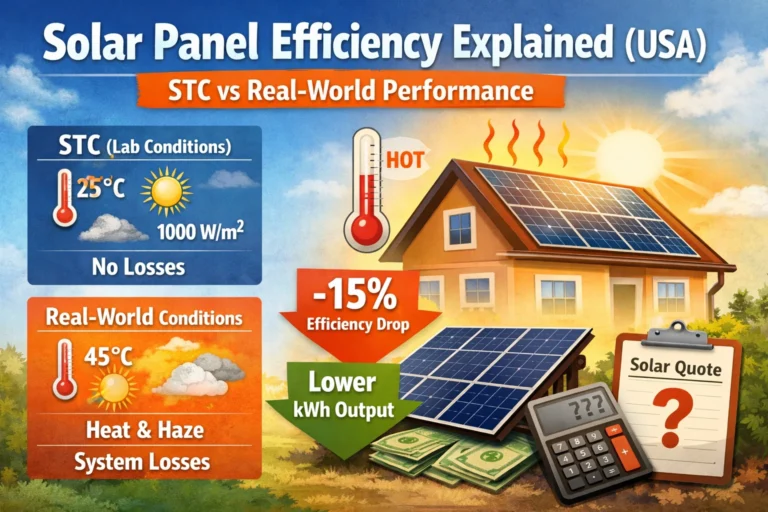
Performance warranty typically relates to the panel’s rated power output under defined conditions, not your monthly kWh (which is affected by sun hours, temperature, shading, inverter clipping, and system downtime).
9) Weather events are usually excluded (or handled by insurance)
Hail, hurricanes, wildfire smoke/ash, falling branches, and similar events are typically treated as external damage. Homeowners insurance often matters more here than a manufacturer warranty.
10) Shade changes over time
Trees grow. New buildings happen. A panel can be “fine” but your system output drops. That’s not a panel defect.
11) Your monitoring data isn’t aligned to your utility billing cycle
App production windows and utility bill windows can differ. Before you panic, compare using the same date range and use the troubleshooting guide: why solar production is low.
12) Confusing certification with warranty
Certifications indicate a module design passed certain performance/safety testing standards, but they are not the same as warranty terms. Many PV modules are tested/certified against standards such as IEC 61215 and IEC 61730 through certification bodies and labs. Source: SGS overview of PV module certification and IEC standards. :contentReference[oaicite:32]{index=32}
Practical rule: ask for certificates and warranty PDFs separately, and keep both on file.
The homeowner checklist: what to ask before you sign (copy/paste)
Copy/paste these questions into email to every installer so you can compare answers apples-to-apples.
- Panels: What is the panel model number and provide the warranty PDF for that model?
- Inverters: What is the inverter model and warranty PDF (and is labor included)?
- Workmanship: What exactly is covered (roof penetrations, leaks, labor) and for how many years?
- Claim pathway: If something fails, do I call you or the manufacturer? Who files paperwork?
- Costs: Who pays labor, shipping, disposal, permits/inspections if a replacement is needed?
- Performance terms: Is the performance warranty expressed as year-based thresholds or annual degradation cap?
- Monitoring: Is monitoring included, and will I keep access if I switch internet providers?
- Maintenance: Are there required maintenance steps to keep coverage valid?
- Roof: If my roof needs work later, how do removals/reinstalls affect warranties?
Then use your standardized quote comparison method here: How to Compare Solar Quotes (Line by Line).
A simple table to compare warranties across quotes (fast and practical)
| Warranty bucket | Who provides it | What it should clearly state | What homeowners often miss |
|---|---|---|---|
| Solar product warranty | Panel manufacturer | Years covered, what counts as a defect, remedy (repair/replace/refund) | Labor/shipping exclusions; “authorized installer” requirements |
| Solar performance warranty | Panel manufacturer | Year-by-year threshold or max annual degradation + year-25 % | It’s not a promise of your monthly kWh; it’s a panel power threshold definition |
| Solar panel workmanship warranty | Installer | Roof leak/penetration scope, labor, service response, exclusions | Company longevity; service fees after year X; transfer rules when selling home |
| Inverter warranty (bonus, but critical) | Inverter manufacturer / installer | Years, labor coverage, replacement logistics | Inverter is often the first major component to need service |
How to file a warranty claim (what to document first)
Every manufacturer has a process, but most successful claims follow the same structure: prove the problem is a warranty-defined issue, not normal variation.
Step 1: Rule out normal “real-world” explanations
Before calling it a defect, check:
- Seasonality and sun hours: peak sun hours explained
- Normal losses and assumptions: performance ratio (PR) explained
- Safe homeowner checks: why solar production is low
Step 2: Gather the documents that make claims go fast
- Invoice + equipment list (panel and inverter model numbers, serials if available)
- Warranty PDFs
- Monitoring screenshots/exports for the same date range (monthly is usually best)
- Utility bills showing imports/exports where relevant
- Photos of any visible physical damage (if applicable)
Step 3: Understand what “underperformance” means in warranty language
A performance warranty is typically evaluated against a defined threshold. If the panel is above the threshold, it may be “within spec” even if you expected more kWh. If you’re unsure, your installer (or manufacturer) may request testing or diagnostic evidence.
How to compare quotes using warranties (simple scoring method)
Here’s a practical homeowner scoring method that fits SolarBasicsHub’s “safe planning” approach:
- Score clarity (0–3): Are model numbers + warranty PDFs provided for panels and inverter?
- Score workmanship (0–3): Is roof/leak/labor scope clearly covered and for how long?
- Score cost exposure (0–3): Are labor/shipping/truck-roll costs addressed in writing?
- Score realism (0–3): Does the installer discuss assumptions (shade/losses/degradation) transparently?
Then apply your quote normalization method (price per watt, production realism, scope): How to Compare Solar Quotes. Also keep lifetime cost context in mind: solar cost breakdown.
One useful reality check: “derate” and losses exist even in standard tools
If you see wildly optimistic output assumptions in proposals, remember that widely used calculators bake in realistic system losses. PVWatts documentation describes a default total system losses value (with inverter efficiency treated separately). Source: PVWatts manual. :contentReference[oaicite:33]{index=33}
When to consult a professional (safety + USA-friendly disclaimers)
- If any work involves your main panel, meter base, service equipment, or rooftop electrical components, use licensed professionals for safety and code compliance.
- If you suspect roof structural issues, leaks, or flashing problems, consult a qualified roofer and document findings (this helps warranty clarity).
- If you need a formal production model (shade analysis, roof planes, monthly estimates), ask a qualified solar professional to provide assumptions in writing.
This guide is for education and planning, not legal advice and not DIY electrical instruction.
Summary
- A “solar panel warranty” usually means product + performance + workmanship (installer) coverage.
- Performance warranties define a threshold; they are not a promise of your monthly kWh.
- Degradation is usually slow, but system-level performance can drift due to many factors. Source: NREL degradation resources. :contentReference[oaicite:34]{index=34}
- Before signing, demand model numbers + warranty PDFs and clarify labor/shipping responsibilities in writing.