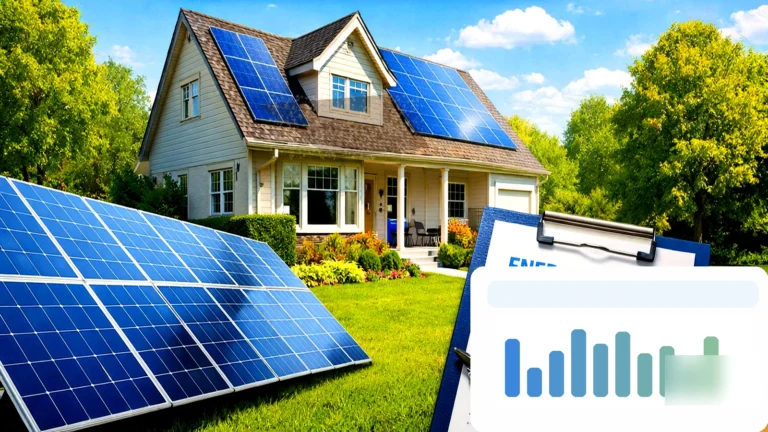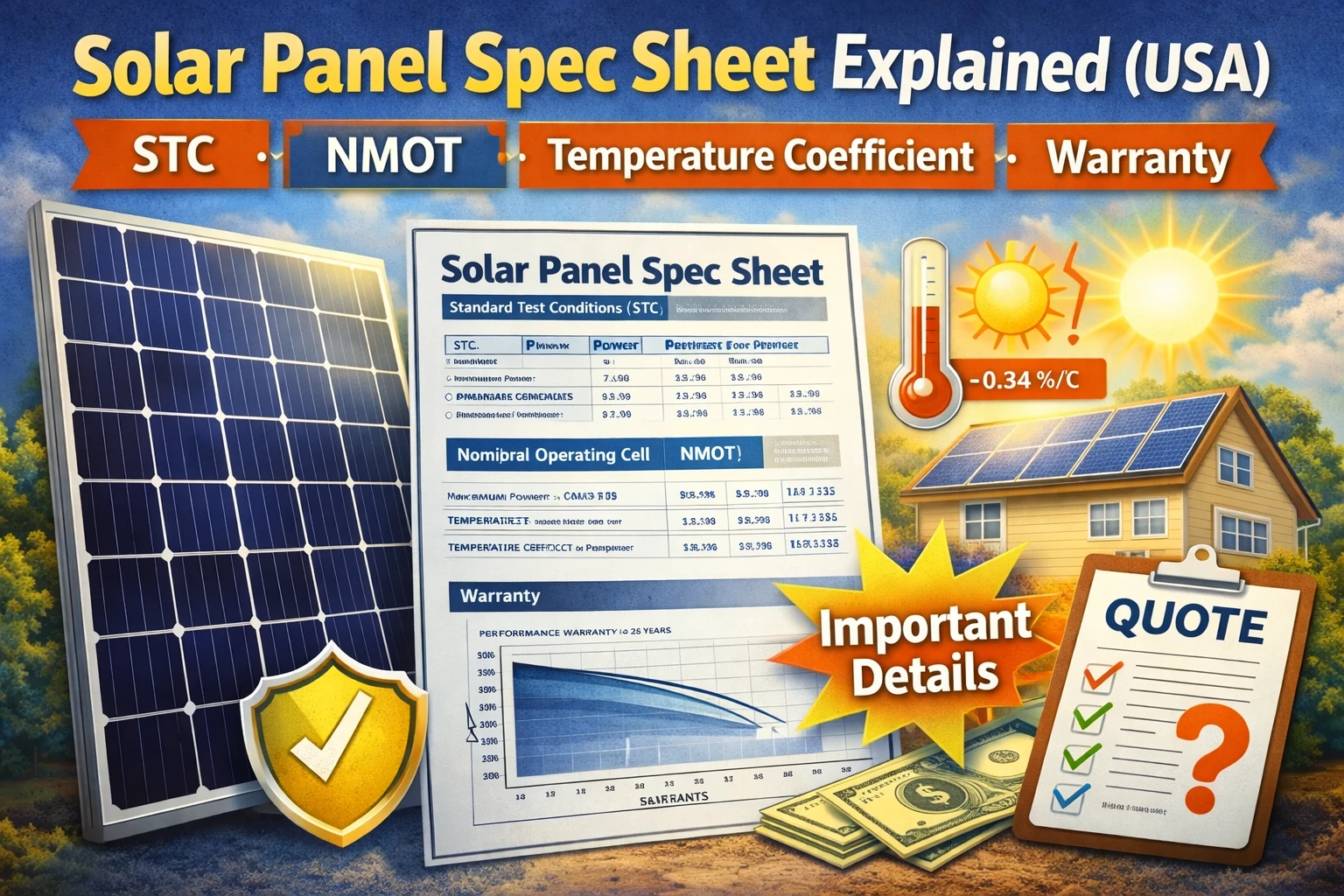

A solar panel spec sheet, also called a datasheet or cut sheet, is the manufacturer document that lists the panel’s rated power, efficiency, voltage/current values, temperature behavior, dimensions, certifications, and warranty terms.
In plain English, it is the panel’s official fact sheet.
If you are comparing solar quotes, this document matters because it helps you answer practical questions like:
- Is this really a premium panel, or just marketed that way?
- Is the wattage difference meaningful or tiny?
- Will this panel hold up better in hot weather?
- Do the warranty claims actually match the fine print?
- Is the exact model in the quote the same model shown on the paperwork?
Quick answer: what a solar panel spec sheet is
A solar panel spec sheet is the manufacturer datasheet for the exact module model in your quote. It usually includes electrical ratings, module efficiency, dimensions, weight, certifications, and warranty terms.
For homeowners, the point of the datasheet is not to become an engineer. The point is to verify that the panel being sold is real, documented, and worth the price premium if one is being charged.
Why homeowners should care about the datasheet
Most homeowners do not need to size strings, calculate breaker limits, or do design math. But you do need the datasheet to protect yourself from vague or inflated sales claims.
A good homeowner use of the spec sheet is to verify:
- exact manufacturer and model number
- panel wattage used in the quote
- whether “high efficiency” is real or mostly marketing
- whether heat performance looks better or worse than competing options
- whether the warranty headline matches the fine print
This is also where many quote misunderstandings start. A proposal may say “premium 430 W panel,” but the real model on the datasheet tells you whether that premium label is justified.
If you are also reviewing engineering paperwork, remember the simple split:
- Proposal = price and estimated savings
- One-line diagram = how the system connects
- Site plan = where the equipment goes
- Spec sheet = what the equipment actually is
Related reading:
- https://solarbasicshub.com/how-to-compare-solar-quotes-line-by-line/
- https://solarbasicshub.com/solar-one-line-diagram-explained/
The 10 lines on a solar panel spec sheet that matter most
1) Wattage / Pmax
This is the panel’s rated maximum power, usually shown as something like 400 W, 425 W, or 460 W.
Homeowner takeaway: wattage tells you the panel’s nameplate size under lab conditions, not what it will produce every hour on your roof.
A 430 W panel is not “making 430 watts all day.” It means that under Standard Test Conditions, its rated peak output is 430 W.
Source: U.S. DOE / NREL performance references explain that PV module ratings are measured under standard test conditions, not typical rooftop conditions.
2) STC vs NMOT (or NOCT on older datasheets)
This is one of the most important parts of any solar panel spec sheet.
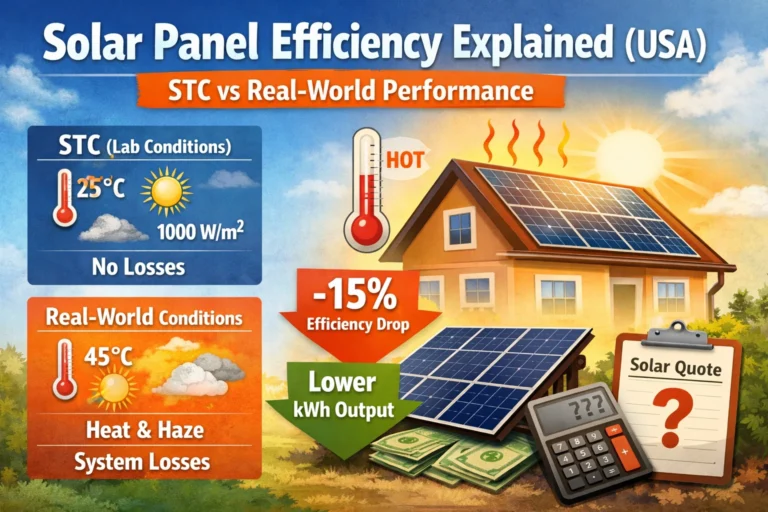
STC stands for Standard Test Conditions. It is the standard lab rating condition used to compare modules fairly. STC is based on 1,000 W/m² irradiance and 25°C cell temperature.
In real life, panels usually operate hotter than that, and sunlight is often below 1,000 W/m², so real output is usually lower.
Many datasheets also show NMOT performance. On older datasheets, you may see NOCT instead.
Simple homeowner takeaway:
- use STC for apples-to-apples comparison
- use NMOT/NOCT as a clue that real-world output will be lower than STC
- do not treat STC wattage like a production promise
Source: DOE/NREL performance references describe STC at 1,000 W/m² and 25°C, while NREL standards material notes NOCT was later renamed NMOT in updated standards context.
3) Efficiency
Panel efficiency tells you how much sunlight becomes electricity at the module level.
This matters most when roof space is limited. If two panels have similar size but one has higher efficiency, it usually packs more watts into the same footprint.
But efficiency is often overhyped. A slightly more efficient panel is not automatically the better financial choice if:
- the price jump is too large
- you have plenty of roof space
- the production difference is tiny in real life
Related reading:
4) Temperature coefficient
This spec tells you how much panel power drops as the panel gets hotter above the reference condition.
Since real rooftops often run hotter than STC, this line matters more than many homeowners realize. A less negative temperature coefficient is usually better for hot climates.
Simple example:
- Panel A: -0.30%/°C
- Panel B: -0.40%/°C
If cell temperature runs 20°C above STC, Panel A would lose about 6% relative to STC, while Panel B would lose about 8%.
That does not mean Panel A always wins overall, but it does mean heat sensitivity is real.
Source: NREL/DOE performance references explain that module power depends on irradiance and cell temperature, and that STC is a 25°C reference point.
5) Power tolerance
Some datasheets show a power tolerance like:
- 0 to +5 W
- 0 to +3%
- ±3%
Homeowner takeaway: this tells you how much the panel’s real measured output may vary around the nameplate when it leaves the factory.
This is useful, but it usually should not be the main reason you choose one quote over another unless the difference is unusually large or the installer is using it to justify a big premium.
6) Voc, Vmp, Isc, and Imp
These are real electrical specs, but homeowners often give them too much weight.
In simple terms:
- Voc = open-circuit voltage
- Vmp = voltage at maximum power
- Isc = short-circuit current
- Imp = current at maximum power
These values matter a lot to the installer and engineer because they affect string design and compatibility. For most homeowners, their main value is not “do the math yourself.” It is to confirm that the installer is giving you an exact model with real published specs instead of vague placeholder equipment.
These numbers are important — but usually more for engineering compatibility than for your own quote decision.
7) Maximum system voltage
This is the highest system voltage the panel is rated to be used within.
Most homeowners do not need to do anything with this number directly, but it is a real spec you want to see on a legitimate datasheet. It helps show that the panel is being documented properly for system design and code review.
8) Dimensions, weight, and load ratings
A lot of buyers ignore this section, but it matters more than it seems.
This part can tell you:
- whether the panel is physically larger than average
- whether roof layout may be affected
- how many panels may fit on a certain roof face
- whether weight/loading details are clearly documented
- snow and wind load information
This becomes especially important when two quotes both claim “high wattage,” but one gets there partly by using a physically larger module.
Homeowner takeaway: compare watts per panel with panel size, not watts alone.
9) Certifications and listings
Many module datasheets reference standards such as IEC 61215 and IEC 61730.
Homeowner takeaway: certifications do not guarantee perfection, but they are an important legitimacy and safety screen. If the exact model in your quote has weak or unclear documentation, that is a red flag.
Source: NREL materials describe IEC 61215 as a major design qualification standard and IEC 61730 as a major safety standard used for PV modules.
10) Product warranty vs performance warranty
This is one of the most misunderstood parts of the datasheet.
- Product warranty usually relates to defects in the panel itself.
- Performance warranty usually relates to how much output the panel is expected to retain over time.
A “25-year warranty” headline is incomplete by itself. You need to know:
- is that product, performance, or both?
- what degradation schedule applies?
- what labor or shipping is excluded?
- what actions can void coverage?
Related reading:
- https://solarbasicshub.com/solar-panel-warranty-explained/
- https://solarbasicshub.com/solar-production-guarantee-explained/
How to compare two panel datasheets without getting distracted
Here is the simplest homeowner-first approach.
First, compare these in order:
- Exact model number
- Panel wattage
- Efficiency
- Temperature coefficient
- Product warranty
- Performance warranty
- Panel dimensions
- Price impact in the quote
Then ask one more question:
Does the better-looking panel meaningfully improve annual kWh or just the brochure?
That is where many buyers get fooled. A quote may upsell a “premium” module with slightly higher efficiency, slightly better heat behavior, and a stronger warranty headline, but if the cost premium is large and your roof has enough room anyway, the real value may be modest.
That is why you should pair the datasheet with a realistic production estimate:
- https://solarbasicshub.com/pvwatts-solar-production-estimate/
- https://solarbasicshub.com/solar-panel-shading/
- https://solarbasicshub.com/best-direction-for-solar-panels-usa/
Red flags on a solar panel spec sheet
- the quote lists a panel brand but not an exact model number
- the installer sends only a marketing flyer, not a real datasheet
- the model in the quote does not match the model in the engineering packet
- the “25-year warranty” is mentioned, but product vs performance is not explained
- the panel is described as premium, but the efficiency and warranty look ordinary
- the panel dimensions are larger than expected and may affect roof fit
- the installer cannot explain why this panel is better for your roof
- the quote leans heavily on wattage alone without discussing heat, layout, or warranty terms
Copy/paste questions to ask your installer
- Please send the exact manufacturer datasheet for the panel model in my quote.
- Confirm the exact panel model number that will be installed.
- Is the wattage shown in my proposal the STC rating?
- What is the panel’s temperature coefficient, and why did you choose this model for my climate/roof?
- Are you choosing this panel mainly for efficiency, warranty, size, aesthetics, or price?
- If roof space were not limited, would this panel still be your best-value choice?
- What are the product warranty and performance warranty terms for this exact model?
- If the exact panel model changes before install, how will you notify me and update the quote/production estimate?
- Do the panel model numbers on the proposal, datasheet, and permit packet all match exactly?
- If this is a premium panel upgrade, show me the expected kWh benefit and payback difference in writing.
Simple table: what matters most on a panel datasheet
| Spec on the datasheet | What it means | Why it matters to homeowners | Priority |
|---|---|---|---|
| Pmax / Wattage | Nameplate power under STC | Confirms system size and quote accuracy | High |
| STC | Lab comparison rating | Useful for comparison, not a real-life promise | High |
| NMOT / NOCT | More realistic operating-condition clue | Helps show why real output is lower than STC | High |
| Efficiency | Power per panel area | Important when roof space is tight | High |
| Temperature coefficient | Output loss as panels get hotter | Important in hot climates and on hot roofs | High |
| Product warranty | Defect coverage | Important for risk and service expectations | High |
| Performance warranty | Long-term output retention | Important, but read the fine print | High |
| Dimensions / weight | Physical size and handling | Affects roof fit and layout | Medium |
| Voc / Isc / Vmp / Imp | Electrical specs | Mostly installer/engineering relevance | Medium |
| Power tolerance | Factory output variation | Useful, but rarely decisive alone | Low-Medium |
FAQ
1) What is the most important number on a solar panel datasheet?
There is no single best number, but for homeowners the most useful group is: wattage, efficiency, temperature coefficient, exact model number, and warranty terms.
2) Is STC the same as real output on my roof?
No. STC is a lab comparison standard. Real roofs are usually hotter, and sunlight is often lower than STC assumptions.
3) What is NMOT or NOCT in simple terms?
It is a more realistic operating-condition clue than STC. It helps remind you that the panel will usually make less than its STC rating in normal outdoor conditions.
4) Should I focus on Voc and Isc when comparing quotes?
Usually not first. Those values matter a lot to the installer and designer, but homeowners should usually prioritize model number, wattage, efficiency, temperature coefficient, dimensions, and warranty.
5) Does a higher-wattage panel always mean a better panel?
No. Higher wattage can come from higher efficiency, larger physical size, or both. You need to compare size, price, warranty, and real design fit too.
6) How do I know if a premium panel upgrade is worth it?
Ask for the exact model, the extra cost, the expected kWh gain, and the reason the installer recommends it for your roof. Then compare that against roof space limits, aesthetics, heat performance, and warranty.
USA-safe note
This guide is for homeowner education and quote comparison only. It does not provide wiring, string-design, breaker-sizing, rooftop work, or installation instructions. Any design or electrical work should be handled by qualified professionals and approved by the local AHJ and utility where required.
Next to Read
- https://solarbasicshub.com/solar-panel-efficiency-explained/
- https://solarbasicshub.com/solar-panel-warranty-explained/
- https://solarbasicshub.com/solar-production-guarantee-explained/
- https://solarbasicshub.com/pvwatts-solar-production-estimate/
- https://solarbasicshub.com/solar-panel-shading/
- https://solarbasicshub.com/best-direction-for-solar-panels-usa/
- https://solarbasicshub.com/how-to-compare-solar-quotes-line-by-line/
- https://solarbasicshub.com/solar-one-line-diagram-explained/