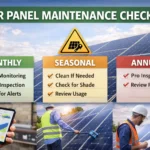

Solar panel maintenance at a glance
Here’s the simplest “do this, not that” plan:
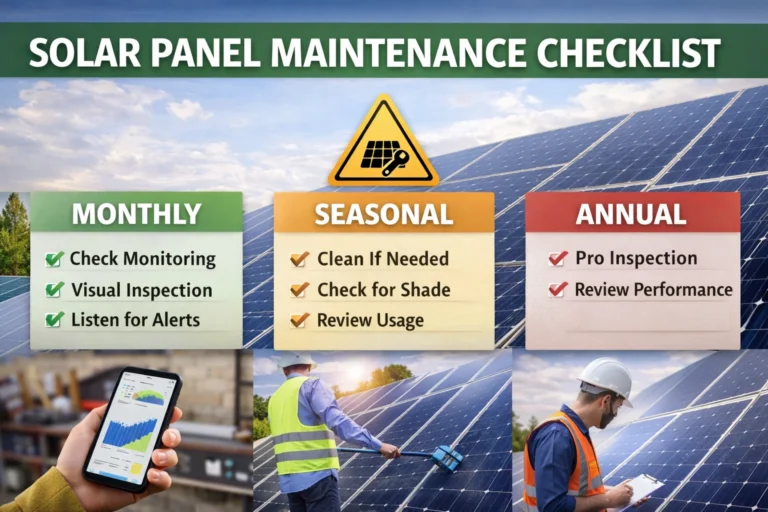
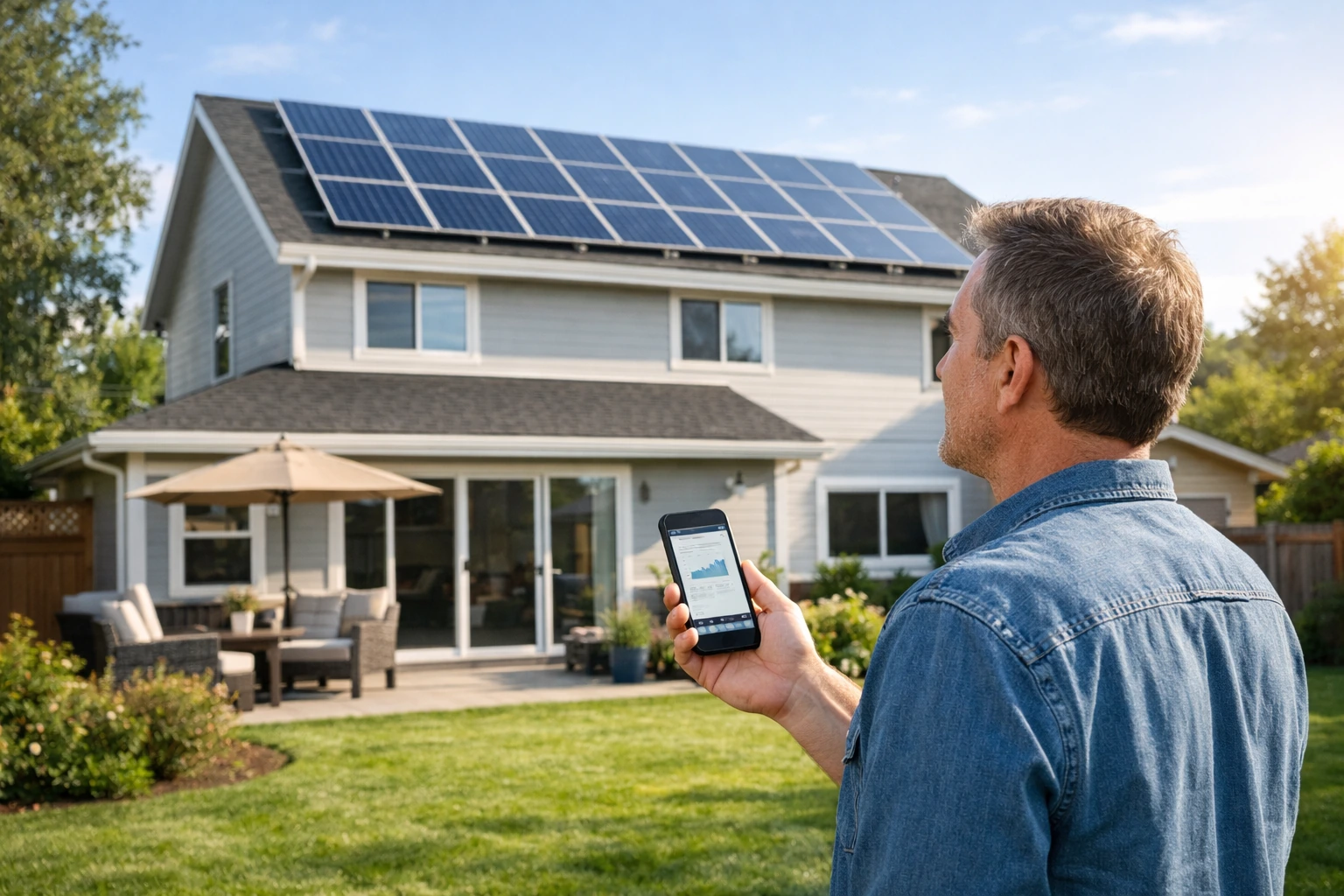
- Check your monitoring app monthly (look for unusual dips). (U.S. DOE FEMP)
- Look for debris/shade quarterly (leaves, new branch growth, nesting). (energy.gov.au)
- Clean only when needed (dusty climates, pollen, bird droppings, salt mist). (SEIA)
- Inspect after severe weather (from the ground—no roof risks). (SolarEdge)
- Book a professional solar service periodically (many agencies suggest around every 2 years; follow your installer manual/warranty). (energy.gov.au)
What “solar panel maintenance” actually includes
Most homeowners hear “maintenance” and think “washing panels.” That’s only one piece. A complete solar panel maintenance routine covers:
- Cleaning (sometimes) to reduce soiling losses when rain isn’t enough. (SEIA)
- Visual inspections (often) to catch cracked glass, loose flashing, corrosion, animal damage, or new shading. (SolarEdge)
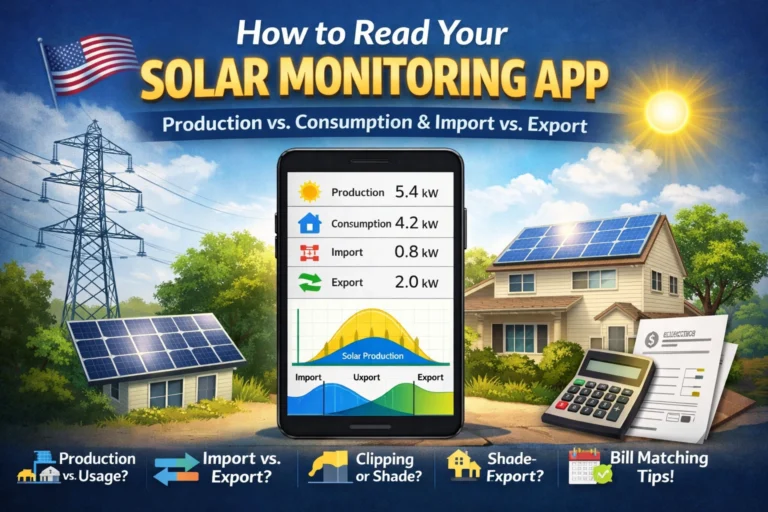
- Performance checks (monthly/seasonally) using monitoring data and year-over-year comparisons. (U.S. DOE FEMP)
- Inverter & safety checks (pro task) if you see warnings, nuisance tripping, or unexplained shutdowns. (U.S. DOE FEMP)
- Record-keeping for warranty/insurance and to make troubleshooting faster. (WorkSafe QLD checklist)
A simple maintenance schedule (what to do, and who should do it)
Use this as your baseline, then adjust for your climate (dust, snow, coastal salt, nearby trees).
| Frequency | What to do | Who | Why it matters |
|---|---|---|---|
| Monthly | Check monitoring for alerts and production dips | You | Catches problems early (U.S. DOE FEMP) |
| Monthly | Quick glance at inverter indicator lights/messages | You | Inverter often tells you first (SolarEdge) |
| Quarterly | Visual check from the ground (debris, shading, obvious damage) | You | Prevents easy losses (energy.gov.au) |
| As needed | Clean panels if soiling is visible or output drop persists | You or Pro | Restores sunlight reaching modules (Energy Saving Trust) |
| After storms | Check for shifted modules, fallen branches, cracked glass | You (ground view) | Storm damage can become safety issues (SolarEdge) |
| ~Every 2 years (or per warranty) | Full system service: electrical components, cabling, isolators, fault history | Qualified solar pro/electrician | Safety + warranty-friendly inspection (energy.gov.au) |
How often do solar panels need maintenance?
Most homeowners can think in two buckets:
Routine homeowner care (ongoing):
Monitoring and quick visual checks (minutes per month). (U.S. DOE FEMP)
Periodic professional service (occasionally):
Many programs recommend servicing by an accredited installer/qualified electrician every couple of years, but your system manual and local conditions should drive the schedule. (energy.gov.au)
Cleaning: when it helps (and when it doesn’t)
Cleaning is worth it when rain isn’t doing the job.
You’re a good candidate for cleaning if:
- You live in a dusty/desert area (or near agriculture/dirt roads). (SEIA)
- You’re near the ocean and get salt mist deposits. (SEIA)
- You have frequent bird droppings or sticky pollen. (Energy Saving Trust)
- Your monitoring shows a persistent drop that doesn’t match weather/season patterns. (U.S. DOE FEMP)
Cleaning may be unnecessary (or rare) if:
- You get regular rainfall and panels are installed at a typical slope that self-rinses. (energy.gov.au)
If you want the full safe process and what to avoid, use this guide: How to clean solar panels safely.
Cleaning safety rules (homeowner-safe)
- Prefer cleaning from the ground when possible; avoid roof work if you’re not trained/equipped. (Energy Saving Trust)
- Use soft, non-abrasive tools and avoid harsh chemicals that can damage coatings. (SolarEdge)
- Avoid high-pressure washing that can compromise seals/wiring. (Energy Saving Trust)
- If you’re unsure how to safely power down/avoid electrical risks, stop and call your installer. Don’t attempt repairs yourself. (SEIA)
Inspections: what you can spot vs. what a pro should handle
Homeowner visual checks (from the ground)
Look for:
- Cracked glass, heavy discoloration, or broken frames
- Loose-looking modules/racking after wind
- New shading (tree growth, a new vent, satellite dish, etc.) (energy.gov.au)
- Bird nests or animals under the array
What to do if you see issues: take photos and contact your installer/service provider for next steps.
Professional inspection (recommended periodically)
A qualified solar professional/electrician can safely check things you shouldn’t, such as:
- Cabling, isolator switches/disconnects, and electrical components
- Inverter fault history and system shutdown causes
- Test procedures and formal inspection protocols (commonly referenced in international O&M guidance) (energy.gov.au)
Ask for a written checklist/report for your records—helpful for warranty, insurance, or selling your home. (WorkSafe QLD checklist)
Performance basics: how to tell if your system is underperforming
Step 1: Expect normal year-to-year change
Solar panels slowly degrade over time. A large NREL literature review found a median degradation rate of ~0.5% per year (with many results below 1%/year). (NREL (Jordan & Kurtz, 2012))
What that means in plain English: if you produced 10,000 kWh in year 1, a “typical” degradation trend might be around ~9,500 kWh in year 11 (very roughly, before weather and site factors).
Step 2: Compare the right months
Do year-over-year comparisons for the same month (e.g., July 2026 vs. July 2025). Weather varies daily; seasons vary a lot.
Step 3: Use monitoring like a smoke alarm
Good monitoring should let you see production hourly/daily/monthly and spot anomalies. (U.S. DOE FEMP)
A practical trigger: If your production is down ~10%+ year-over-year for the same month and you don’t have obvious causes (smoke, storms, heavy soiling, new shade), it’s time to investigate.
Solar panel troubleshooting: a homeowner-safe flow (no electrical DIY)
When something’s wrong, your goal is to identify clues and hand off safely—not to repair live electrical equipment.
Quick troubleshooting flow
- Check monitoring: Is the drop system-wide or just one part (if you have optimizers/microinverters)? (U.S. DOE FEMP)
- Look at the inverter display/lights: Any error message or warning? (SolarEdge)
- Rule out obvious external causes: unusual weather, seasonal sun angle, new shade, visible debris/soiling. (U.S. DOE FEMP)
- If the system tripped or shut down: don’t just cycle power and hope—get an electrical inspection to address the root cause. (U.S. DOE FEMP)
- Contact your installer/service provider with screenshots/photos and the date/time the issue started. (SEIA)
Inverter maintenance: what to expect over the life of your system
Inverters are often the component that needs attention first. Some homeowner resources note that solar inverters commonly need replacement in the 10–15 year range (varies by type, environment, and workload). (Energy Saving Trust)
Homeowner-safe inverter care:
- Keep the area around the inverter clear and well-ventilated (don’t block it with storage).
- Pay attention to fault codes or warning lights, and contact a professional if they appear. (U.S. DOE FEMP)
Maintenance costs: what most homeowners budget for
Costs vary widely by country and region, but homeowners most often pay for inspection and occasionally professional cleaning.
Typical published ranges (for budgeting only):
- Inspection: many homeowner cost guides report roughly $150–$350 per inspection on average. (Angi)
- Cleaning: some sources report cleaning starting around $200 in certain markets, with wide variation by access and array size. (Angi)
Tip: if access is difficult (steep roof, multiple stories), hiring a professional is often cheaper than the risk of a fall.
Your maintenance log (copy/paste template)
Keeping a simple log can save hours later—especially for warranty claims.
- System installed: ________
- Installer/service company: ________
- Panel model + warranty terms: ________
- Inverter model + warranty terms: ________
Log entries (date / note):
- 2026-__-__: Monitoring check (kWh month-to-date) ________
- 2026-__-__: Noted new shading from ________
- 2026-__-__: Cleaning performed (reason: ________)
- 2026-__-__: Service visit (findings: ________)
Record-keeping is commonly recommended for owners and can support warranty/insurance claims. (WorkSafe QLD checklist)
Who This Is For
This guide is for you if:
- You’re a homeowner with a rooftop solar PV system (with or without a battery)
- You want a simple routine to protect output for the long haul
- You’d like to understand what’s “normal” vs. what needs service
When to Consult a Professional
Call a qualified solar installer or licensed electrician if:
- Your inverter shows persistent faults/warnings or the system keeps tripping offline (U.S. DOE FEMP)
- You see damaged cabling, scorch marks, melting smells, or anything that suggests an electrical fault
- Your production drops sharply and stays low despite cleaning and clear weather checks (U.S. DOE FEMP)
- You would need to climb onto a roof or near roof edges to access panels (Energy Saving Trust)
Consumer guidance is blunt for a reason: don’t attempt to repair the system yourself—contact your solar service provider. (SEIA)
Key Takeaways
- Solar panel maintenance is mostly monitoring + visual checks, not constant work. (SEIA)
- Clean panels when conditions require it (dust, pollen, bird droppings, salt mist). (SEIA)
- Plan on periodic professional service to check electrical components and fault history. (energy.gov.au)
- Keep a simple maintenance log for warranty and troubleshooting. (WorkSafe QLD checklist)
FAQ
Do solar panels need maintenance?
Yes, but usually minimal: monitor production, keep panels clear of debris, clean when needed, and schedule periodic professional checks. (SEIA)
How often should I clean my solar panels?
It depends on your site. Some homeowner guidance suggests cleaning around every 12–18 months in many conditions, while dusty or coastal locations may need more frequent attention. If rainfall keeps them clear, you may rarely need manual cleaning. (Energy Saving Trust)
How do I know if my solar panels are underperforming?
Use your monitoring to compare month-to-month and year-over-year. If you see a sustained drop that doesn’t match season/weather and isn’t fixed by clearing debris, it’s time to investigate and potentially book service. (U.S. DOE FEMP)
What’s the most common solar maintenance issue?
Homeowners most often deal with soiling/debris and inverter alerts. Inverter nuisance tripping or error codes should be handled as a service call, not a DIY reset loop. (U.S. DOE FEMP)
How long do solar panels last with good maintenance?
Panels commonly operate for decades, with performance slowly declining. A major NREL review found a median degradation rate around 0.5%/year across published field results, though real-world outcomes depend on climate, equipment, and installation quality. (NREL (Jordan & Kurtz, 2012))
Conclusion
Solar panel maintenance doesn’t have to be complicated. If you monitor monthly, keep panels clear and clean when conditions demand it, and schedule periodic professional inspections, you’ll protect your output, improve reliability, and make troubleshooting far easier when something changes. Most importantly, treat anything electrical as a pro job—your safest “fix” is fast, informed service.
Sources
- NREL — Best Practices for Operation and Maintenance of Photovoltaic and Energy Storage Systems (3rd ed., 2018)
- SEIA — Residential Consumer Guide to Solar Power (v8.0, 2025)
- U.S. DOE (FEMP) — Operate and Maintain an Existing Photovoltaic System
- Australian Government — Look after your solar system
- NREL — Photovoltaic Degradation Rates—An Analytical Review (Jordan & Kurtz, 2012)
- WorkSafe QLD — Inspection and maintenance checklist: solar energy systems