
Quick answer: what “solar panel efficiency” really tells you
Solar panel efficiency is simply how much of the sunlight hitting a panel becomes electricity—per square foot of panel area. It helps you understand how much power you can fit on a roof, but it does not automatically tell you how much you’ll save or how many kWh you’ll make in a year.
One-sentence takeaway: If you have plenty of roof space, panel efficiency often matters less than system design (layout, shading, inverter choice, and realistic production assumptions).
Efficiency = power per area (not “how much you save”)
Homeowners usually care about kWh/year (because your bill is in kWh), not the percent efficiency printed on a spec sheet. Efficiency becomes important when roof space is limited and you need more watts in the same footprint.
If you want a quick refresher on the numbers used in quotes, read: https://solarbasicshub.com/kw-vs-kwh-solar/
STC vs real life (why your roof isn’t a lab)
What STC means (and why manufacturers use it)
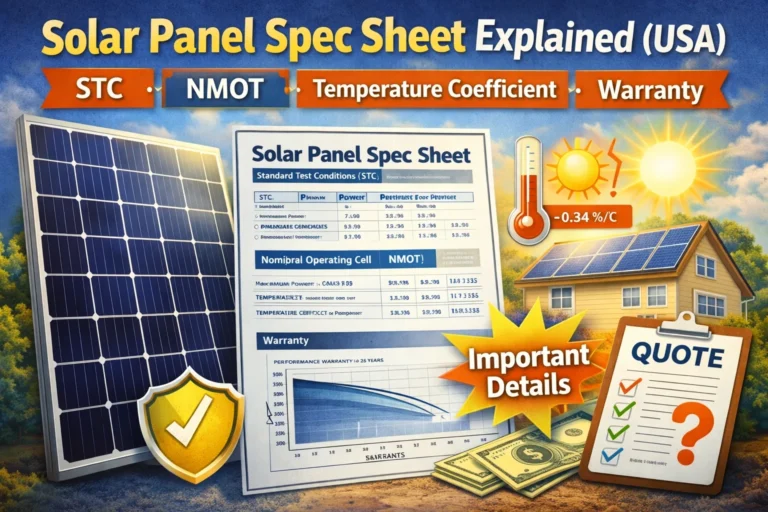
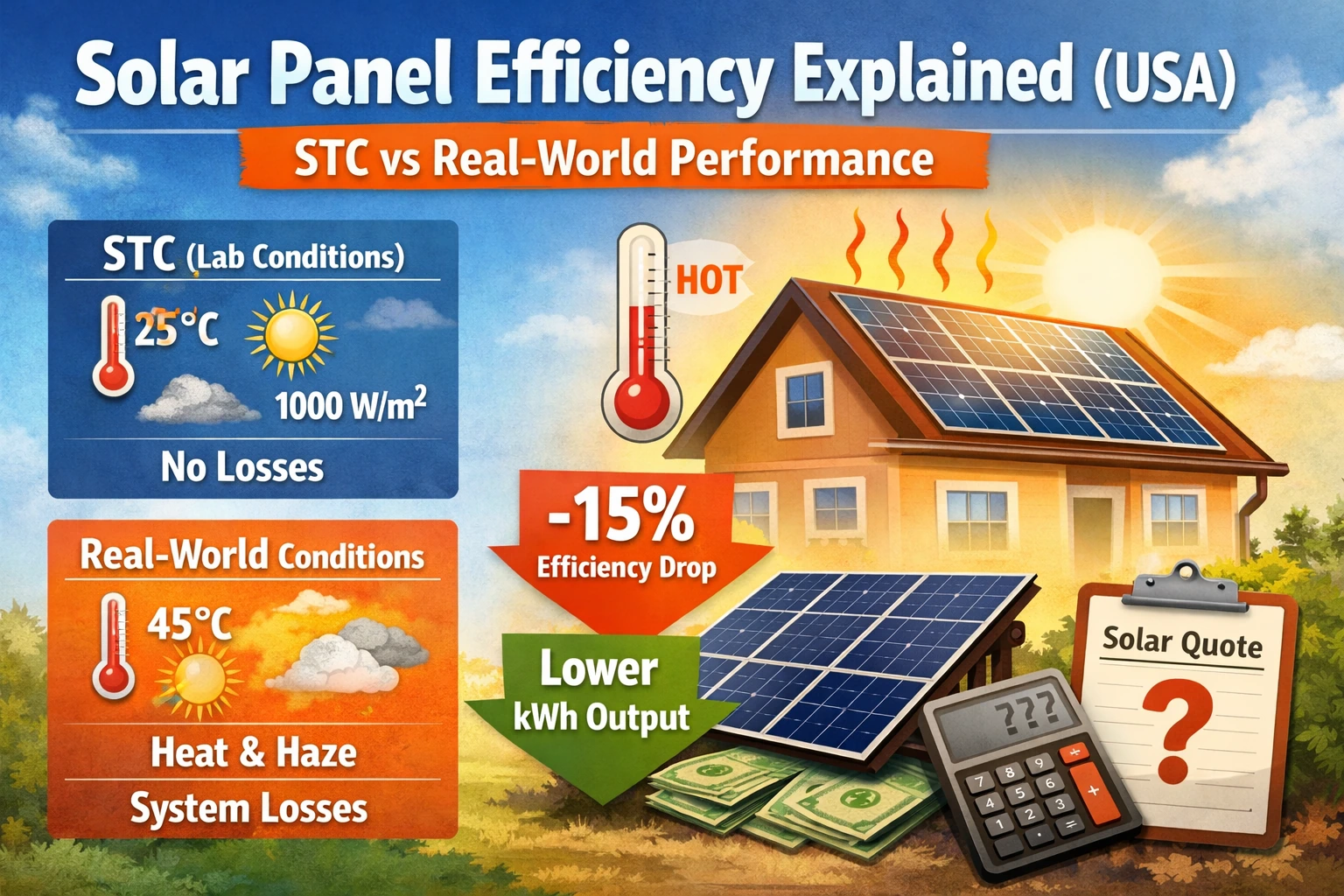
Panel ratings are usually given at STC (Standard Test Conditions), which are a lab standard used so panels can be compared consistently: 1000 W/m² sunlight, 25°C cell temperature, and an AM1.5 spectrum. Source: IEC testing explanation and STC definition references. :contentReference[oaicite:3]{index=3}
STC is useful for “apples-to-apples” comparison, but it can make output look better than what you’ll see on a hot roof.
NOCT / operating conditions (what it tries to represent)
NOCT (Nominal Operating Cell Temperature) is a reference meant to better reflect real outdoor operation. Typical NOCT reference conditions are around: 800 W/m² irradiance, 20°C ambient, and 1 m/s wind with an open-back mounting style. Source: PV education and PVsyst NOCT definition pages. :contentReference[oaicite:4]{index=4}
Different brands may list NOCT (or NMOT) values and temperature coefficients—these help explain why “same STC wattage” panels can behave differently in heat.
A simple expectation reset (real-world vs STC)
In real life, panels are often hotter than 25°C, your sunlight intensity changes all day, and your system has normal losses (wiring, inverter conversion, dirt/soiling, mismatch, etc.). PVWatts uses a default “system losses” assumption of 14% in its classic guidance (you can customize it), which is a good reminder that “rated watts” aren’t “delivered watts.” Source: PVWatts manual. :contentReference[oaicite:5]{index=5}
The 6 biggest reasons real-world output is lower than the brochure
1) Temperature (temperature coefficient)
Most solar panels produce less power when they’re hotter. That sensitivity is captured by the temperature coefficient (often listed as % power change per °C). In many PV performance discussions, temperature sensitivity around the order of tenths of a percent per °C is commonly referenced in performance analysis. Source: NREL performance ratio report discusses temperature-linked output changes as a typical behavior. :contentReference[oaicite:6]{index=6}
Practical homeowner rule: If your roof runs hot in summer afternoons, panels with a “better” (less negative) temperature coefficient can retain more output during those hours—especially in sunny, hot regions.
2) Irradiance & haze (not always “full sun”)
Sunlight intensity (irradiance) is not constant. Thin haze, smoke, clouds, and morning/evening sun angles reduce irradiance—so output drops. This is also why your daily production curve rises and falls even on “nice” days.
3) Angle & direction (tilt/azimuth)
Direction (azimuth) and tilt matter because they change how directly sunlight hits panels. For a homeowner-friendly walkthrough (including a quick PVWatts comparison method), see: https://solarbasicshub.com/best-direction-for-solar-panels-usa/
4) Shading (small shade can cause big losses)
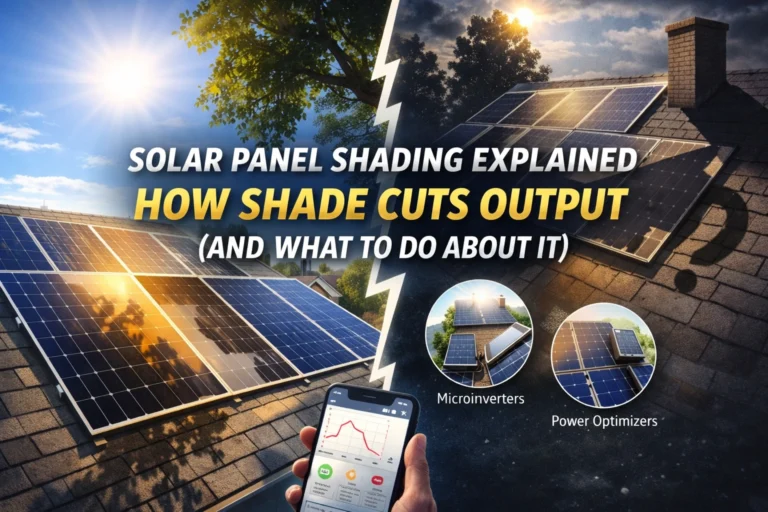
Partial shading can reduce output more than the shaded area suggests because of how cells and panels are electrically connected. If shade is a factor for your roof, start here: https://solarbasicshub.com/solar-panel-shading/
5) Inverter limits (DC/AC ratio & clipping)
Even if sunlight is strong, your inverter can cap AC output if the DC side could produce more than the inverter can convert at that moment. That’s called clipping, and it’s often normal design—not a defect. Learn the homeowner-safe explanation here: https://solarbasicshub.com/solar-inverter-clipping-dc-ac-ratio/
6) System losses (soiling, wiring, mismatch, downtime)
All systems have real losses. PVWatts groups common losses into categories and uses a default total losses assumption in its documentation as a baseline. Source: PVWatts manual and PVWatts system losses guidance pages. :contentReference[oaicite:7]{index=7}
Homeowner takeaway: “Panel efficiency” alone can’t overcome a design with avoidable shading, unrealistic assumptions, or a mismatch between goals and equipment.
Efficiency vs wattage vs “kWh/year” (the numbers that matter)
Solar panel efficiency vs wattage: how they relate
Wattage (like 400 W) is the panel’s power rating at STC. Efficiency is basically how much wattage you get per square foot of panel area.
- If two panels are the same physical size, the higher-efficiency panel usually has a higher watt rating.
- If you have plenty of roof space, you may be able to meet your target system size without paying extra for premium efficiency.
The bill number is kWh/year
Your savings depend most on how many kWh your system produces and how your utility credits exports (net metering vs net billing), not on an efficiency percentage. For the utility-credit side, see: https://solarbasicshub.com/net-metering-explained-how-solar-credits-work-and-what-net-billing-changes/
Use PVWatts for a reality check
If you want to test “premium panel” claims, run two PVWatts scenarios with the same roof assumptions and compare annual kWh. Start here: https://solarbasicshub.com/pvwatts-solar-production-estimate/
When high-efficiency panels are worth it (and when they’re not)
High-efficiency panels are often worth it when:
- Your roof is space-limited (small roof, many obstructions, strict setbacks), and you need more kW in the available area.
- You have high usage and want the largest practical array without using ground-mount.
- Your electric rates are high and additional kWh have strong value (especially if exports are still reasonably credited).
- You’re adding electrification loads (EV, heat pump) and want more capacity without expanding roof area.
High-efficiency panels are often NOT worth it when:
- You have plenty of roof space to hit your target system size using standard panels.
- Your biggest issue is shading (layout + electronics choices often matter more).
- Your savings are limited mostly by export credit rules or minimum bills, not panel output.
The “premium panel” checklist (beyond efficiency)
If you’re paying more, make sure the premium is supported by more than marketing:
- Temperature coefficient (less negative can help in hot conditions)
- Warranty terms (product warranty, performance warranty thresholds, exclusions)
- Installer support and serviceability (warranty is only as good as the claim process)
Warranty deep dive: https://solarbasicshub.com/solar-panel-warranty-explained/
How to compare panels safely (homeowner checklist)
- Ask for the full equipment list (panel model + inverter model) in writing.
- Confirm the assumptions behind kWh/year estimates (tilt, azimuth, shading, losses).
- Check temperature coefficient and NOCT/NMOT values if you live in a hot climate.
- Compare warranties using the actual PDF thresholds and exclusions.
- Verify shading strategy (layout changes, microinverters/optimizers where appropriate).
If you’re also comparing inverter architectures for shade and roof complexity, see:
- https://solarbasicshub.com/string-inverter-vs-microinverter/
- https://solarbasicshub.com/power-optimizer-vs-microinverter/
Decision table: what should you prioritize?
| Your situation | Best priority | Why |
|---|---|---|
| Small / space-limited roof | Higher efficiency (more W per ft²) | Lets you fit more kW into limited area |
| Plenty of roof space | Design + realistic kWh estimate | Efficiency premium may not increase savings much |
| Shade at key hours | Layout + shade strategy + electronics | Shading losses can overwhelm small efficiency gains |
| Hot climate, strong sun | Temperature coefficient + ventilation | Hot panels lose output; coefficient matters more |
| Conflicting quotes | Apples-to-apples comparison checklist | Normalize assumptions (tilt, shade, losses, DC/AC ratio) |
FAQ
1) Does higher efficiency always mean more energy?
Not always. It mainly means more power per square foot. If roof space isn’t limiting, a lower-cost panel can still meet your target system size.
2) Why does my 400W panel not produce 400W most of the day?
Because 400W is an STC lab rating. Real conditions differ (temperature, irradiance, angle, system losses). Source: STC definition references. :contentReference[oaicite:8]{index=8}
3) What’s the difference between STC and NOCT?
STC is a lab standard for comparison; NOCT is a reference meant to represent typical outdoor operation conditions more realistically. Source: NOCT condition references. :contentReference[oaicite:9]{index=9}
4) If I’m shaded, should I just buy “more efficient” panels?
Usually you should address shading first (layout changes and/or microinverters/optimizers), because shade can create outsized losses. Start here: https://solarbasicshub.com/solar-panel-shading/
5) What matters more than efficiency for savings?
Yearly production (kWh/year), your utility credit rules, and a design that matches your roof and usage. For credits: https://solarbasicshub.com/net-metering-explained-how-solar-credits-work-and-what-net-billing-changes/
6) Is PVWatts accurate for my roof?
It’s great for a fast reality check, but it can’t “see” your trees or detailed shading. Use it as a baseline and sanity check. Source: PVWatts documentation and PVWatts manual. :contentReference[oaicite:10]{index=10}
7) How do I protect myself when comparing panels?
Get model numbers, warranty PDFs, and the assumptions behind kWh estimates in writing. Then compare apples-to-apples (tilt, azimuth, shade, losses, inverter size).
Next to Read (internal links)
- How to Use NREL PVWatts to Estimate Solar Production (USA)
- Best Direction for Solar Panels (USA): South vs West vs East
- Solar Panel Shading Explained: How Shade Really Affects Output
- Solar Inverter Clipping Explained (DC-to-AC Ratio)
- Solar Panel Warranty Explained (USA)
- Why Is My Solar Production Low? 12 Common Causes (Safe Checks)