
Solar inverter clipping is one of the most misunderstood “solar monitoring” moments: your system hits a certain power level around midday… and then the curve looks flat. Many homeowners assume something is wrong or that their inverter is “undersized.”
In many systems, that flat top is normal by design.
This guide explains clipping in plain English, how the DC-to-AC ratio (also called inverter loading ratio) works, how much energy you typically lose, and when clipping could actually be a sign you should redesign your system.
Safety note: This article is for education and planning. Do not open electrical equipment or touch wiring. If you suspect a fault, contact a licensed solar professional.
What is solar inverter clipping?
The 30-second definition
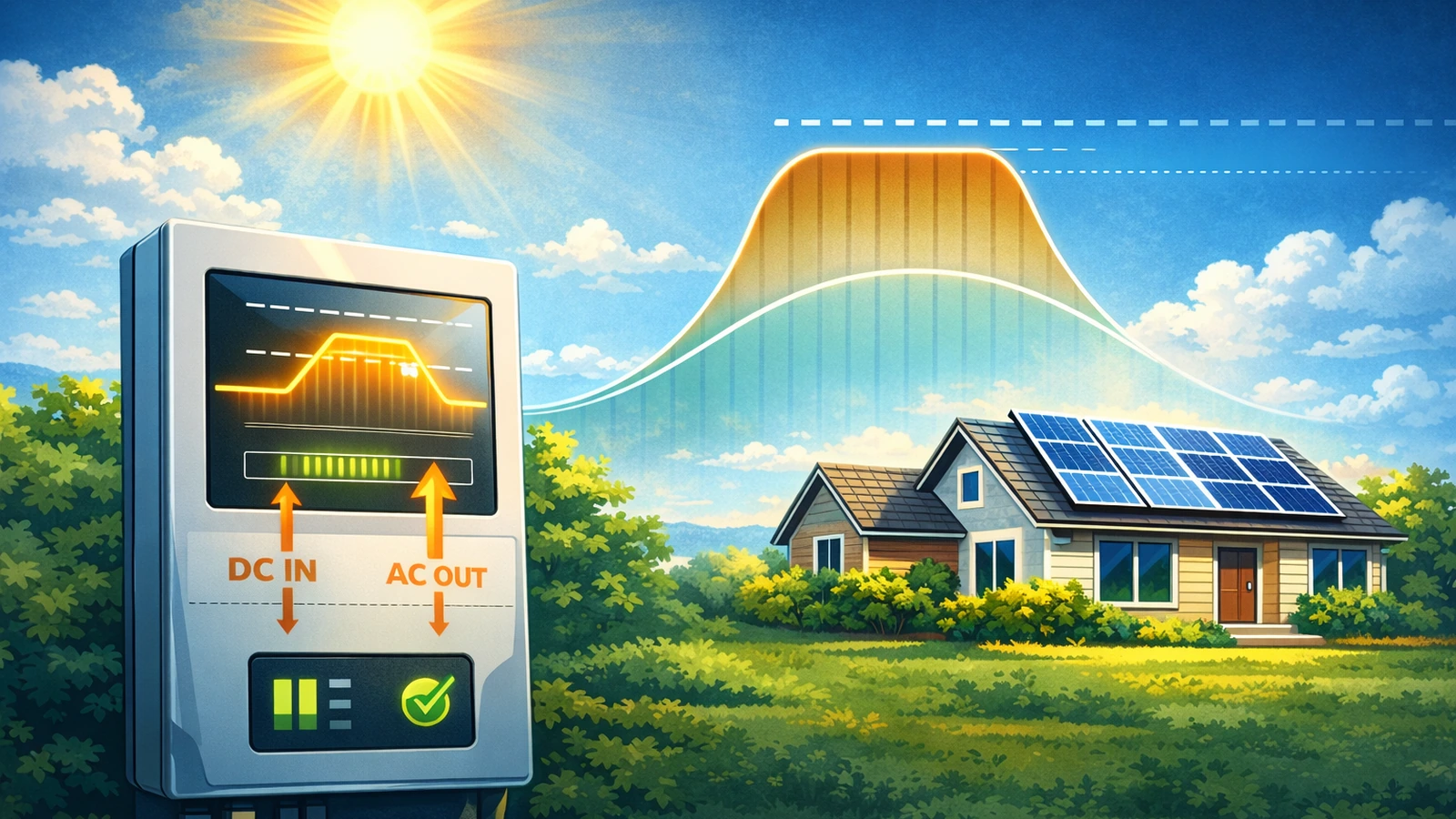
Clipping happens when your solar panels (DC side) are capable of producing more power than your inverter can convert to AC power (home/grid side) at that moment. When DC input exceeds the inverter’s maximum conversion/output, the inverter limits output to stay within its rating.
Source: Sandia National Laboratories PV Performance Modeling Collaborative (PVPMC) describes inverter saturation (“clipping”) when DC power exceeds the inverter limit and the inverter self-limits output.
What clipping looks like on your monitoring graph
- Your power curve rises in the morning.
- Near midday, it reaches a “ceiling.”
- Instead of a rounded peak, you see a flat top or “plateau.”
- Later, it drops as sunlight weakens.
If everything else looks normal (no alerts, no sudden drops, no missing strings), that flat top is often clipping—not a failure.
DC kW vs AC kW (the reason clipping exists)
If you’re brand new to solar units, read this first: kW vs kWh in Solar.
Why panel ratings (DC) and inverter ratings (AC) differ
Solar panels are rated in DC watts under lab test conditions. Inverters are rated by how much AC power they can output continuously.
It’s extremely common for a solar design to have:
- DC size (panel nameplate) greater than
- AC size (inverter output)
That mismatch is where clipping can happen—and why installers sometimes intentionally choose it.
What “DC-to-AC ratio” (ILR) means (simple formula)
The DC-to-AC ratio (also called the inverter loading ratio, ILR) is simply:
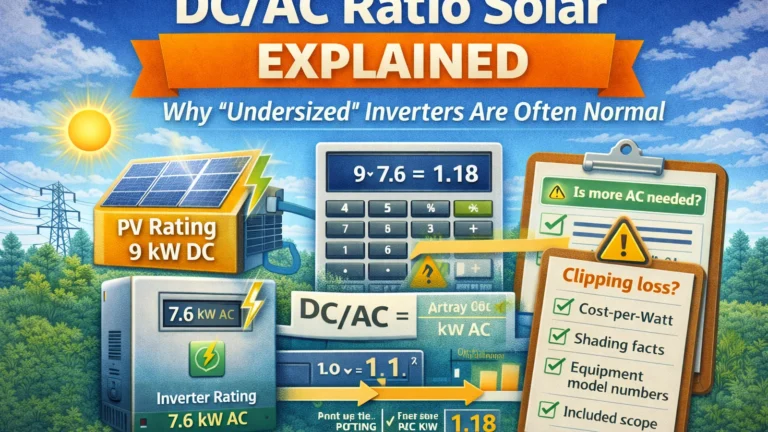
DC-to-AC ratio = (Total panel DC rating, kW) ÷ (Inverter AC rating, kW)
Example:
- Panels: 8.0 kW DC
- Inverter: 6.7 kW AC
- DC-to-AC ratio = 8.0 ÷ 6.7 = 1.19
A higher ratio generally increases the chance of clipping during strong sun, but can improve output in mornings/evenings and during hazy or cooler conditions.
Is clipping bad? Usually not—here’s why
The tradeoff: higher “shoulders” vs capped midday peak
Think of your daily solar curve like a hill:
- The top of the hill (midday) is where clipping happens.
- The “shoulders” (morning and late afternoon) are where extra panel capacity can help you produce more.
Many homeowners care most about total energy (kWh) over the day/year—not the single highest power (kW) moment at noon.
This is the same idea you see throughout SolarBasicsHub’s planning content: energy is what pays the bill. (Review: kW vs kWh.)
Clipping is “lost power,” not necessarily “lost savings”
Clipping does reduce what you could have produced in those peak minutes/hours. But the real question is:
- How much annual kWh is clipped?
- Is the system producing enough energy overall to meet your goals (offset %, bill reduction, export strategy)?
In many real systems, clipping losses are relatively small compared to other factors (temperature, soiling, shading, wiring, etc.). A modern modeling/measurement study from NREL quantifies clipping as one component of overall losses in PV systems under certain configurations.
Source: NREL (2024) research on quantifying inverter clipping impact on PV systems.
How much clipping is “normal”?
There is no single universal “good” number. The right DC-to-AC ratio depends on:
- Your location (sun intensity)
- Roof tilt and orientation
- Module temperature (hotter panels produce less)
- Typical weather and haze
- Inverter type (string vs microinverters vs optimizer systems)
In plain terms: Arizona summer sun can clip more than a milder coastal climate, even with the same hardware.
Rule-of-thumb ranges (use as a starting point, not gospel)
Residential designs commonly fall in a “moderate” DC-to-AC ratio band (often around the low-to-mid 1.x range). Industry tools and research discuss how higher ratios increase clipping probability, while also boosting energy outside peak irradiance windows.
Source: Sandia PVPMC explains clipping as inverter saturation behavior; NREL publications discuss increased inverter loading ratios and clipping behavior in PV systems.
What you should ask your installer (copy/paste)
- What is my system’s DC-to-AC ratio (panels DC kW ÷ inverter AC kW)?
- How much clipping do you estimate annually (kWh and %)?
- What assumptions are used (weather dataset, shading model, tilt/azimuth)?
- If the DC-to-AC ratio is high, what’s the reason (cost, inverter availability, TOU strategy, export limits)?
Tip: If you want a safe “planning-level” framework, review: Solar Components & Sizing Basics.
When clipping might be a problem (red flags)
Clipping is not automatically bad. But it can be a concern when it’s paired with other issues.
Red flag #1: Your annual production estimate seems artificially low
If your quote shows a high DC array but the estimated annual kWh doesn’t seem to benefit from it, ask why. Your model should reflect higher shoulder production, not only a capped noon peak.
Red flag #2: The system clips for long stretches in mild conditions
If you’re clipping heavily in spring/fall (not just during clear summer days), it may be worth checking whether the AC size is too constrained for your site conditions.
Red flag #3: The “flat top” is accompanied by alerts or irregular drops
Clipping looks like a smooth plateau. If you see sudden step-downs, missing sections, or error codes, that could indicate a fault, curtailment, or communication issue.
Use this checklist to separate causes safely: Why Is My Solar Production Low?
How inverter choice affects clipping (string vs microinverters vs optimizers)
Clipping can occur with any inverter type, but it shows up differently depending on architecture:
- String inverter: one AC ceiling for the whole string/inverter.
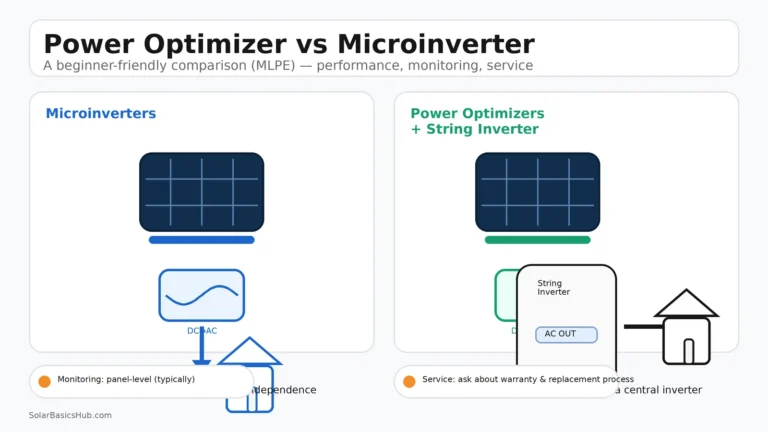
- Microinverters: each panel has its own AC ceiling (panel-level clipping).
- Optimizers + string inverter: panel-level optimization, but still a central inverter AC ceiling.
If you’re comparing quotes, read these two first:
What to do if you think you have “too much” clipping (safe steps)
Step 1: Confirm it’s really clipping
- Look for a smooth plateau near peak sun.
- Compare multiple clear days.
- Check whether the “ceiling” matches your inverter AC rating (or close to it).
Step 2: Compare the right months (year-over-year)
Seasonal sun patterns change a lot. Compare the same month year-to-year when possible. (This is also covered in your maintenance/troubleshooting content.)
Step 3: Ask for the annual clipping estimate (kWh and %)
The only “real” question is annual impact. If clipping is only shaving a small percent of yearly energy, it’s often an acceptable tradeoff.
Step 4: If redesigning, choose the goal first
- Maximize annual kWh?
- Maximize self-consumption for TOU?
- Stay under an export limit?
- Prepare for future battery backup?
These goals change the “best” inverter choice. Start here for planning: Solar Components & Sizing Basics.
Clipping vs other common causes of low production
Clipping is just one explanation for a “weird-looking” curve. Common look-alikes include:
- Shade (jagged dips, different day-to-day)
- Soiling (overall lower curve, not a clean plateau)
- Heat (lower peak on hot days)
- Grid limits / curtailment (may look like clipping but not tied to inverter rating)
Use this guide to troubleshoot safely: Why Is My Solar Production Low?
Quick decision table: keep it, redesign it, or investigate it
| What you see | Most likely meaning | What to do (safe) |
|---|---|---|
| Flat-top plateau near noon on clear days; no alerts | Normal inverter clipping | Ask installer for annual clipping % (kWh) and confirm DC/AC ratio |
| Long clipping window + annual kWh estimate seems low | AC limit may be too restrictive for your site/goals | Request alternate design: larger inverter AC rating or different architecture |
| Jagged drops, missing hours, error codes | Not “pure” clipping; could be fault/communications/curtailment | Check monitoring alerts; contact installer for diagnostics |
| No plateau, just generally lower production than expected | Could be shade/soiling/weather/heat | Use: Why Production Is Low checklist |
FAQ
1) Does clipping damage my inverter or panels?
Clipping is a normal operating mode where the inverter limits output. It’s not automatically harmful. The inverter is designed to self-limit when input exceeds output capability.
Source: Sandia PVPMC describes inverter saturation/clipping behavior as a self-limiting response.
2) How do I calculate my DC-to-AC ratio?
DC-to-AC ratio = (Total panel DC kW) ÷ (Inverter AC kW). Your quote should list both.
3) Why would an installer choose a design that clips?
Because it can increase energy production in non-peak hours and improve cost-effectiveness. The goal is often higher total kWh/year, not the highest noon kW spike.
4) Is clipping the same as curtailment?
No. Clipping is an inverter limit. Curtailment is when output is reduced due to grid/export constraints or utility controls. They can look similar, so confirm which you’re seeing.
5) Do microinverters eliminate clipping?
No—microinverters can also clip, but at the panel level. The benefit is panel-level independence for shade/complex roofs, not “zero clipping.”
6) Should I increase inverter size to eliminate clipping?
Not always. A larger inverter may reduce clipping, but it can increase cost and may reduce shoulder-hour gains if panel DC sizing changes. Decide based on annual kWh impact and your goals.
7) Will a battery “capture” clipped energy?
Usually not directly in a typical setup, because clipping is power that never becomes usable AC output. A redesigned system (different inverter architecture/control strategy) may change how energy is utilized, but don’t assume a battery automatically recovers clipping losses.