
Quick answer: what a solar export limit is (and why you might see “curtailment”)
A solar export limit is a cap on how much power your home is allowed to send back to the grid. If your solar system would normally export more than that cap, your system may reduce output so exports stay under the allowed limit.
Homeowners usually notice this as:
- “Flat tops” (a power ceiling) that doesn’t match your inverter’s nameplate rating, or
- Sudden step-downs on clear days that look like the system is “holding back.”
When your system reduces output to meet a grid/export cap, that behavior is commonly called solar curtailment.
Safety note (USA): This guide is for education and quote comparison. It does not include wiring instructions. If your system shows alerts or faults, follow the manufacturer guidance and contact your installer.
Export limit vs curtailment vs clipping (the definitions that prevent 90% of confusion)
1) Export limit = the rule (the cap)
An export limit is the maximum net power you’re allowed to push to the grid at any moment. “Net” means: solar production minus your home’s usage at that moment.
2) Curtailment = the behavior (output is reduced)
Curtailment is when your system reduces output below what the sun would allow—often to comply with an export limit or other grid requirement. Utility/grid operators also use the word “curtailment” at large scale when solar plants reduce output for grid reasons. Source: NREL discusses PV curtailment in grid operations context (utility-scale), which helps explain why curtailment exists as a grid tool.
Source: https://docs.nrel.gov/docs/fy21osti/74176.pdf
3) Clipping = an inverter ceiling (not a grid/export cap)
Clipping happens when your panels could produce more DC power, but your inverter can only convert up to its AC rating—so the curve “flattens” at the inverter’s maximum. SolarBasicsHub already explains clipping and the DC-to-AC ratio here:
Solar Inverter Clipping Explained (DC-to-AC Ratio)
Why it matters: clipping and curtailment can look similar in your app (both can “flatten” output), but the causes and next steps are different.
Why utilities and interconnection rules use export limits (plain English)
Export limits exist because distribution grids have physical constraints. Too much export in a neighborhood can cause issues like local voltage rise, equipment limits, or “hosting capacity” constraints. Instead of denying interconnection entirely, utilities sometimes allow interconnection with limits (including “non-export” configurations).
California example: Rule 21 and “Non-Export” interconnections
California’s interconnection framework (CPUC Rule 21) explicitly covers different facility types, including Non-Export facilities, showing that export control is a real, formal interconnection category—not just a random installer preference. Source: CPUC Rule 21 overview page.
Source: https://www.cpuc.ca.gov/Rule21/
Important: Rules vary by utility and state. Your installer should be able to tell you whether export is capped, whether “non-export” is required, and what documentation applies.
How export limiting works (the simplest accurate model)
Most export limiting setups require two elements:
- A meter that measures import/export at (or near) the point where your home connects to the grid
- A controller (inverter energy manager / gateway / controller) that reduces solar output when exports approach the cap
The role of the meter (“solar export limit meter”)
In export limiting, the system needs to know how much power is flowing to the grid in real time. One common approach is a meter at the grid connection point (or a measured point that allows export calculation). Manufacturer documentation (example: SolarEdge export limitation note) describes export limitation as being managed by an inverter/gateway that reads exported power from a meter and adjusts PV production to keep exports under a configured limit.
Source: SolarEdge Export Limitation Application Note (Jan 2025): https://knowledge-center.solaredge.com/sites/kc/files/feed-in_limitation_application_note.pdf
The controller/inverter action (“export limiting inverter”)
When the meter indicates export is nearing the cap, the inverter/controller can throttle production. In plain English: your solar “backs off” because your home is already producing more than you’re allowed to export.
Key takeaway: Export limiting is usually not a “broken solar system.” It’s often a compliance behavior: the system is doing what it was configured to do.
How to tell clipping vs curtailment vs shade (safe patterns you can use in your app)
Use this as a homeowner-safe diagnostic checklist. If you see system alerts, stop guessing and call your installer.
| What you see in the app | Most likely cause | Quick check (safe) | What to do next |
|---|---|---|---|
| Flat “plateau” near the same max level on many sunny days | Clipping (inverter max AC output) | Does the plateau roughly match your inverter AC rating? | Confirm DC/AC ratio; read Clipping explained |
| Flat top at a level that does NOT match inverter rating; may occur only on certain days/times | Curtailment / export limit | Do you have export caps in your interconnection paperwork or installer notes? | Ask installer: “Is my system export-limited? What is the kW cap and where is it measured?” |
| Jagged dips or repeating “notches,” varies day-to-day | Shade (trees, vents, chimneys) | Do dips line up with known shade times? | Read Solar Panel Shading Explained |
| Sudden step-downs, missing blocks, or unusual gaps | Comms issues, faults, or curtailment events | Any alerts/warnings in the app? | Start with How to Read Your Solar Monitoring App and contact installer if persistent |
SolarBasicsHub already flags that curtailment and clipping can look similar, and that you should verify which one you’re seeing rather than assuming. For a monitoring-first approach, start here:
How to Read Your Solar Monitoring App
What export limits mean for savings (net metering vs net billing)
Whether export limits “hurt” you depends on how valuable exports are in your area.
If you have full-value net metering
When exports earn strong credits, an export cap can reduce the value of midday overproduction (because you can’t export as much). That can change the “best” system size and design choices.
If you’re under net billing (exports worth less than imports)
When export credits are low, you already want to avoid large overproduction. In that case, export limits can be less painful—and can even push you toward smarter self-consumption strategies.
SolarBasicsHub’s net metering/net billing guide explains how export credit value changes sizing and savings:
Net Metering Explained: How Solar Credits Work (and What “Net Billing” Changes)
Practical rule: In low-export-value areas, “flattening your production curve” (more late-day production, better matching loads) can matter more than maximizing noon peak power.
What you can do if you have an export cap (realistic homeowner options)
You typically can’t “DIY remove” an export limit—because it’s often part of your interconnection agreement. But you can still design around it to reduce waste and improve value.
Option 1: Improve self-consumption (use more solar in the home)
- Shift flexible loads into sunny hours (dishwasher, laundry, EV charging when allowed)
- Reduce midday export by increasing daytime usage where it makes sense
Note: Don’t change electrical equipment without a pro. Focus on usage habits and smart scheduling first.
Option 2: Add or optimize a battery (store surplus instead of exporting)
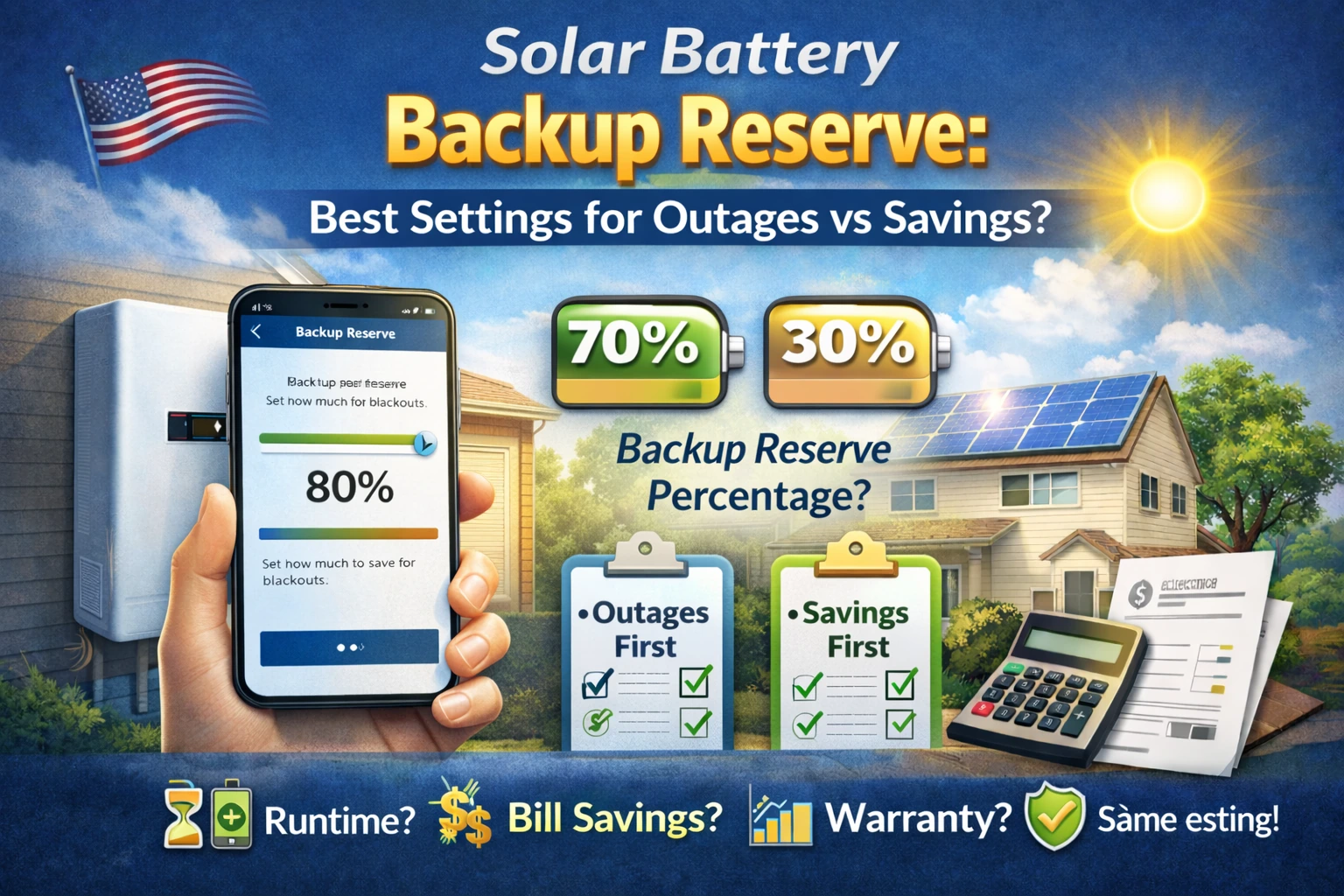
A battery can absorb midday surplus and serve evening loads, which is especially valuable when export credits are low or exports are capped. Your best battery choice depends on your goals (backup vs savings) and your rate plan.
Start with these SolarBasicsHub battery fundamentals:
Option 3: Design choices that reduce “wasted noon spikes”
- Orientation strategy: West-facing or east/west split arrays can flatten the curve and shift production later (often better under TOU/net billing).
- Right-sizing: Avoid oversized systems when exports are capped or low value.
- DC/AC ratio strategy: Sometimes a design that clips a bit is intentional, but it’s different from export curtailment—know which one you’re dealing with.
Related reading:
- Best Direction for Solar Panels (USA)
- Solar System Components & Sizing Basics
- Solar Inverter Clipping Explained
What to ask your installer (copy/paste checklist)
Use these questions before you sign (or if you suspect curtailment now):
- Is my system export-limited? If yes, what is the cap (kW) and where is it measured (point of interconnection vs other point)?
- What device enforces the cap? (inverter setting, gateway/energy manager, utility control, etc.)
- Is it an interconnection requirement? (part of utility approval / program rules)
- How will it show up in monitoring? What pattern should I expect on a sunny day?
- How much energy do you estimate I’ll lose annually due to export limits (kWh and %)?
- What design alternatives did you consider to reduce midday waste (orientation, right-sizing, battery, load shifting)?
- Will a battery charge during export-limited periods? (depends on configuration and priorities)
FAQ
1) What is a solar export limit?
A solar export limit is a cap on the maximum power you’re allowed to send to the grid. If your system would export above the cap, it may reduce output to comply.
2) What is solar curtailment?
Curtailment is the reduction of solar output below what the sun could produce, often for grid or export-limit reasons. Source: NREL discusses PV curtailment as a grid-management outcome (utility-scale), which helps explain why curtailment exists in general.
Source: https://docs.nrel.gov/docs/fy21osti/74176.pdf
3) How do I tell clipping vs curtailment?
Clipping typically flattens at (or near) your inverter’s AC rating and is consistent on strong-sun days. Curtailment/export limiting can flatten at a different level (the export cap) or occur only at certain times/days. Use the comparison table above and your inverter nameplate rating.
4) Do export limits mean my solar system is “bad”?
Not necessarily. Export limits can be a utility/interconnection requirement. The best approach is to confirm the cap, estimate annual impact, and design around it (self-consumption, battery, or smarter orientation).
5) Will a battery help with export limits?
Often, yes—because a battery can store surplus solar instead of exporting it. Whether it helps “a little” or “a lot” depends on your export credit value (net metering vs net billing), TOU rates, and battery configuration.
6) Can I remove an export limit myself?
You generally should not attempt to change export-control settings yourself. Export caps may be required for interconnection approval and safety/compliance. Always go through your installer and utility processes.