
Last updated: February 14, 2026
If a battery system is “90% efficient,” does that mean you keep 90% of your stored solar energy? Usually, yes — but only if you understand what kind of efficiency is being quoted and where it’s measured.
Round-trip efficiency (RTE) is one of the most important (and most misunderstood) battery specs. It affects:
- How much solar energy you actually get to use later (self-consumption)
- How long backup lasts during an outage
- Your real savings if you’re charging and discharging daily
Start here (pillar): Solar Basics (Start Here)
Who this is for
- You’re comparing solar + battery quotes and want to avoid “marketing math.”
- You want a realistic estimate of how much stored energy becomes usable energy.
- You keep seeing terms like “AC-to-AC efficiency,” “DC-to-DC,” or “system efficiency” and want clarity.
What is round-trip efficiency (RTE)?
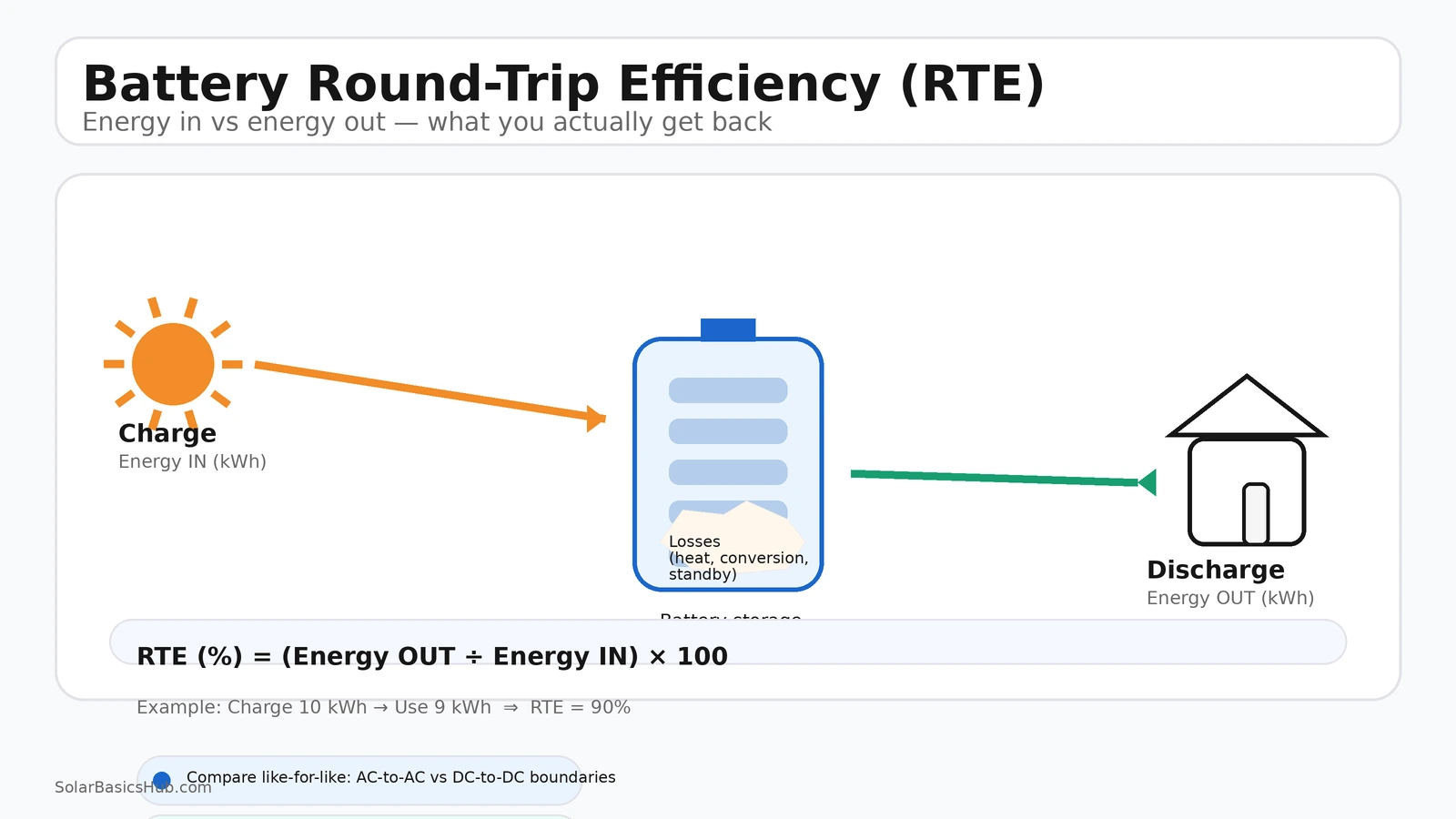
Round-trip efficiency is the ratio of energy you get out of storage to energy you put into storage over a full charge + discharge cycle.
Simple formula:
RTE (%) = (Energy out ÷ Energy in) × 100
Quick example: If you charge a battery with 10 kWh and later you can use 9 kWh, the round-trip efficiency is 90%.
Why RTE is never 100% (where the energy goes)
No battery system is perfect. Losses typically come from:
- Battery chemistry losses (heat inside the cells during charge/discharge)
- Power electronics losses (inverters, converters, control hardware)
- Standby/self-consumption (the system using a little power to stay “awake”)
- Temperature effects (very hot or very cold conditions can reduce efficiency)
Important: Some datasheets quote “battery-only” efficiency, while others quote “whole-system” efficiency. That brings us to the biggest trap…
The big trap: AC-to-AC vs DC-to-DC efficiency
Solar battery systems move energy through multiple stages. Depending on where the manufacturer measures “Energy in” and “Energy out,” you can get different efficiency numbers.
DC-to-DC (battery-only style)
This is closer to “how efficient is the battery bank itself.” It may exclude some conversion steps and can look higher.
AC-to-AC (whole-system style)
This is closer to “what you feel at home”: AC energy used to charge vs AC energy delivered back to your home loads. AC-to-AC often includes more real-world losses and is frequently the more useful comparison for homeowners.
Practical takeaway: When comparing two quotes, ask each installer: “Is this round-trip efficiency measured AC-to-AC or DC-to-DC, and at what point?”
Original value: the 60-second “usable stored energy” calculator
To estimate how much of your charged energy becomes usable energy later:
Usable energy out (kWh) ≈ Energy charged (kWh) × RTE
Example:
- You charge your battery with 8 kWh from excess solar.
- Your system RTE is 85% (0.85).
Usable energy out ≈ 8 × 0.85 = 6.8 kWh
That “missing” 1.2 kWh didn’t vanish — it was lost in heat/conversion/standby during the process.
How RTE changes your backup runtime
Backup runtime depends mainly on usable kWh and your average load. RTE affects usable kWh because it reduces how much of the charged energy becomes deliverable energy.
Use this safe planning rule:
Runtime (hours) ≈ Usable kWh ÷ Average load (kW)
To understand the other battery specs that affect runtime:
What’s a “good” round-trip efficiency?
There isn’t one perfect number because it depends on chemistry, system design, and how it’s measured. But you can use this as a practical interpretation guide:
| RTE range (rough) | What it usually implies | What to double-check |
|---|---|---|
| < 80% | Higher losses; may be older tech or more conversion steps | AC-to-AC vs DC-to-DC? Standby losses? Temperature conditions? |
| 80–90% | Common in many storage discussions; often a realistic planning zone | Is the spec “system-level” and under what operating conditions? |
| > 90% | Possible for many modern lithium systems depending on measurement method | Make sure you’re comparing the same measurement boundary (AC-to-AC preferred). |
Note: Don’t compare a “battery-only DC efficiency” from one product to an “AC-to-AC system efficiency” from another. That’s how apples-to-oranges comparisons happen.
RTE vs DoD: they solve different questions
- DoD answers: “How much of the battery’s nameplate capacity is usable without harming longevity?”
- RTE answers: “How much energy do I lose when I store and then retrieve energy?”
Both matter. A battery can have a high DoD (lots of usable capacity) but a lower RTE (more losses), or vice versa.
Battery chemistry plays a role too: LiFePO4 vs Lead-Acid Solar Batteries
Original value: quote checklist (copy/paste)
Use these questions to compare storage quotes safely:
- 1) What round-trip efficiency are you quoting — AC-to-AC or DC-to-DC?
- 2) At what point is it measured? (home AC output, inverter output, DC bus, etc.)
- 3) Does the estimate include standby/self-consumption? If yes, what is it?
- 4) What assumptions were used? temperature range, discharge rate, and cycle pattern can change results.
- 5) What is the usable kWh after DoD limits and reserve settings?
- 6) What is continuous kW and peak/surge kW? (what you can run at once)
- 7) Is the warranty limited by time only, or also by throughput/energy cycled?
Pricing context (so you can judge ROI more realistically): Solar Cost Breakdown
When to consult a professional
- If your goal is whole-home backup, HVAC backup, or running pumps/motor loads, ask a qualified solar + storage professional to design a safe “critical loads” plan.
- If the project involves changes to your main electrical panel, subpanels, or service equipment, use licensed professionals and local-code compliant installers.
- If your installer can’t clearly explain whether efficiency is AC-to-AC or DC-to-DC (and show a datasheet), get a second opinion before signing.
Quick recap
- RTE = energy out ÷ energy in (over a full charge + discharge cycle).
- Always ask whether the efficiency is AC-to-AC or DC-to-DC.
- RTE affects both savings (daily cycling losses) and backup runtime (usable energy).