
Last updated: February 14, 2026
When people buy a solar battery, they usually ask: “How many kWh is it?” That’s a good start—because kWh tells you how much energy the battery can store.
But the second number—kW—is just as important. It tells you how much power the battery can deliver at one moment. In real life, kW decides what you can run, and kWh decides how long you can run it.
If you want the big picture of solar sizing (panels + inverter + battery): A Practical Planning Guide (Panels, Inverters, Batteries)
Who this is for
- You’re comparing solar + battery quotes and don’t want to get tricked by “big kWh” marketing.
- You want backup power and need a realistic runtime estimate for essentials.
- You keep seeing “continuous kW” and “peak kW” and want plain-English answers.
Quick definitions (battery version)
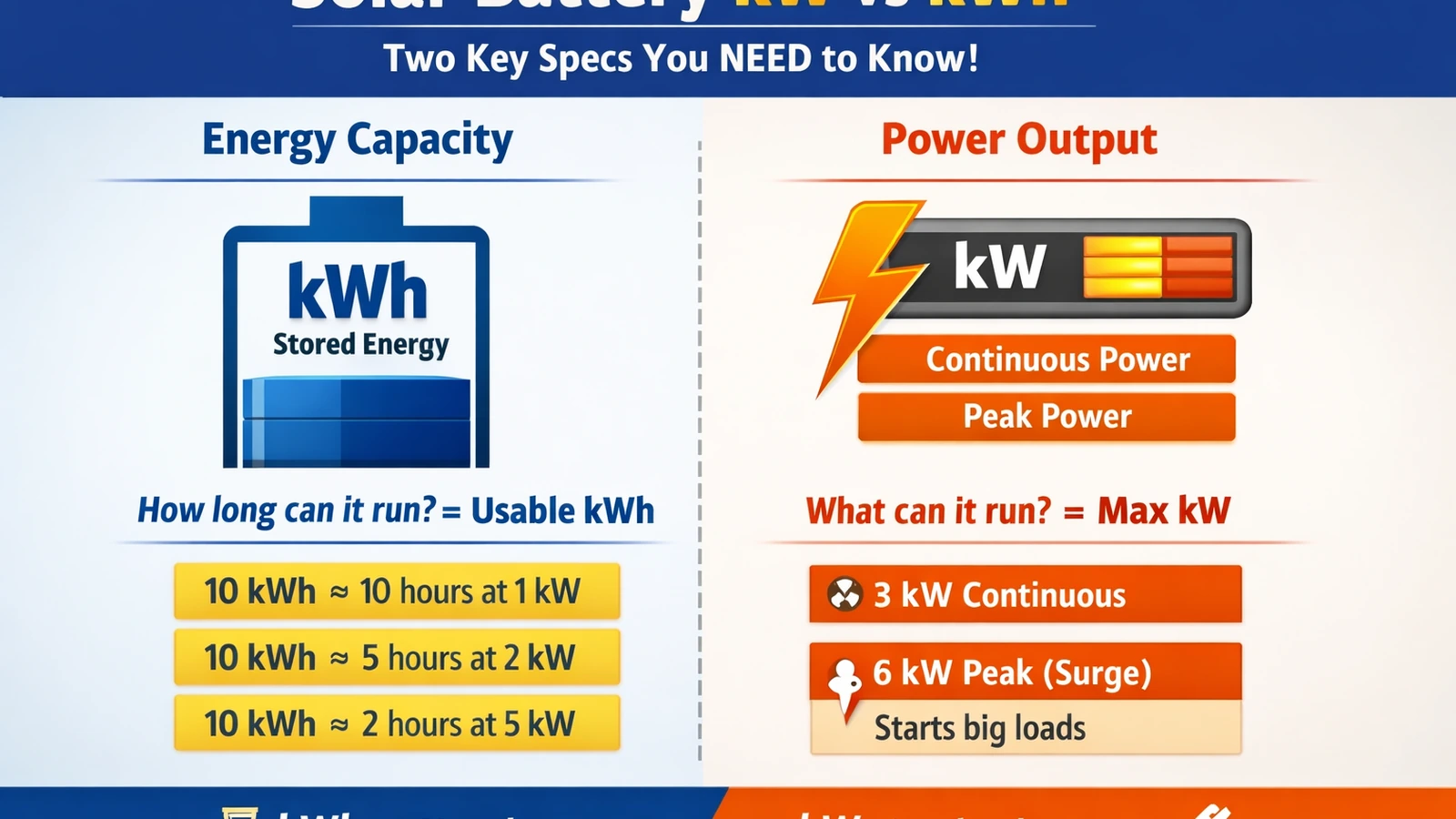
kWh = energy (the “fuel tank”)
kWh (kilowatt-hours) is stored energy. A 10 kWh battery can deliver:
- 1 kW for ~10 hours, or
- 2 kW for ~5 hours, or
- 5 kW for ~2 hours (if the battery’s kW rating allows it).
kW = power (the “engine strength”)
kW (kilowatts) is how fast energy can flow at one time. A battery with a low kW rating might have plenty of kWh, but still struggle to run multiple appliances simultaneously.
Need a general refresher first? kW vs kWh in Solar
Original value: the 2-line formula that explains almost every battery quote
1) Runtime (hours) ≈ Usable kWh ÷ Average load (kW)
2) Can I run it? → Check battery continuous kW (and surge/peak kW)
That’s it. Most confusion comes from mixing up these two ideas.
Why “usable kWh” matters (not the headline number)
Battery labels and sales pages often highlight a single “capacity” number. But in real systems, your usable energy is affected by:
- Depth of discharge (DoD)
- Reserve settings (keeping some charge for outages)
- Efficiency losses (charging/discharging isn’t perfect)
Use this guide to estimate usable energy safely: Solar Battery Depth of Discharge (DoD) Explained
Continuous vs peak kW (the “can it start my appliance?” question)
Battery specs usually include:
- Continuous power (kW): what it can supply steadily.
- Peak/surge power (kW): extra power for a short time (seconds) to start motors or handle brief spikes.
Tip: If you want to run an air conditioner, well pump, or other motor load, the surge rating and system design matter a lot. This is a top reason two batteries with similar kWh can feel very different in “real backup.”
Real product examples (to see kW and kWh side-by-side)
These examples show how batteries can have similar “size” (kWh) but very different “strength” (kW):
| Example battery | Energy (kWh) | Continuous power (kW) | What it helps you understand |
|---|---|---|---|
| Example A (13.5 kWh class) | ~13.5 kWh | ~11.5 kW continuous | High kW can support bigger “simultaneous loads” with fewer limits. |
| Example B (5 kWh class) | ~5.0 kWh usable | ~3.84 kW continuous | Smaller kWh and moderate kW = great for essentials, limited for whole-home. |
Note: Always verify numbers on the manufacturer spec sheet for the exact model in your quote.
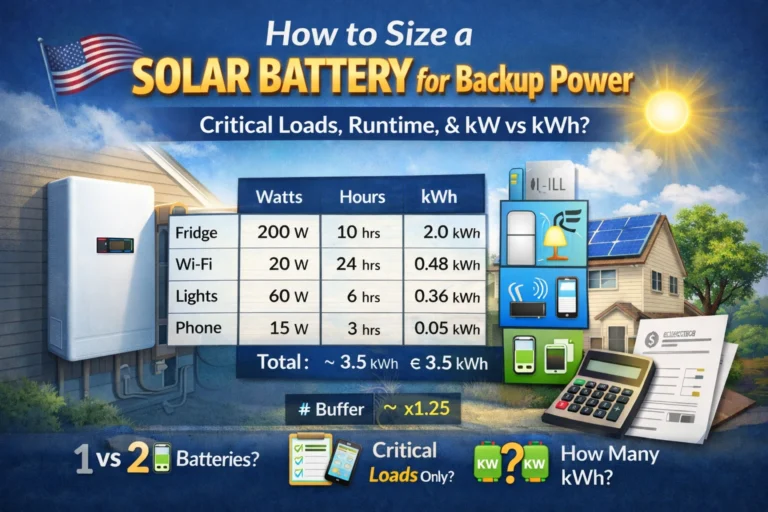
Original value: a simple “backup sizing” table (essentials planning)
This table is not for electrical design—just a safe way to think about the difference between kW and kWh.
| Backup goal | What usually limits you | What to check first | Common mistake |
|---|---|---|---|
| Run essentials overnight (lights, fridge, Wi-Fi) | kWh (energy) | Usable kWh + your average overnight load | Using nameplate kWh instead of usable kWh |
| Run many things at once (microwave + kettle + HVAC fan) | kW (power) | Continuous kW and peak/surge kW | Assuming “more kWh” automatically means “runs everything” |
| Start motor loads (AC compressor, pump) | Peak/surge + system design | Surge rating and installer load plan | Ignoring startup surges |
What is “battery duration” (and why utilities talk about it)?
Duration is a simple ratio:
Duration (hours) = kWh ÷ kW
Example: a 12.5 kWh battery with a 5 kW power rating is a 2.5-hour battery (12.5 ÷ 5 = 2.5). This “kW/kWh pairing” is a standard way to describe storage systems.
What is C-rate (optional, but helpful)
C-rate is another way to express “how fast” a battery can discharge relative to its energy size.
- 1C means it can discharge its full kWh in ~1 hour.
- 0.5C means ~2 hours (half as fast).
This matters because two batteries with the same kWh can have different C-rates—and therefore different kW capability.
Battery quote checklist (copy/paste)
- What is the battery’s usable kWh (not just nameplate)?
- What is the continuous kW rating?
- What is the peak/surge kW rating and for how many seconds?
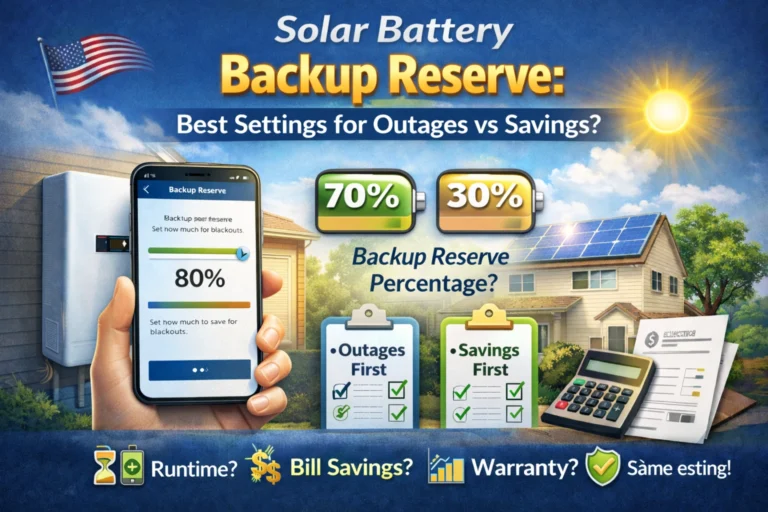
- What reserve % will be set for outages?
- Does the warranty limit time only, or also energy throughput?
- Is the quote for essential loads backup or whole-home backup (and what’s excluded)?
When to consult a professional
- If you want whole-home backup or to run HVAC, pumps, or other large motor loads, ask a qualified solar + storage professional to create a safe “critical loads” plan.
- If your project needs any electrical panel changes, subpanels, or service upgrades, use licensed professionals—do not DIY electrical work.
- If you rely on medical equipment or cannot tolerate downtime, have a professional validate runtime assumptions and system behavior during outages.
Quick recap
- kWh = how much energy the battery stores (how long it can run things).
- kW = how much power it can deliver at once (what it can run).
- For backup planning: Runtime ≈ usable kWh ÷ average kW, then verify continuous/peak kW.
References (manufacturer + independent)
- Tesla Powerwall specifications (power and energy)
- Enphase IQ Battery 5P specifications (usable kWh and continuous power)
- NREL Annual Technology Baseline (residential battery storage: kW/kWh pairing)
- NREL SAM help: battery power (kW) vs energy capacity (kWh)
- sonnen: distinguishing capacity (kWh) vs output (kW)