
Last updated: February 13, 2026
If you’ve ever seen a battery advertised as “10 kWh” and wondered why you can’t (or shouldn’t) use all 10 kWh every day, you’re already asking the right question.
Depth of Discharge (DoD) is the key concept that connects:
- Usable energy (how many kWh you can actually use),
- Battery longevity (how quickly it wears out), and
- Real backup runtime (how long your essential loads can run).
Start here if you want the big picture first: Solar System Components & Sizing Basics
Who this is for
- You’re comparing solar + battery quotes and want to understand “usable” vs “nameplate” capacity.
- You want backup power and need a realistic runtime estimate.
- You’re deciding between battery chemistries (like LiFePO4 vs lead-acid) and keep seeing DoD mentioned.
What is Depth of Discharge (DoD)?
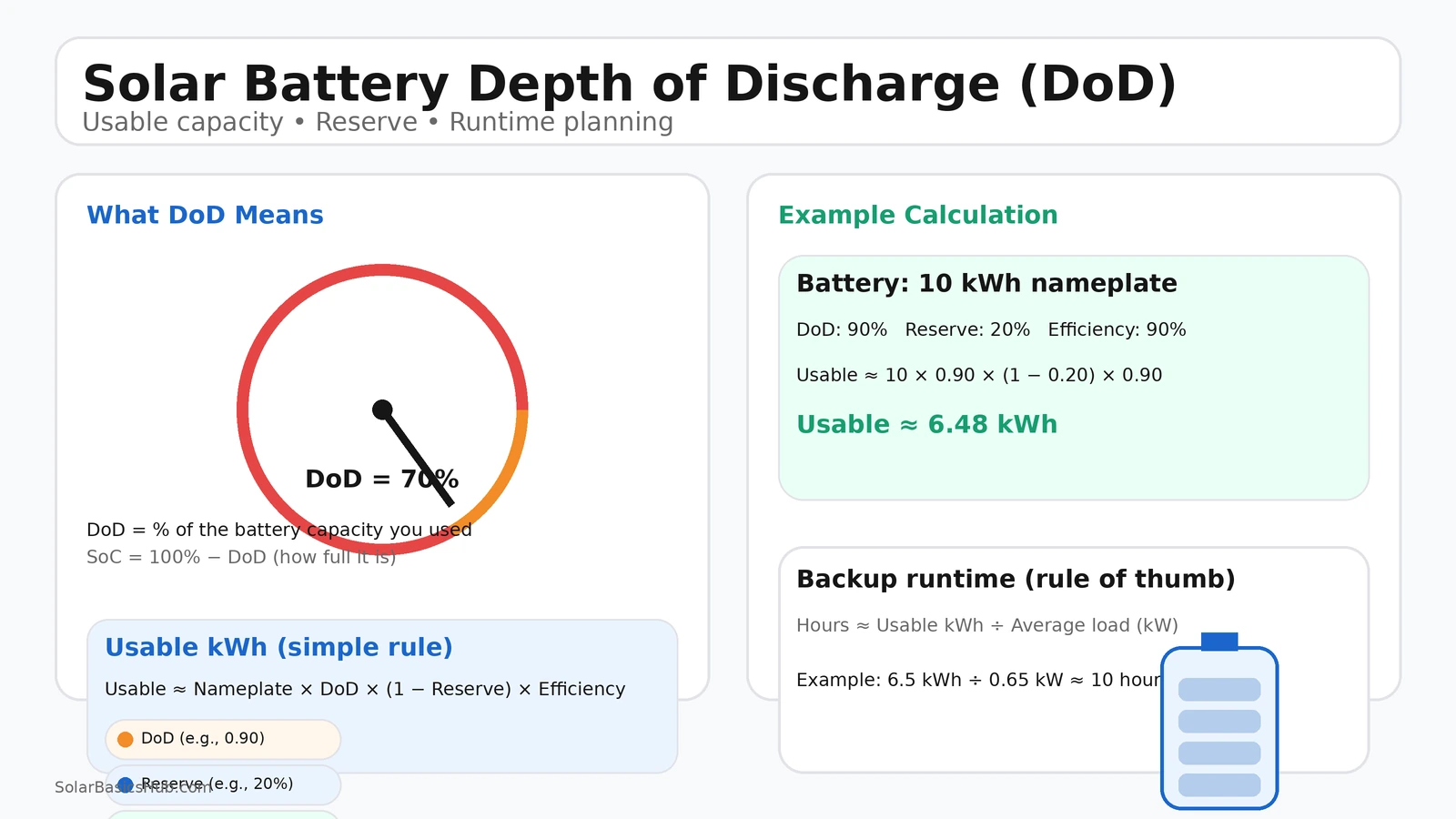
DoD = the percentage of the battery’s total capacity that has been used (discharged).
- 0% DoD = the battery is full (you’ve used none of it)
- 50% DoD = you’ve used half of the stored energy
- 100% DoD = fully discharged (not always recommended in daily use)
DoD vs State of Charge (SoC)
SoC is what most apps show (how full the battery is). DoD is the opposite direction (how much you’ve used).
Simple relationship: DoD (%) = 100% − SoC (%)
Example: If your battery is at 70% SoC, then it is at 30% DoD (you’ve used 30%).
DoD is why “10 kWh” doesn’t always mean 10 kWh usable
Battery marketing often highlights nameplate capacity (the headline kWh). But what matters for planning is usable capacity.
Rule of thumb:
- Usable kWh is usually less than nameplate kWh because of DoD limits and system reserves.
Two common reasons usable capacity is lower
- DoD limit (hardware / chemistry): some batteries shouldn’t be cycled deeply every day without shortening life.
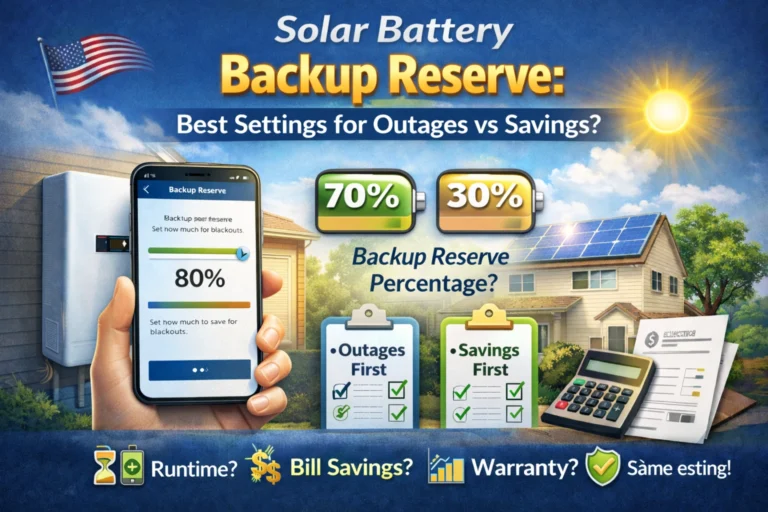
- Reserve setting (software / backup): many systems let you “hold back” 10–30% so you still have emergency power during an outage.
Quick refresher on units: kW vs kWh in Solar
Original value: the 1-minute “usable kWh” calculator
Use this simple planning formula to estimate realistic usable energy:
Usable kWh ≈ Nameplate kWh × DoD × (1 − Reserve) × Round-trip efficiency
- DoD as a decimal (e.g., 90% → 0.90)
- Reserve as a decimal (e.g., 20% reserve → 0.20)
- Round-trip efficiency accounts for energy lost charging/discharging (check the datasheet; many modern systems are high, but it varies)
Example (simple, realistic planning)
- Battery nameplate: 10 kWh
- DoD allowed: 90% (0.90)
- Backup reserve: 20% (0.20)
- Round-trip efficiency: 90% (0.90)
Usable kWh ≈ 10 × 0.90 × (1 − 0.20) × 0.90
Usable kWh ≈ 6.48 kWh
That number is much closer to what you can reliably plan around for everyday cycling + keeping a reserve.
How DoD affects battery lifespan (why deeper cycles wear batteries faster)
In general, the deeper you discharge a battery each cycle, the fewer total cycles it will deliver before its capacity meaningfully fades. This relationship exists across chemistries, but the sensitivity differs.
Typical DoD expectations by battery type (always verify the datasheet)
| Battery type | Common planning DoD range | Practical note |
|---|---|---|
| Lead-acid (deep cycle) | ~50% (often recommended for longer life) | Deep discharges can shorten lifespan quickly; sizing often assumes shallower cycles. |
| Lithium (LiFePO4 / LFP) | Often high (many systems advertise 90–100% usable) | Generally tolerates deeper cycling better, but many owners still choose a reserve for longevity and outage readiness. |
| Lithium (NMC and others) | Often ~80–90% (varies by product) | Specs differ widely; compare warranty terms and usable capacity, not just nameplate. |
If you’re choosing chemistry: LiFePO4 vs Lead-Acid Solar Batteries
Backup runtime: converting usable kWh into “hours”
Once you have usable kWh, runtime is just a division problem:
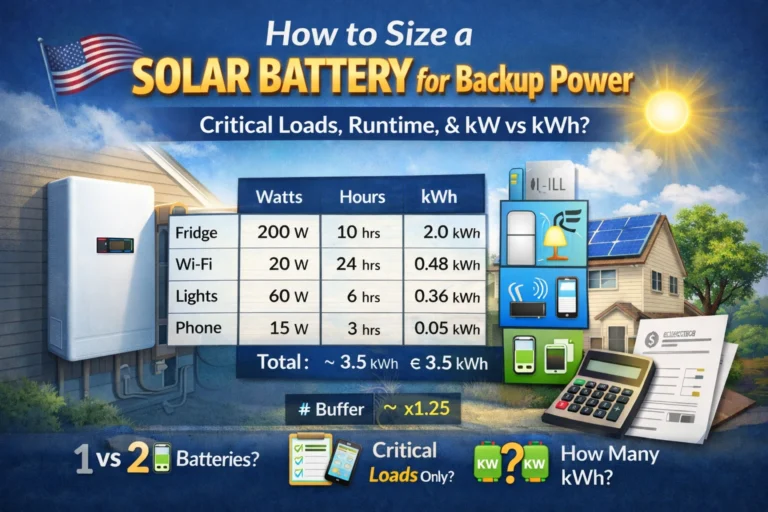
Estimated runtime (hours) ≈ Usable kWh ÷ Average load (kW)
Example
- Usable energy: 6.5 kWh
- Average essential loads: 0.65 kW (650 watts)
Runtime ≈ 6.5 ÷ 0.65 ≈ 10 hours
Important: Your “average load” matters more than almost anything. Many homes overestimate runtime because they forget intermittent loads (fridge compressor cycles), startup surges, or evening usage spikes.
DoD mistakes that cause bad expectations (and how to avoid them)
- Mistake: Comparing batteries by nameplate kWh only.
Fix: Compare usable kWh after DoD limits and reserves. - Mistake: Ignoring reserve settings.
Fix: Ask each installer: “What reserve is configured by default, and can I change it?” - Mistake: Forgetting efficiency losses.
Fix: Use round-trip efficiency from the datasheet for planning (or conservatively assume some loss). - Mistake: Not checking the warranty structure.
Fix: Ask whether the warranty is time-based only, or also limited by throughput/energy cycled.
Battery quote checklist (copy/paste)
- What is the battery’s nameplate kWh and usable kWh?
- What is the stated DoD (and is it “recommended” or “maximum”)?
- What backup reserve will be set at commissioning?
- What is the continuous power (kW) and any short-term surge rating?
- What is the round-trip efficiency (datasheet value)?
- What is covered under warranty (battery + inverter + controls), and are there throughput limits?
Costs context: Solar Cost Breakdown
When to consult a professional
- If you want whole-home backup, critical-loads backup, or generator integration, talk to a qualified solar + storage professional for safe system design.
- If any quote involves electrical panel upgrades, new subpanels, or service changes, use licensed professionals—do not DIY electrical work.
- If you rely on medical equipment, work-from-home uptime, or refrigeration needs, have a professional validate the runtime assumptions and load plan.
Quick recap
- DoD tells you how much of a battery’s capacity is used; SoC tells you how much is left.
- Usable kWh is usually less than nameplate kWh once DoD limits, reserves, and efficiency are included.
- Runtime is simple: usable kWh ÷ average kW (but your load estimate must be realistic).