
Who this is for
This guide is for anyone new to solar who wants a clear explanation of how solar power works, what the main system types are, and how the key parts fit together—without electrical jargon or risky DIY instructions.
Solar basics in 60 seconds (the big idea)
A home solar system is an energy pipeline:
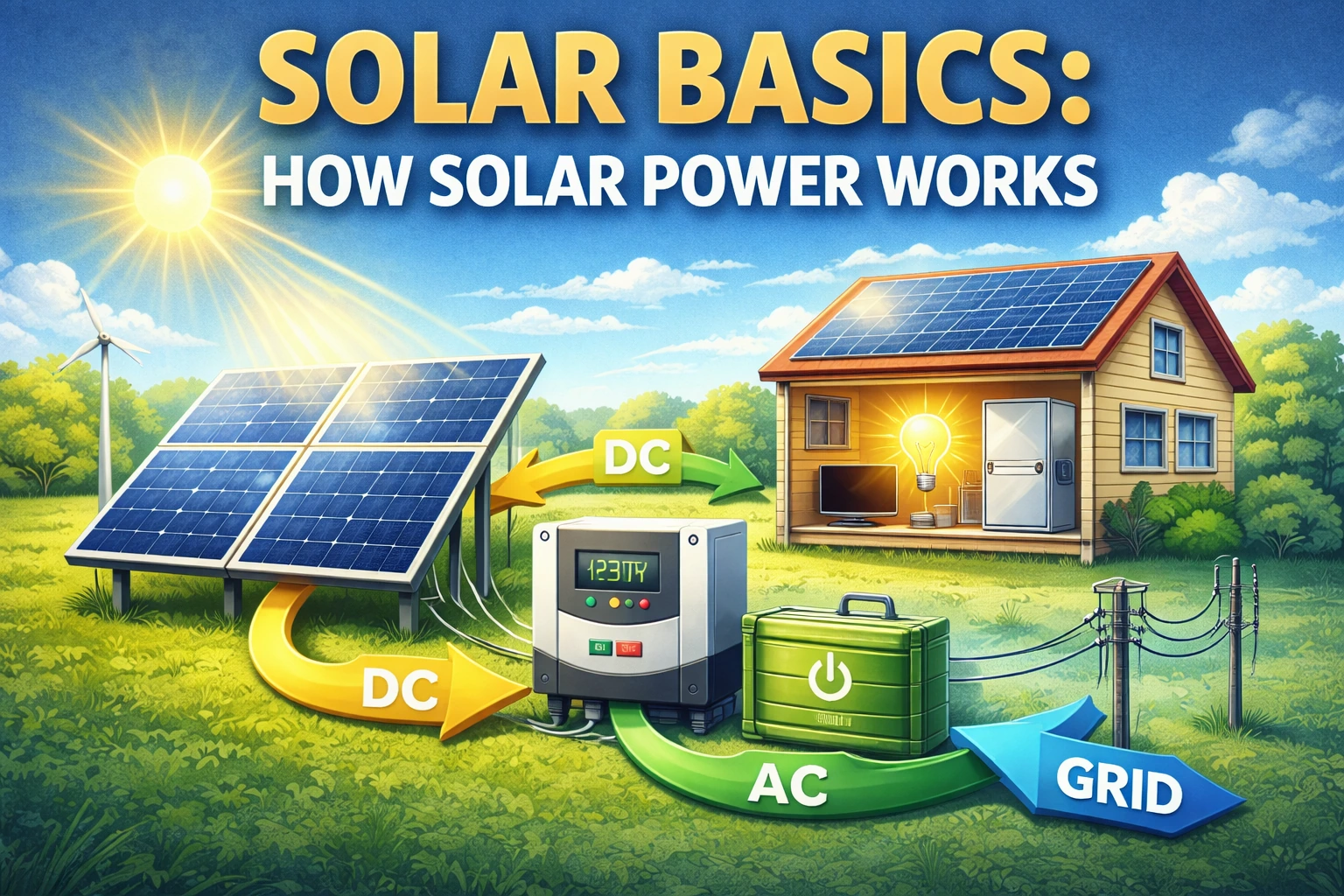
Sunlight → Solar panels (make DC electricity) → Inverter (turn DC into AC) → Your home (uses AC)
Optional parts can be added to the pipeline:
- Battery (stores energy for later or backup)
- Grid connection (lets you import/export power, depending on local rules)
- Monitoring (shows production and helps diagnose issues)
If you only remember one sentence: Panels make DC, homes use AC, and the inverter is the translator.
Related reading on SolarBasicsHub: Solar Panels, Inverters, Solar Costs & Payback
What solar panels actually do
Most residential panels are solar photovoltaic (PV) panels. PV panels convert sunlight into electricity using the photovoltaic effect. They do not “store sunlight,” and they don’t need batteries to work (batteries are optional).
DC electricity: what your panels produce
Solar panels produce direct current (DC) electricity. DC flows in one direction. That’s perfect for charging batteries and powering some electronics, but most home appliances and wall outlets are designed for alternating current (AC).
AC electricity: what your home uses
Your home’s outlets deliver AC. AC changes direction in a wave pattern many times per second (the exact frequency depends on your country’s grid standard).
Because of that mismatch, every modern home solar system needs a way to convert DC → AC. That’s the inverter’s job.
DC vs AC (simple explanation + why it matters)
Here’s an easy mental model:
- DC is like water flowing steadily down a pipe.
- AC is like a wave moving back and forth.
Why you care:
- Your panels are DC devices.
- Your house wiring and most appliances expect AC.
- The inverter is the bridge between the two.
This one concept explains why “solar panels alone” are not the full system you need for a typical home.
The main types of solar systems (grid-tied, hybrid, off-grid)
Most home solar setups fall into one of these categories:
1) Grid-tied solar (most common)
A grid-tied system connects to the utility grid and usually has no battery.
How it behaves:
- Solar powers your home first.
- If your panels produce more than you need at the moment, the excess may be exported to the grid (rules vary by country/utility).
- If solar is not enough (night, cloudy periods), you import electricity from the grid.
Best for:
- Lower upfront cost
- Simple maintenance
- Areas with a reliable grid
Important blackout note: many grid-tied systems are designed to shut down during a power outage for safety (to protect utility workers). Some systems can provide backup only if they have battery/backup features.
2) Hybrid solar (grid + battery)
A hybrid system is grid-connected and includes a battery (and a hybrid inverter or compatible setup).
How it behaves:
- You can store excess solar in the battery.
- You can use stored energy at night or during high-cost time periods (if your utility has time-of-use pricing).
- Some hybrid systems provide backup power for selected circuits during outages.
Best for:
- Homes that want backup protection
- Homes aiming to increase self-consumption (using more of their own solar)
- Places with outages or expensive evening electricity
3) Off-grid solar (no grid)
An off-grid system is not connected to the utility grid. It typically requires:
- Batteries (energy storage)
- A strategy for low-sun periods (often a generator or oversized storage)
Best for:
- Remote locations without grid access
- People prioritizing independence over lowest cost
Key solar terms beginners should know
Solar discussions get easier once you know these:
| Term | Meaning | Why it matters |
|---|---|---|
| kW | Power capacity (instant “speed”) | Affects how much power you can produce at once |
| kWh | Energy over time (total “distance”) | Your electric bill is mainly measured in kWh |
| Peak Sun Hours | “Equivalent full sun” hours/day | Helps estimate daily solar energy production |
| Inverter | Converts DC to AC | Makes solar usable for your outlets |
| Battery (kWh) | Stored energy capacity | Determines backup duration and night-time use |
| Efficiency | % of sunlight converted | Affects panel area needed on roof/ground |
Quick rule:
- kW = power right now
- kWh = energy over time
How solar power flows through your home (day vs night)
Morning
Solar production starts low and increases as the sun rises. Your home may still import some grid power if consumption is higher than production.
Midday
Production usually peaks. If you’re home using electricity at this time, you can consume a larger share directly. If your home usage is low, you may export more (grid-tied) or charge a battery (hybrid).
Evening
Production drops while household use often rises (lights, cooking, TV). Grid-tied homes import from the grid; hybrid homes can use stored battery energy for part of the evening.
Night
Panels produce zero. Your home uses grid power or the battery (if you have one).
This “solar curve” is why two homes with the same roof can experience different savings: usage timing matters.
What determines how much solar energy you can produce?
Solar output depends on several real-world factors:
1) Sunlight at your location
Climate and season affect how much sunlight is available. Solar is predictable in patterns, but it’s not constant day to day.
2) Shading
Shading can reduce production significantly. Shade from trees, nearby buildings, chimneys, or even dirt and leaves can matter.
3) Roof orientation and tilt
Orientation and tilt affect how much sunlight hits your panels. “Not perfect” does not mean “not worth it”—many roofs still work well with thoughtful layout.
4) Temperature and system losses
Panels typically operate less efficiently when very hot. There are also losses in wiring and the inverter conversion. That’s normal; installers account for it.
5) Panel and inverter quality
Quality and matching components affect long-term performance, reliability, and monitoring.
Solar costs and savings: the non-hype way to think about payback
The simplest way to think about solar savings:
Savings = (electricity you no longer buy) – (any added costs for the system)
Payback time depends on:
- Your electricity price
- How much solar energy you use directly vs export
- Local compensation rules (net metering or export rates)
- System cost, incentives (if available), and financing terms
- How long you plan to stay in the property
Solar can be an excellent investment, but it’s not one-size-fits-all.
Related: Solar Costs & Payback (a full guide with a planning worksheet)
Battery basics: when storage makes sense (and when it doesn’t)
Batteries can be valuable, but they’re not mandatory.
Common reasons people add a battery
- Backup power during outages (critical loads)
- Higher self-consumption (use solar at night instead of exporting)
- Time-of-use optimization (use stored energy when grid prices are higher)
When a battery might not be the best first step
- You have a stable grid and your main goal is lowest-cost solar savings
- Your utility compensation rules already make exporting valuable
- Budget is tight and you’d rather add more panels or improve efficiency first
A smart planning approach: start with your goal (savings vs backup vs independence), then choose the system type.
Beginner checklist: is your home “solar-ready”?
Use this simple checklist before you spend time on quotes:
Solar readiness checklist
- ✅ You have enough roof/ground space for panels
- ✅ Roof condition is good (or you can repair before installing)
- ✅ Shading is limited (or manageable)
- ✅ Your electricity bill is meaningful enough to offset
- ✅ You plan to stay long enough to benefit from the system
If you check 3–5 boxes, solar is usually worth a deeper evaluation.
Solar myths (quick reality check)
Myth: “Solar means you’re off-grid.”
Reality: Most home solar is grid-tied.
Myth: “Solar works the same every day.”
Reality: Weather and seasons change production. Grid and batteries help manage variability.
Myth: “Bigger is always better.”
Reality: The “best” system matches your bill, roof, and goals—oversizing can waste budget.
Myth: “A battery always pays for itself fast.”
Reality: Batteries are often purchased for resilience and control, not purely fastest ROI.
A simple framework to choose your next solar step
If you’re just starting, use this safe, practical sequence:
- Understand your usage
Check monthly kWh and how it changes across seasons. - Define your goal
Savings? backup? independence? (one, or a mix) - Choose a system type
Grid-tied, hybrid, or off-grid. - Learn the core components
Panels + inverter + protections + (optional) battery + monitoring. - Estimate a rough size
Use a planning method (next pillar explains sizing basics). - Get quotes and compare apples-to-apples
Compare warranties, inverter type, monitoring, and assumptions.
Continue here: Solar System Components & Sizing Basics (Pillar Article 02)
FAQ: quick beginner questions
Do solar panels work on cloudy days?
Yes, but they typically produce less than on clear sunny days. Output depends on cloud thickness and daylight.
Do I need to clean my panels?
It depends on local dust, pollen, and rain patterns. Many systems perform fine with occasional natural cleaning from rain, but dusty regions may benefit from periodic cleaning. Avoid unsafe roof work—use professionals when needed.
Will solar increase my home value?
In some markets, solar can improve property appeal, but it varies widely. Think of solar as both an energy upgrade and a home system that should be installed and documented professionally.
What happens if my roof needs repair later?
That’s why roof condition matters. If your roof is near end-of-life, consider repairing/replacing before installing.
Net metering and export credits (high-level, because rules vary)
When a grid-tied system produces more than your home uses, that excess may flow to the grid. What happens next depends on local policy:
- Net metering (classic model): exports can “spin your bill backward” as credits you use later.
- Net billing / export rate: exports are paid at a specific rate that can be lower than the rate you pay to import power.
- No export / capped export: some areas limit exports, which changes how systems are designed (and can make batteries or load-shifting more attractive).
Why this matters for beginners: two homes with the same panels can have different savings depending on how their utility values exported energy. Always ask your installer which compensation model they assumed.
Why grid-tied solar usually shuts off during outages
Many people assume “solar means power when the grid is down.” In most cases, a standard grid-tied inverter will shut down during an outage to prevent energizing grid lines while utility workers repair them.
If you want outage power, you typically need:
- A hybrid inverter or inverter with backup capability
- A battery (and a planned “critical loads” panel/circuits)
- Proper transfer and safety equipment (done by professionals)
This is also why “battery + backup” is a different project than “lowest-cost solar savings.”
Lifespan, maintenance, and what “good solar” looks like long-term
A well-designed solar system should be boring: it quietly produces energy and rarely needs attention.
What you can expect (in general terms):
- Panels: designed for long service life with gradual performance change over time
- Inverters: often the most likely component to need service during the system’s lifetime
- Batteries (if added): have a defined usable life based on cycling and conditions
Low-effort maintenance habits:
- Check monitoring monthly (spot sudden drops early)
- Keep trees trimmed if shading grows over time
- Use safe cleaning methods; avoid risky roof work
If a quote doesn’t include monitoring or doesn’t clearly explain service/warranty handling, treat that as a warning sign.
Mini decision table: which “solar basics path” fits you?
| Your situation | A practical first step |
|---|---|
| Stable grid, want savings | Grid-tied solar (no battery) |
| Frequent outages | Hybrid + battery for critical loads |
| Remote with no grid | Off-grid design with storage strategy |
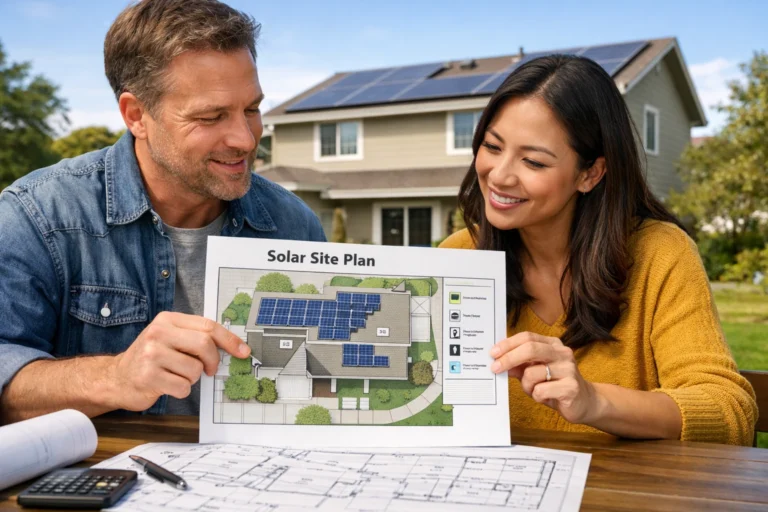
| Unsure about roof/shade | Site assessment + shading plan before sizing |
| Budget limited | Efficiency upgrades + right-sized grid-tied solar |
This keeps your planning focused and prevents overspending.
When to consult a professional (important)
Solar involves electrical and structural work. Consult a qualified installer/electrician/engineer if:
- Your roof needs reinforcement or major repairs
- You want backup power for critical circuits (battery or generator integration)
- You have complex shading, multiple roof sections, or older electrical panels
- Your area requires permits/utility interconnection
- You’re considering off-grid systems
This guide is for education and planning—not a substitute for professional design.