
Quick answer: what a solar AC disconnect is
A solar AC disconnect is a shutoff device installed on the AC side of a solar system so the system can be isolated from the home and/or utility service equipment. In plain English, it is often the extra box near the meter, main panel, or other service equipment that lets qualified people separate the solar power source from the utility connection point.
For homeowners, the most important thing to know is this: a solar AC disconnect is not automatically required in the exact same form everywhere. Some systems have one because of utility interconnection rules, some because of local design choices, and some because a visible-open lockable disconnect is specifically required by the serving utility or local authority. Source: utility interconnection manuals and municipal PV requirements show visible-open, lockable disconnect requirements in some jurisdictions. :contentReference[oaicite:7]{index=7}
Safety note (USA): This guide is for homeowner education and quote review only. Do not open enclosures, operate unfamiliar disconnects under load, or attempt solar electrical work yourself.
What a solar AC disconnect actually does
Your solar system has a few different “control” and “protection” layers. The AC disconnect’s job is simple: it provides a defined means of isolating the solar system from other electrical equipment on the AC side.
In real projects, that can help with:
- utility access during interconnection and service,
- maintenance and troubleshooting,
- inspection and labeling compliance,
- clear system isolation for emergency or field personnel where local rules require it.
Source: utility and local interconnection documents commonly describe a visible, lockable disconnect intended to isolate the generating facility from the distribution system. :contentReference[oaicite:8]{index=8}
Solar AC disconnect vs rapid shutdown vs main breaker
This is the part that confuses most homeowners. These terms are related to solar safety, but they do different jobs.
| Item | What it does | Where homeowners notice it | Why it matters |
|---|---|---|---|
| Solar AC disconnect | Isolates the solar system on the AC side from other electrical equipment | Often an exterior box near service equipment or meter | May be required by utility/interconnection rules or local design |
| Rapid shutdown | Reduces defined rooftop PV conductor hazards for firefighter/service safety | Labels, shutdown switch, equipment design notes | Rooftop solar safety / code compliance |
| Main service disconnect | Shuts off service to the home or major service equipment | Main breaker / service disconnect | Whole-home electrical shutoff, not a solar-specific substitute in every case |
Rapid shutdown and AC disconnect are especially easy to mix up. SolarBasicsHub’s rapid shutdown article already explains that rapid shutdown is a rooftop hazard-reduction function, while enforcement depends on local adoption and AHJ interpretation. That is different from a utility-visible AC disconnect requirement tied to interconnection or utility access. Source: local adoption and AHJ interpretation matter for solar safety rules; utility manuals separately require visible-open lockable disconnects in some cases. :contentReference[oaicite:9]{index=9}
Related reading: https://solarbasicshub.com/solar-rapid-shutdown-explained/
Why some solar systems have an AC disconnect and some do not
The short version: because solar rules are layered.
Your final design can be affected by:
- the electrical code adopted in your state/city,
- your AHJ (authority having jurisdiction),
- your utility’s interconnection handbook or tariff,
- the equipment architecture being installed,
- whether storage/backup equipment is included.
Source: SEIA consumer-protection terminology notes the AHJ is the local authority responsible for permitting and approval; utility handbooks and municipal PV requirements show additional disconnect requirements may be imposed at the local/utility level. :contentReference[oaicite:10]{index=10}
1) Code side
Solar systems need disconnecting means, but the exact field implementation you see on a house depends on how the project is designed and approved. That is why two apparently similar homes can end up with slightly different disconnect hardware or locations. :contentReference[oaicite:11]{index=11}
2) Utility interconnection side
This is where many homeowner surprises happen. Some utilities still want a visible-open, lockable AC disconnect that utility workers can identify and isolate easily. Utility and local documents I found explicitly describe requirements such as visible blades, lockable-open position, and placement within sight of service equipment. :contentReference[oaicite:12]{index=12}
3) Equipment architecture side
Modern equipment can change how the system is controlled, but it does not automatically erase every utility requirement. Enphase’s current technical documents still discuss system shutdown switches and visible-blade disconnect scenarios, which is a good reminder that field requirements are often more practical and jurisdiction-specific than broad online summaries suggest. :contentReference[oaicite:13]{index=13}
Related reading: https://solarbasicshub.com/string-inverter-vs-microinverter/
What “visible open” and “lockable open” mean in plain English
These are the two phrases that show up most often in utility/interconnection language.
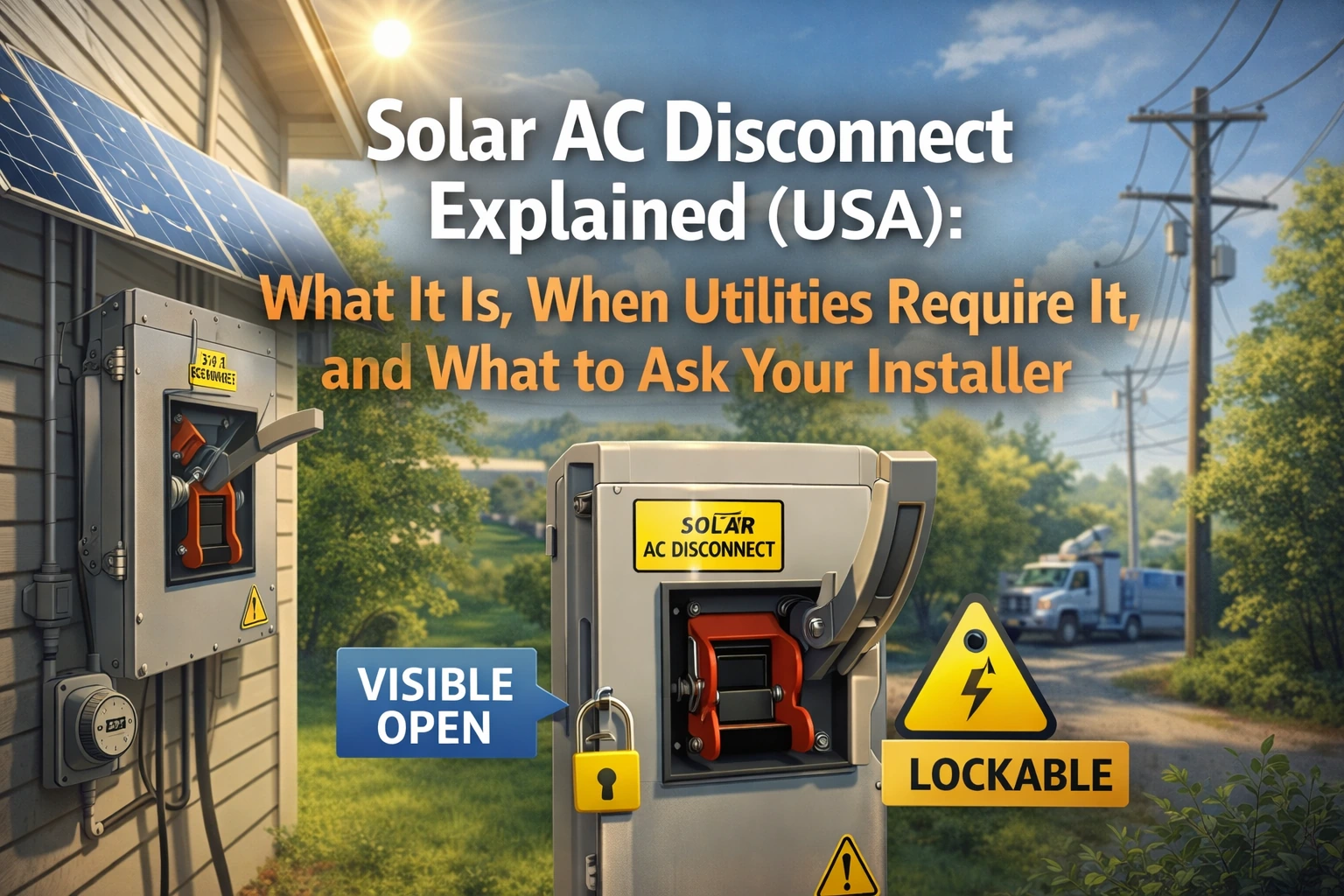
- Visible open means someone can clearly confirm the disconnect is physically open, not just trust a small handle position.
- Lockable open means the disconnect can be secured in the open position so it cannot be re-energized casually while someone is working.
That is why some utility documents specifically reference visible-blade disconnects or manual disconnect devices that can be padlocked open. :contentReference[oaicite:14]{index=14}
Where the disconnect is usually installed
On many U.S. homes, the solar AC disconnect is placed outside near the meter, service equipment, or main panel area so inspectors and utility personnel can access it easily. Exact placement varies by local rule, site layout, and equipment arrangement.
Some local documents specify that utility AC disconnects be within sight of the electrical service and sometimes within a defined distance. That is one reason installers often place this hardware in a location that looks awkward to homeowners: they may be satisfying a local rule rather than a visual preference. :contentReference[oaicite:15]{index=15}
What it looks like in your quote or plan set
Installers do not always label this clearly for homeowners. You may see it described as:
- AC disconnect
- PV AC disconnect
- utility disconnect switch
- visible open disconnect
- knife-blade disconnect
- service disconnecting means (in some contexts, though that can refer to a different function)
If the quote only says “electrical BOS” or “required disconnects as needed,” ask for the exact device and reason in writing.
Does a solar AC disconnect add cost?
Usually yes, but the cost impact is often less about the switch itself and more about the full electrical scope around it: enclosure rating, wire routing, conduit, labeling, labor, and whether service equipment is crowded or far from the interconnection point.
In homeowner terms, this can show up as:
- a modest electrical adder,
- a broader “service equipment / interconnection” line item,
- part of a larger package with surge protection, meter-main work, or panel changes.
That is why you should not compare quotes by total price only. Require the electrical scope in writing and compare line by line.
Related reading: https://solarbasicshub.com/how-to-compare-solar-quotes-line-by-line/
Related reading: https://solarbasicshub.com/main-panel-upgrade-for-solar/
When a disconnect is more likely vs less likely
| Your situation | More likely to see a disconnect? | Why |
|---|---|---|
| Utility explicitly requires visible-open switch | Yes | Utility interconnection rules can override homeowner expectations |
| Simple residential system in an area with streamlined approval | Sometimes not | Local approval pathway and equipment design may differ |
| Backup/storage system with additional control equipment | Maybe | Design complexity and utility preference can increase |
| Older or crowded service equipment | More likely to have visible added scope | Interconnection layout may require extra hardware or rework |
What homeowners should ask before signing
This is the most useful part of the article for real-world quote review.
Copy/paste checklist
- Do I need a solar AC disconnect for my utility and AHJ, or is it just your standard company design?
- If yes, what exact rule or utility requirement is driving it?
- What is the exact model and type: standard AC disconnect, visible-blade switch, or other?
- Where will it be installed?
- Can you show it on the site plan or single-line diagram?
- Is it included in the quoted price, or listed as an adder?
- Does it affect surge protection, panel work, or meter/service layout?
- If my utility does not require it, why are you recommending it anyway?
- Who confirms final compliance: you, the AHJ, or the utility?
- Will the final installed system match the approved interconnection plan exactly?
If the installer cannot answer those questions clearly, that is not automatically a dealbreaker, but it is a sign the electrical scope may not be well explained to the homeowner yet.
Red flags homeowners should not ignore
- Red flag 1: The proposal includes a vague electrical allowance with no mention of disconnect type or location.
- Red flag 2: The salesperson says rapid shutdown means no other disconnect questions matter.
- Red flag 3: The installer cannot say whether the disconnect is being required by the utility, the AHJ, or their own standard practice.
- Red flag 4: The disconnect cost appears after contract signing as a change order.
- Red flag 5: The system design shows service-equipment work, but no one has explained how the utility interconnection point is being handled.
Related reading: https://solarbasicshub.com/solar-permits-inspection-interconnection-pto/
Common homeowner misunderstandings
“If I have rapid shutdown, I do not need to care about an AC disconnect.”
Not necessarily. Rapid shutdown and AC disconnects can both appear on the same project because they solve different problems. :contentReference[oaicite:16]{index=16}
“If my neighbor does not have one, I will not need one either.”
Not necessarily. Utility territory, approval date, equipment design, and local rules can all change the final requirement. :contentReference[oaicite:17]{index=17}
“It is just an ugly box, so I can ask to delete it later.”
Do not assume that. If it was part of the approved design or required for interconnection, removing or altering it can create inspection, utility, warranty, or safety problems. Use licensed professionals and get written approval before any changes.
Decision table: how to handle it in a quote review
| If you see this | What it probably means | What to do |
|---|---|---|
| “Utility-visible AC disconnect included” | Utility/interconnection requirement is likely driving design | Ask for utility rule reference and installed location |
| “Disconnect as required” | Scope is not fully defined yet | Ask for model, type, and allowance before signing |
| “Rapid shutdown compliant” with no other explanation | Rooftop safety function is being described, not full interconnection scope | Ask separately about AC disconnect and utility requirements |
| Change order after approval | Site or utility review found added scope | Request revised single-line and itemized cost breakdown |
FAQ
1) What is a solar AC disconnect?
It is a device that isolates the solar system on the AC side from the rest of the electrical system or utility interconnection point.
2) Is a solar AC disconnect the same as rapid shutdown?
No. Rapid shutdown addresses rooftop PV hazard reduction in defined parts of the system. An AC disconnect isolates the AC-side solar connection. They are related safety/interconnection concepts, but not the same thing. :contentReference[oaicite:18]{index=18}
3) Do all residential solar systems need one?
No single national homeowner rule works for every project. Requirements can vary by utility, AHJ, local adoption, and system design. :contentReference[oaicite:19]{index=19}
4) Why does my utility want a visible blade disconnect?
Because some utility programs want a manual disconnect that is clearly visible when open and lockable for field safety and service isolation. :contentReference[oaicite:20]{index=20}
5) Where is it usually installed?
Often outside near the service equipment, meter, or main electrical area, depending on local requirements and the approved plan. :contentReference[oaicite:21]{index=21}
6) Does it increase system cost?
Usually somewhat, but the real impact depends on total electrical scope, not only the switch itself.
7) Can I operate or remove it myself?
No homeowner DIY is recommended here. Use licensed professionals and follow installer, utility, and local-authority instructions.
8) What is the safest way to compare quotes when disconnect hardware is involved?
Ask for the exact model, location, reason, and cost in writing. Then compare the full electrical scope line by line.
Next to Read
- https://solarbasicshub.com/solar-rapid-shutdown-explained/
- https://solarbasicshub.com/solar-permits-inspection-interconnection-pto/
- https://solarbasicshub.com/main-panel-upgrade-for-solar/
- https://solarbasicshub.com/how-to-compare-solar-quotes-line-by-line/
- https://solarbasicshub.com/string-inverter-vs-microinverter/
- https://solarbasicshub.com/solar-surge-protection-explained/