
If you are comparing solar quotes for the first time, you will probably see the phrase monocrystalline vs polycrystalline solar panels. Both are proven photovoltaic (PV) technologies that turn sunlight into electricity, but they can differ in efficiency, appearance, roof-space needs, availability, and value.
The short answer: monocrystalline solar panels are usually the better fit for most USA homeowners today, especially when roof space is limited. Polycrystalline panels can still make sense when the price is clearly lower, the roof has enough usable space, and the exact panel model has strong warranty and performance terms.
But the label alone is not enough. A high-quality polycrystalline panel can be a better purchase than a weak monocrystalline panel. The smart homeowner decision is to compare the exact model, the expected annual kWh production, the temperature coefficient, the warranty, and the installed cost—not just the crystal type.
Quick Answer: Which Solar Panel Type Should You Choose?
Choose monocrystalline if your roof space is limited, you want a cleaner dark-black appearance, or the quote price is close to a polycrystalline option. Because mono panels usually deliver more watts from a similar roof area, they often help homeowners fit more system capacity on a smaller or more complicated roof.
Choose polycrystalline only if the savings are meaningful, your roof has plenty of sunny usable space, and the specific panel model is backed by a solid product warranty and performance warranty.
For beginners, the safest rule is this: compare total system value, not just panel type. A quote with a slightly lower-efficiency panel may still win if it produces enough energy, costs less, uses a reliable inverter, includes strong workmanship coverage, and fits your roof well.
Before you choose, it helps to understand how a solar system is sized. Read the SolarBasicsHub guide to solar system components and sizing basics if you want a simple planning method before comparing quotes.
Monocrystalline vs Polycrystalline Solar Panels: Comparison Table
| Feature | Monocrystalline Solar Panels | Polycrystalline Solar Panels | Homeowner Takeaway |
|---|---|---|---|
| Cell material | Made from a single-crystal silicon structure | Made from multiple silicon crystal fragments | Both use silicon PV cells; the manufacturing structure is different |
| Typical efficiency | Usually higher | Usually lower | Mono is often better when roof space is tight |
| Roof space needed | Less area for the same system size | More area for the same system size | Roof layout can decide the winner |
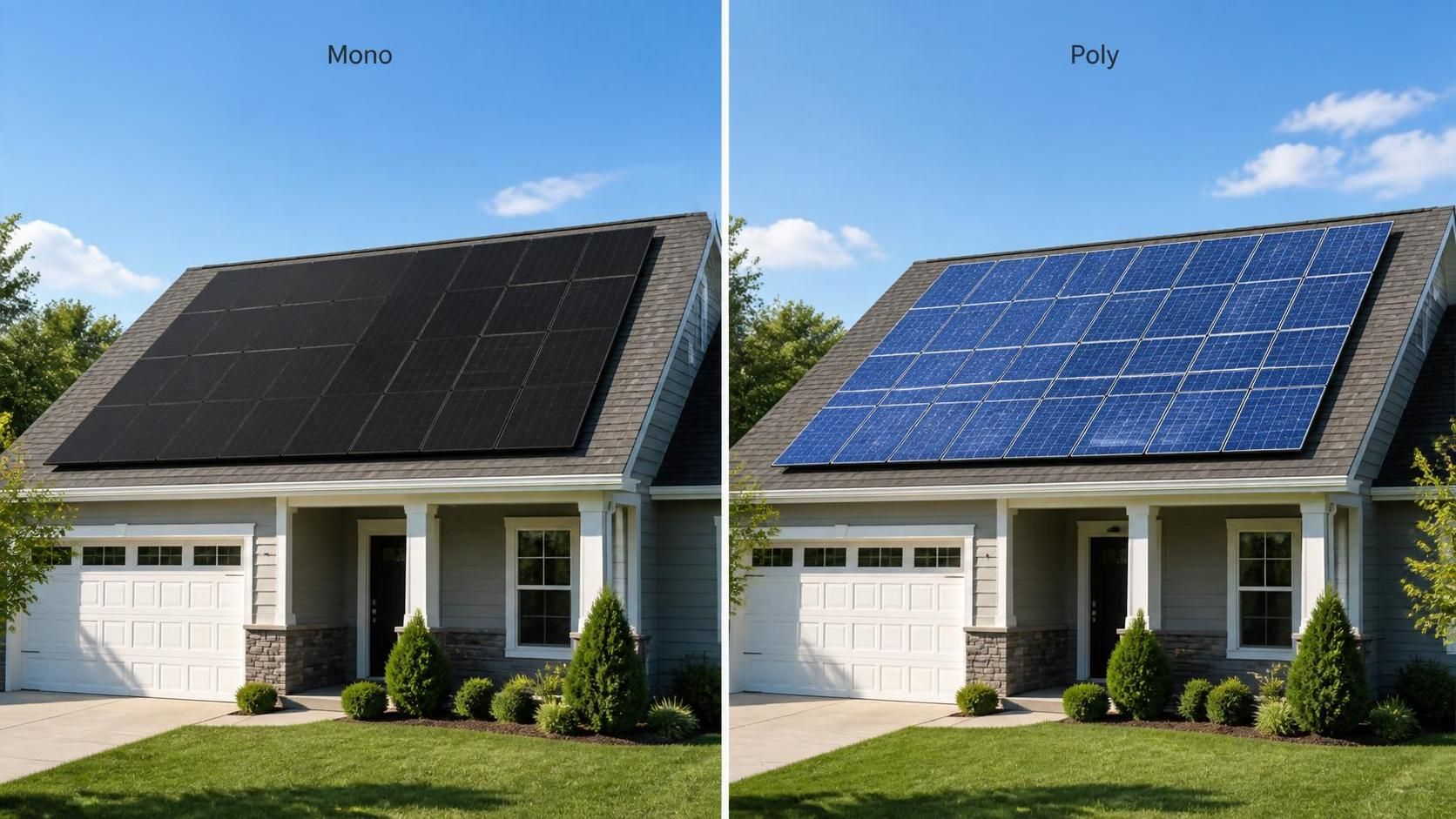
| Appearance | Often black and more uniform | Often blue-speckled | Mono usually has the cleaner curb appeal |
| Heat performance | Depends on the exact model | Depends on the exact model | Check the temperature coefficient, not just the panel type |
| Best fit | Limited roof space, premium appearance, higher output density | Budget-focused systems with plenty of usable roof space | Use the quote’s kWh estimate to confirm value |
Use this table as a starting point, not a final decision. The best choice depends on your roof layout, quote details, local sunlight, inverter design, and the total installed cost after incentives.
What Is a Monocrystalline Solar Panel?
A monocrystalline solar panel uses solar cells made from a single-crystal silicon structure. In simple terms, the silicon is more uniform, which usually helps the cell convert sunlight into electricity more efficiently.
For homeowners, the technical manufacturing details matter less than the practical result: mono panels often provide more power from the same roof area. That can be valuable if your roof has vents, chimneys, dormers, shade, fire setbacks, or only one strong sun-facing section.
Monocrystalline panels are also popular because they often have a darker, more uniform look. If curb appeal matters, many all-black mono modules look cleaner on a residential roof than older blue-speckled panel designs.
What Is a Polycrystalline Solar Panel?
A polycrystalline solar panel uses cells made from multiple silicon crystal fragments. These panels have historically been known for a bluish, speckled appearance and somewhat lower efficiency compared with many monocrystalline options.
That does not mean polycrystalline panels are “bad.” If the system is well designed, the roof has enough space, and the installed price is attractive, a polycrystalline system can still produce useful energy for many years. The key is to compare the exact panel model and the expected annual production, not just the category name.
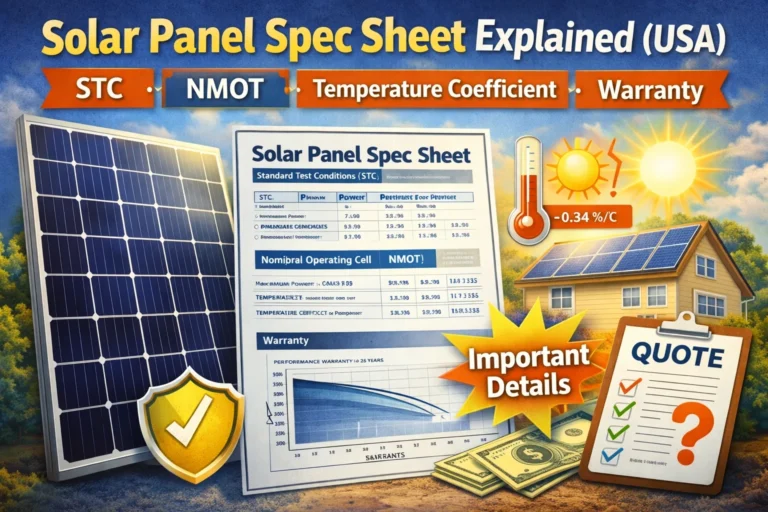
For a deeper explanation of module ratings and datasheets, use the SolarBasicsHub guide to solar panel spec sheets.
The Main Difference: Efficiency and Roof Space
Solar panel efficiency tells you how much sunlight a panel converts into electricity at the module level. Higher efficiency is not automatically “better” for every budget, but it becomes important when roof space is limited.
Imagine two panels with a similar physical size. If one panel has higher efficiency, it can usually fit more watts into that same area. That may allow the installer to design a larger kW system on your roof or use fewer panels to reach a similar system size.
This is why monocrystalline panels usually have an advantage for many USA homes. Residential roofs are rarely perfect rectangles. Shading, plumbing vents, skylights, roof hips, roof valleys, setbacks, and local fire-access rules can reduce usable space. In those cases, higher output per panel can make the design easier.
If your roof has plenty of sunny space, efficiency becomes less decisive. A slightly lower-efficiency system may still reach your energy goal if it can simply use more panels at a lower installed cost.
Why the “Best Panel” Depends on Your Roof
The best solar panel type is not the one with the most impressive brochure. It is the one that produces the right amount of energy on your roof at a fair price.
Before choosing between mono and poly, look at three roof questions:
- How much usable sunny space do you have? Limited space usually favors higher-efficiency mono panels.
- How much shade hits the array? Shade can reduce real output and may affect inverter choices.
- Is your roof ready for a long-life solar system? An older roof may need inspection before installation.
For shading decisions, read Solar Panel Shading Explained. For roof timing, read Do You Need a New Roof Before Solar Panels?.
Cost and Value: Do Monocrystalline Panels Save More Money?
Not always. Monocrystalline panels may produce more power per square foot, but that does not automatically mean they save more money. The real question is whether the extra production or better warranty justifies the extra installed cost.
Ask your installer to show the difference in annual kWh, not just the difference in watts. For example, if the mono option costs more but only adds a small amount of annual production on a large roof, the payback improvement may be weak. But if the mono option lets you fit a larger system on a small roof, it may create a real long-term advantage.
A useful homeowner calculation is:
- Compare installed cost: What is the total price difference between the two quotes?
- Compare annual production: How many extra kWh per year does the higher-priced option estimate?
- Compare durability: Are the product warranty, performance warranty, and degradation terms meaningfully better?
For a line-by-line cost view, use Solar Cost Breakdown. To estimate production, use the SolarBasicsHub guide to NREL PVWatts solar production estimates.
When you compare quotes, always ask for the same financial assumptions on both options. Otherwise, a quote can make one panel look better simply by using a different savings model.
Heat, Temperature Coefficient, and Real-World Output
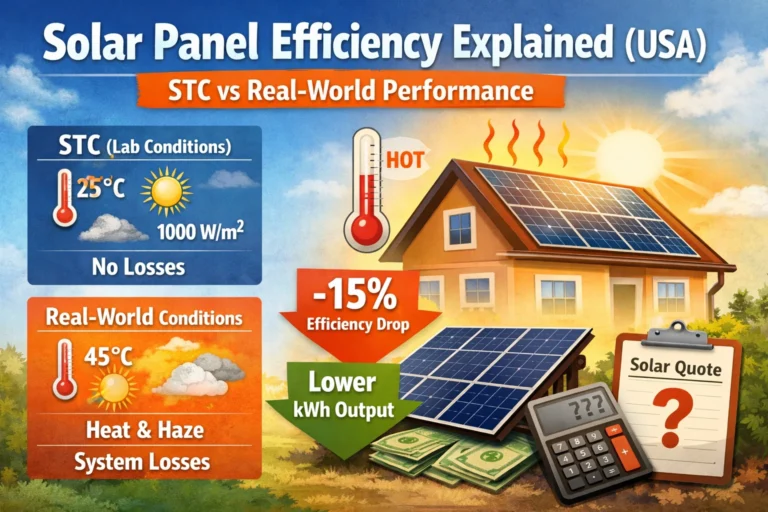
Solar panels are rated under lab conditions, but real rooftops are not laboratories. The U.S. Department of Energy and NREL explain that PV module ratings use Standard Test Conditions, including 1,000 W/m² of sunlight and 25°C cell temperature. In practice, sunlight varies and rooftop cells are often hotter than 25°C.
That is why the temperature coefficient matters. It tells you how much panel output drops as cell temperature rises above the reference condition. A less negative number is generally better. For example, a panel with -0.30%/°C loses less power in heat than one with -0.40%/°C, all else equal.
Do not assume monocrystalline always wins in heat just because it is mono. Compare the exact datasheets. A strong panel model, good roof ventilation, good design, and realistic production modeling matter more than a simple label.
Warranties and Degradation: What to Compare
Solar panels slowly lose a small amount of output over time. This is called degradation. A performance warranty describes how much output the manufacturer expects the panel to retain after many years. A product warranty is different: it covers defects in materials or workmanship for the panel itself.
When comparing mono vs poly quotes, do not stop at “25-year warranty.” Ask what kind of warranty it is, what output is guaranteed after 25 years, what the annual degradation schedule looks like, and who handles a claim if something goes wrong.
Use this simple checklist:
- Exact panel manufacturer and model number
- Product warranty length
- Performance warranty length and final-year output guarantee
- Annual degradation rate shown in the warranty document
- Labor, shipping, removal, and reinstall exclusions
- Installer workmanship warranty for the full system
For a beginner-friendly explanation, read Solar Panel Warranty Explained.
Which Type Looks Better on a Home?
Appearance is not the most important performance factor, but it matters to many homeowners. Monocrystalline panels often look black and more uniform. Many modern residential systems use all-black modules with black frames for cleaner curb appeal.
Polycrystalline panels often look bluer and more speckled. Some homeowners do not mind this, especially if the roof is not visible from the street. Others prefer the cleaner look of mono panels, especially on front-facing roof planes.
There is no right answer here. Appearance is personal. Just avoid paying a major premium for looks unless you are comfortable with the total value of the quote.
Quote Checklist: How to Compare Mono and Poly Offers
Use this checklist when an installer offers two panel options:
- What is the exact panel model number for each option?
- What is the system size in kW for each design?
- How many panels fit on the usable roof area?
- What annual kWh production is estimated for each option?
- What assumptions were used for shading, roof direction, tilt, and losses?
- What is the temperature coefficient for each panel?
- What are the product and performance warranty terms?
- What is the total installed cost difference?
- Does the more expensive panel reduce panel count, improve layout, or meaningfully increase annual production?
- If the panel model changes before installation, will the quote and production estimate be updated in writing?
If the installer cannot give exact model numbers and datasheets, treat that as a red flag. You do not need to become an engineer, but you do need enough documentation to compare real equipment.
Common Myths About Monocrystalline and Polycrystalline Panels
Myth 1: Polycrystalline panels are always bad
False. Polycrystalline panels can still work well when the model is reliable, the roof has enough space, and the installed price is attractive.
Myth 2: Monocrystalline panels are always worth the premium
False. If your roof has plenty of space and the production difference is small, a premium mono upgrade may not pay for itself.
Myth 3: Higher efficiency always means higher savings
False. Efficiency helps with space. Savings depend on energy production, local electricity rates, net metering or net billing rules, incentives, financing, and installed cost.
Myth 4: Panel type matters more than shading
False. Shading and system design can have a major impact on real-world output. In some cases, inverter type and roof layout matter more than mono vs poly.
If your roof has shade or multiple directions, also compare inverter options in String Inverter vs Microinverter.
Best Choice by Homeowner Scenario
| Homeowner Situation | Better Starting Point | Why |
|---|---|---|
| Small roof with limited sunny space | Monocrystalline | Higher output per square foot helps fit more capacity |
| Large roof with plenty of sunny space | Compare both | Lower-cost panels may still meet the energy goal |
| Front-facing roof where appearance matters | Monocrystalline | All-black designs often look cleaner |
| Very budget-focused quote | Compare installed cost per estimated kWh | The lowest panel price is not always the lowest lifetime cost |
| Hot climate | Compare exact datasheets | Temperature coefficient beats the label |
| Complex roof with shade or multiple orientations | Mono plus careful inverter/layout review | Efficiency helps, but design drives output |
FAQ: Monocrystalline vs Polycrystalline Solar Panels
Are monocrystalline solar panels better than polycrystalline?
Usually, monocrystalline panels are more efficient and a better fit for homes with limited roof space. But “better” depends on the exact model, installed cost, warranty, roof layout, and expected annual kWh production.
Are polycrystalline solar panels outdated?
They are less common in many residential quotes than they used to be, but they are not automatically wrong. A polycrystalline option can still make sense if it is priced well and the roof has enough space.
Do monocrystalline panels produce more electricity?
They often produce more electricity per square foot because they are usually more efficient. However, total system production depends on system size, roof direction, shading, inverter design, local weather, and equipment quality.
Which type is better for hot climates?
Do not choose by panel type alone. Compare the temperature coefficient on the datasheet. A less negative temperature coefficient usually means the panel loses less output as it gets hotter.
Which type lasts longer?
Longevity depends on manufacturer quality, materials, installation quality, weather exposure, and warranty terms. Compare the exact product warranty and performance warranty instead of assuming one type always lasts longer.
Should I pay more for high-efficiency panels?
Pay more only when the value is clear. High-efficiency panels are most useful when roof space is limited or the higher-output design meaningfully improves annual kWh production. If space is abundant, the premium may not be worth it.
Conclusion: Focus on the Exact Panel, Not Just the Label
For most USA homeowners, monocrystalline solar panels are usually the stronger starting choice because they tend to offer higher efficiency, better roof-space use, and a cleaner appearance. They are especially useful when you need to maximize production from limited roof area.
Polycrystalline panels can still be a reasonable option when the system has plenty of usable roof space and the price advantage is real. The mistake is choosing only by label. Instead, compare the exact panel model, annual kWh estimate, roof layout, temperature coefficient, warranties, and total installed cost.
The best solar quote is not the one that says “mono” or “poly.” It is the one that gives you the most reliable long-term energy value for your roof, your budget, and your goals.
Sources Mentioned
- U.S. Department of Energy / NREL — PV system performance references for STC ratings, temperature effects, degradation, and real-world production factors.
- Energy.gov — Solar photovoltaic technology basics and homeowner solar guidance.
- IEC standards references commonly used in PV module testing, safety, and performance documentation.