
Outline
- Quick answer: what load-side vs supply-side means
- Where each connection happens in your electrical system
- Load-side solar interconnection explained
- Supply-side solar interconnection explained
- Load-side vs supply-side comparison table
- When a main panel upgrade is needed instead
- AC disconnect, rapid shutdown, and transfer switch: what they are not
- What to ask your installer before approving the design
- FAQ
- Next to Read
Safety note (USA): This guide is for homeowner education, quote comparison, and planning. It does not include wiring steps or permit instructions. Do not open panels, move breakers, or attempt service-conductor work yourself. Use licensed solar/electrical professionals and follow utility and AHJ requirements.
Quick answer: what load-side vs supply-side means
When a solar system connects to your home, the installer has to choose a point of interconnection—the place where solar output joins your electrical system.
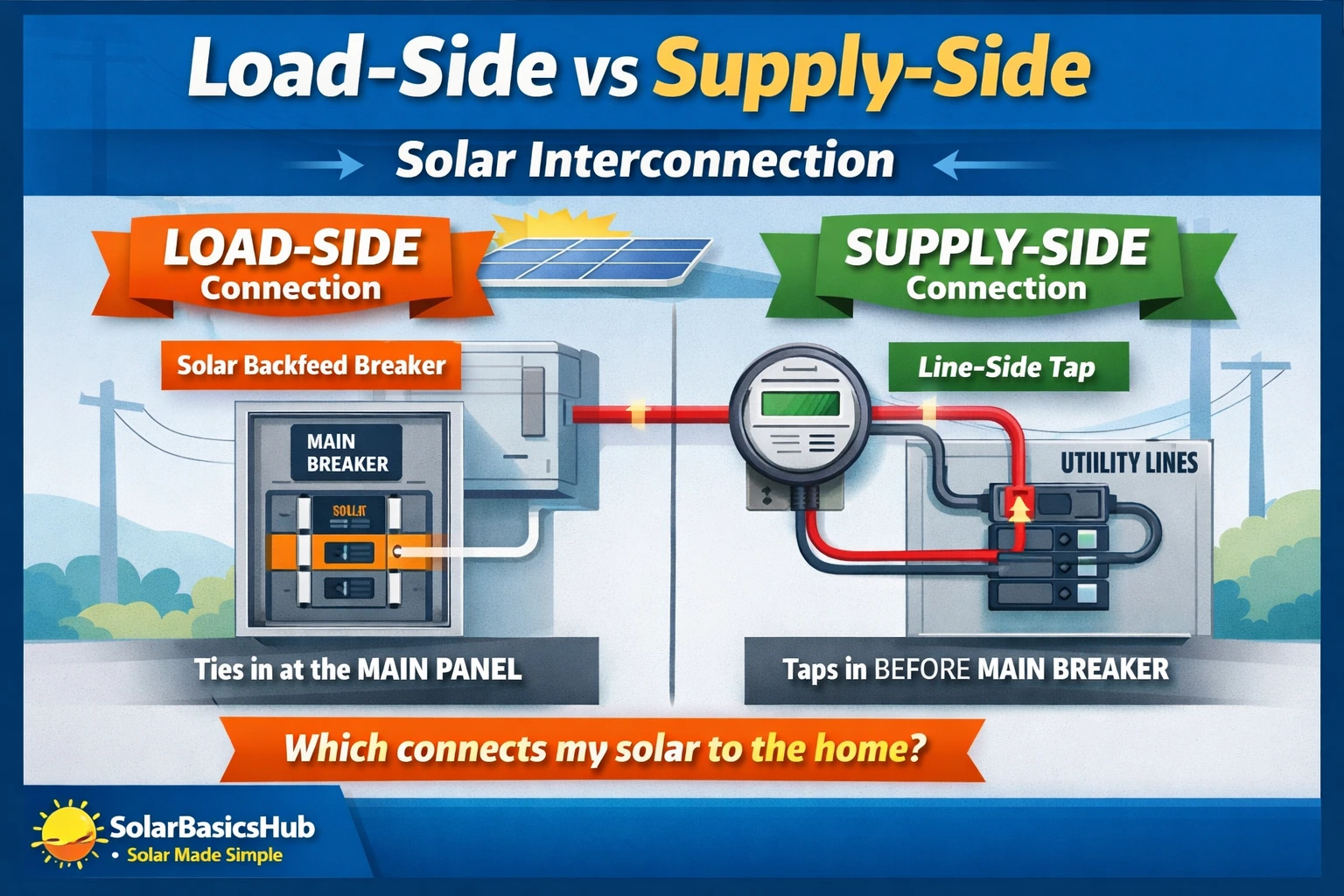
Load-side connection usually means the solar system connects on the panel side of the main disconnect, often through a dedicated solar backfeed breaker in your main panel or a downstream panel.
Supply-side connection usually means the solar system connects on the utility side of the main service disconnect. In installer language, you may also hear line-side tap or sometimes hard tap.
For most homeowners, the practical difference is simple:
- Load-side is often simpler when your panel has enough capacity for the solar breaker.
- Supply-side is often considered when your proposed solar system would push past load-side panel limits.
That does not automatically mean one is “good” and the other is “bad.” It means the installer is solving a design constraint involving your service equipment, utility rules, and inspection path.
Where each connection happens in your electrical system
It helps to picture four major landmarks:
- Utility meter – measures energy flow to and from the grid
- Main service disconnect / main breaker – lets the home be disconnected from utility service
- Main panel / load center – where branch circuits and breakers are located
- Solar point of interconnection – where solar output ties in
In many homes, a load-side solar connection lands at a breaker in the main panel. In a supply-side arrangement, the connection is made before that main disconnecting means, closer to the service conductors.
This is why quotes sometimes change after the installer reviews your existing service equipment. From the outside, two homes can look similar, but one may have a panel that supports a straightforward breaker interconnection while the other may require a supply-side design or a panel upgrade.
If you want background on how solar fits into the bigger electrical picture, start here: https://solarbasicshub.com/solar-basics-how-solar-power-works/
Load-side solar interconnection explained
What homeowners usually see
In a load-side setup, your solar inverter output typically feeds a dedicated breaker in a panelboard. Homeowners may hear this called a:
- solar backfeed breaker
- PV breaker
- breaker connection
- panel interconnection
This is a common residential approach because it is familiar to inspectors and often cleaner to explain on the one-line diagram.
Why the 120% rule comes up so often
If your installer mentions the 120% rule, they are usually talking about a common load-side sizing constraint involving the panel bus rating, the main breaker, and the solar breaker.
For example, a 200A bus with a 200A main does not automatically leave unlimited room for solar backfeed. That is why some quotes include one of these recommendations:
- use a smaller inverter / smaller AC output
- move the solar breaker to an allowed location
- use different service equipment
- choose a supply-side connection
- upgrade the panel or service equipment
For a homeowner, the important takeaway is not the code math itself. It is this: your main panel can limit how much solar can be connected on the load side.
Related reading: https://solarbasicshub.com/main-panel-upgrade-for-solar/
When load-side is often the better fit
- Your existing service equipment supports the solar breaker layout.
- Your proposed solar AC output fits within panel constraints.
- You want a simpler inspection / utility path.
- Your installer wants to avoid extra service-equipment complexity.
In many straightforward residential projects, load-side is the simpler answer. But it is not always possible for the system size you want.
Supply-side solar interconnection explained
What a supply-side connection is
A supply-side connection ties solar into the service conductors on the utility side of the main disconnecting means. In practice, homeowners often hear this described as a line-side tap.
The reason this option exists is simple: it can avoid some of the load-side busbar limitations that come with breaker-based interconnection in the panel.
Why installers choose it
An installer may recommend a supply-side connection when:
- the existing panel is too limiting for the proposed solar breaker size
- downsizing the solar system would hurt production goals too much
- a full main-panel upgrade would cost more than the supply-side approach
- the project already involves service equipment changes or meter-main work
That does not mean supply-side is a shortcut. In many cases, it can mean more design care, utility review, labeling, and disconnect requirements—not less.
Why supply-side can trigger extra questions
Because the interconnection is made on the supply side of the service disconnect, utilities and AHJs often look very closely at:
- service-equipment configuration
- disconnecting means
- placarding / labeling
- accessibility
- whether a visible-open lockable disconnect is required by that utility
This is why homeowners sometimes see a quote change from “simple breaker connection” to “supply-side tap plus exterior disconnect and service modifications.”
If your quote includes an exterior utility-facing disconnect, read: https://solarbasicshub.com/solar-ac-disconnect-explained/
Load-side vs supply-side: pros, cons, and homeowner tradeoffs
| Factor | Load-Side Connection | Supply-Side Connection |
|---|---|---|
| Where solar ties in | On the panel/load side of the main disconnect, often by breaker | On the utility/service side of the main disconnect |
| Common homeowner term | Solar backfeed breaker | Line-side tap / supply-side tap |
| Typical advantage | Simpler, familiar residential approach | Can avoid certain load-side panel limits |
| Typical limitation | May be constrained by panel bus and breaker ratings | May involve more service-equipment complexity |
| Utility / inspection complexity | Often lower | Often higher, depending on utility/AHJ |
| May require exterior AC disconnect | Sometimes | Sometimes, and in some territories more likely |
| Best when | Your panel can support the design cleanly | You need more solar than the panel can support on a breaker-based connection |
Which one is cheaper?
There is no universal answer.
Load-side is often cheaper when your existing panel supports it cleanly.
Supply-side can be cheaper than a full panel upgrade in some homes—but not always. If it requires service-equipment changes, exterior disconnect hardware, meter-main modifications, or extra utility coordination, the price can rise quickly.
This is why you should never compare quotes based only on total price. Compare the interconnection method being proposed and ask the installer to explain why they selected it.
When a main panel upgrade is needed instead
Some homeowners assume the choice is only:
- load-side breaker, or
- supply-side tap
Real projects often have a third answer: main panel or service equipment upgrade.
A true upgrade may still be the best path when:
- the existing panel is old, crowded, or in poor condition
- the service equipment is not suitable for the proposed solar/battery design
- you want future expandability for battery backup, EV charging, or added loads
- the utility/AHJ does not like the proposed supply-side configuration
- you are already doing major electrical modernization
Related: https://solarbasicshub.com/main-panel-upgrade-for-solar/
AC disconnect, rapid shutdown, and transfer switch: what they are not
This topic gets confusing because homeowners hear several terms at once.
Interconnection method
This article is about where solar ties into the electrical system—load-side vs supply-side.
AC disconnect
An AC disconnect is a shutoff/isolation device on the AC side. It is not the same thing as choosing load-side vs supply-side interconnection, even though the two issues can appear in the same project.
Read: https://solarbasicshub.com/solar-ac-disconnect-explained/
Rapid shutdown
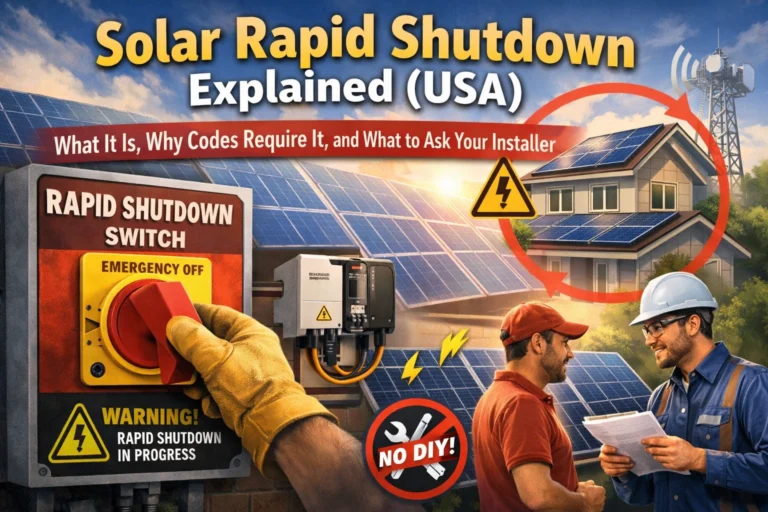
Rapid shutdown is a rooftop PV safety function related to reducing defined conductor hazards in specific situations. It is not your utility interconnection method.
Read: https://solarbasicshub.com/solar-rapid-shutdown-explained/
Transfer switch
A transfer switch is backup-power equipment used in systems designed to isolate loads during outages. It is not the same as the basic grid interconnection choice for a standard solar installation.
Read: https://solarbasicshub.com/solar-transfer-switch-explained/
What to ask your installer before approving the design
Copy/paste this into email or text:
- What is my proposed point of interconnection: load-side breaker or supply-side / line-side tap?
- Why did you choose that method for my home?
- What panel or service-equipment limitation drove that choice?
- If load-side was not selected, what prevented it?
- If supply-side was selected, what extra hardware, disconnects, or labeling does that add?
- Will this design require a utility-visible, lockable exterior AC disconnect?
- Would a smaller inverter or different design make load-side possible?
- Would a main panel upgrade be cleaner long term, and if so, what is the cost difference?
- How does this design affect future battery backup or EV charger expansion?
- Please show the interconnection method clearly on the one-line diagram and identify all disconnects.
Bottom line
Load-side vs supply-side solar interconnection is not “installer trivia.” It directly affects cost, permitting, utility review, future expandability, and whether your quote includes added disconnect or panel work.
For many homes, a load-side breaker connection is the cleaner, simpler path. But if your service equipment limits the design, a supply-side connection may be the way an installer preserves your desired system size without forcing an immediate full panel upgrade.
The best homeowner move is not to memorize code language. It is to ask one smart question:
“Why is this interconnection method the best fit for my specific panel, utility, and future plans?”
If the answer is clear, documented, and shown on the one-line diagram, you are in a much better position to compare quotes safely.
FAQ
1) Is load-side always better than supply-side?
No. Load-side is often simpler, but “better” depends on your existing panel, system size, utility requirements, and future plans.
2) Is a line-side tap the same as a supply-side connection?
In homeowner and installer conversation, usually yes. Terminology can vary, but they commonly refer to connecting solar on the supply side of the main disconnecting means.
3) Does supply-side mean my installer is cutting corners?
No. In some homes it is a legitimate design solution. What matters is whether it is allowed, properly engineered, utility-approved, and clearly documented.
4) Can a supply-side connection help avoid a panel upgrade?
Sometimes, yes. But not always. In other homes, the cleaner long-term answer is still a main panel or service-equipment upgrade.
5) Does this affect net metering or PTO?
It can affect the design and approval path, but PTO and net metering depend on utility/interconnection approval, metering, tariff rules, and final inspection completion.
6) Is this the same as an AC disconnect?
No. The interconnection method tells you where solar ties in. An AC disconnect is a separate isolation/shutoff device that may or may not be required depending on the design and utility rules.
7) Does battery backup automatically mean supply-side?
No. Battery projects can use different configurations depending on equipment, service layout, and backup design goals.
8) Should I approve a quote if I do not understand the interconnection method?
No. Ask for a plain-English explanation and a one-line diagram that shows the point of interconnection and all disconnects before signing.
Next to Read (internal links with exact URLs)
- Do You Need a Main Panel Upgrade for Solar?
- Solar AC Disconnect Explained
- Solar Rapid Shutdown Explained
- Solar PTO Meaning (Permits, Inspection, Interconnection)
- Solar Export Limits & Curtailment
- Do Solar Panels Work During a Power Outage?
- Solar Transfer Switch Explained
- Solar Basics: How Solar Power Works