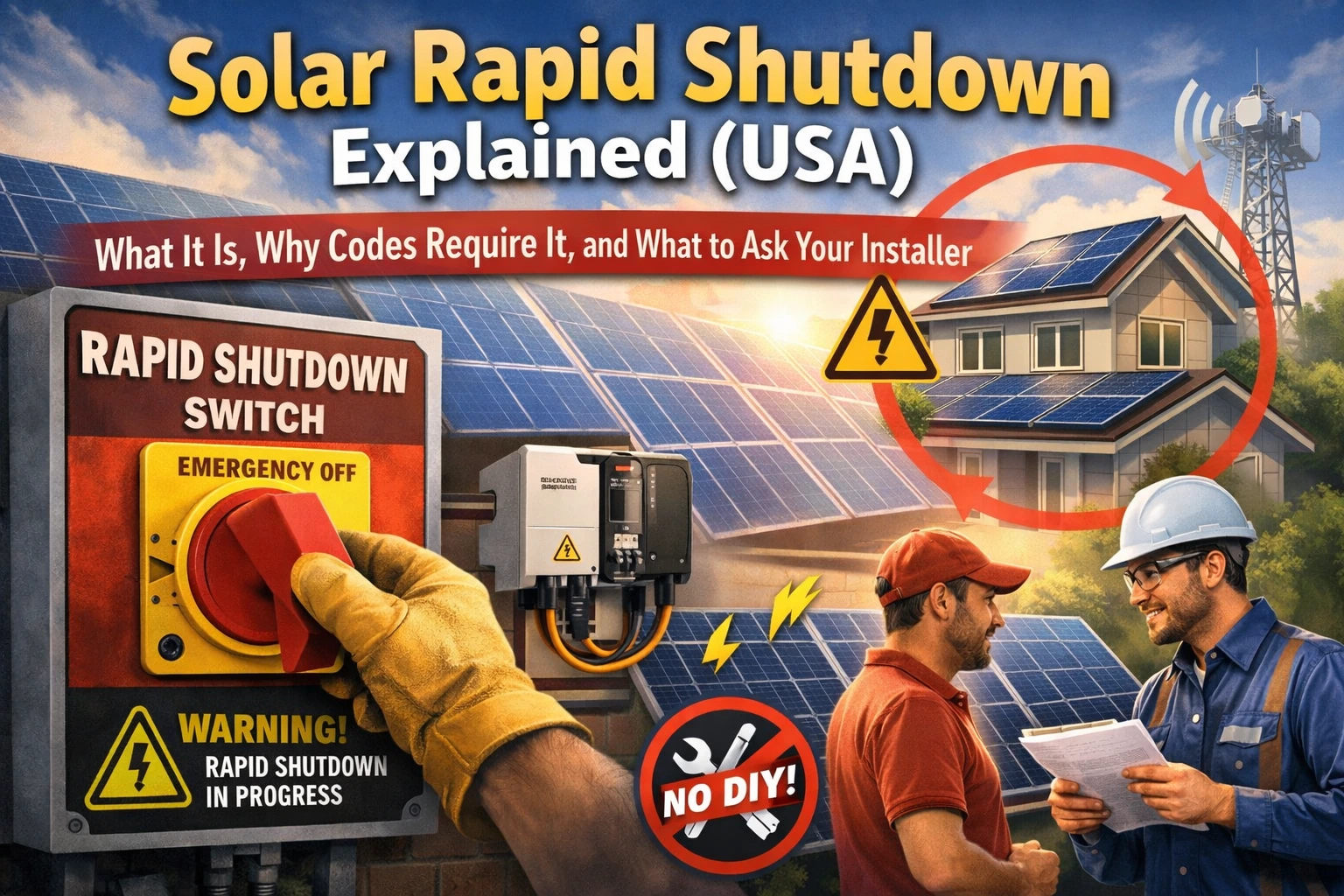

Quick answer: what “solar rapid shutdown” means
Solar rapid shutdown is a safety function used on many building-mounted (rooftop) solar systems in the USA. In an emergency (like a fire) or during certain service situations, it helps reduce voltage on specific solar conductors so first responders and qualified technicians face less shock risk on the roof and around the array.
Important reality check: Solar modules can be energized whenever light hits them, so rapid shutdown is about controlling/limiting hazardous voltages in defined parts of the system—not “making solar 100% dead everywhere.” Source: U.S. DOE notes rapid shutdown reduces risk by preventing current from traveling along conductors; it does not de-energize the PV semiconductor material itself. Source: https://www.energy.gov/femp/solar-photovoltaic-hardening-resilience-wildfire
Why rapid shutdown exists (firefighter + rooftop safety)
The key safety idea: PV makes power when the sun is out
Unlike many household circuits, solar DC wiring can remain energized in daylight whenever modules are producing. That’s why rooftop PV introduces unique hazards during emergencies and certain service work. Source: NREL explains PV modules are energized when exposed to light and systems must be arranged to enable quick disconnects/rapid shutdown. Source: https://docs.nrel.gov/docs/fy22osti/81594.pdf
Why “turn off the main breaker” isn’t the whole story
Shutting off your home’s main breaker can disconnect the house from the grid, but it doesn’t automatically guarantee that rooftop PV conductors are reduced to low voltage everywhere they might be encountered. Rapid shutdown requirements were created so emergency responders have a more predictable way to reduce shock hazards on or near PV arrays. Source: EnergySage overview of rapid shutdown as an NEC safety requirement for rooftop PV. Source: https://www.energysage.com/solar/rapid-shutdown-overview/
Do all solar homes need rapid shutdown in the USA?
Often yes for rooftop solar—but details depend on your local building/electrical code adoption and your Authority Having Jurisdiction (AHJ), plus system type (roof vs ground mount).
Rooftop vs ground-mount (why requirements can differ)
Many rapid shutdown requirements target PV systems on buildings because roof operations (firefighter access, ventilation, rescue) create different hazards than ground-mounted arrays. The U.S. Department of Energy notes that not all states require rapid shutdown and that the NEC allows certain ground-mounted systems to be exempt in some cases. Source: https://www.energy.gov/femp/solar-photovoltaic-hardening-resilience-wildfire
Local adoption matters (your city/utility decides what’s enforced)
The NEC is widely used, but enforcement depends on state/local adoption and AHJ interpretation. If you want the most homeowner-safe approach, treat rapid shutdown like permits/PTO: get confirmation in writing that the design meets your AHJ and utility requirements.
Related (SolarBasicsHub): Solar PTO Meaning (USA): Permits, Inspection, Interconnection & the Real Timeline
The 3 most common ways systems meet rapid shutdown
From a homeowner perspective, there are three “buckets” you’ll see in quotes. You do not need to memorize code text to compare them—you only need to understand what hardware approach the installer is using and whether it’s listed/approved for your jurisdiction.
1) Microinverters
With microinverters, each panel has its own inverter on the roof. Because DC runs are shorter and conversion happens at the module, many microinverter architectures are commonly used to meet rapid shutdown goals depending on the specific product listing and installation design. (Always confirm in writing that the system design meets your local code.)
Related (SolarBasicsHub): Power Optimizer vs Microinverter: What’s the Difference?
2) Power optimizers + a string inverter (hybrid MLPE)
Power optimizers sit at each panel and condition DC power before it goes to a central inverter. Many optimizer systems are designed so that, when shutdown is initiated, the optimizer output drops to a very low voltage per module, reducing string voltage along controlled conductors. Source: NREL O&M best practices describe optimizer behavior and rapid shutdown control concepts. Source: https://docs.nrel.gov/docs/fy19osti/73822.pdf
Related (SolarBasicsHub): Power Optimizer vs Microinverter
3) Rapid Shutdown Devices (RSDs) / module-level shutdown add-ons
Some designs use dedicated rapid shutdown devices installed near modules to reduce voltage when triggered. You’ll see this when installers want certain architectures while still meeting rooftop shutdown requirements. The key homeowner takeaway is the same: ask for the exact product model(s) and confirmation that the design meets your AHJ requirements.
Where the rapid shutdown switch is (and how it’s labeled)
Most homeowners will encounter rapid shutdown as:
- A labeled initiation switch (or labeled means of initiating shutdown), and
- Placards/labels near service equipment indicating the PV system and shutdown behavior.
NREL field/inspection resources emphasize that a rapid shutdown switch is labeled and readily accessible (specific placement/labeling depends on local rules and the approved plan set). Source: NREL PV Quick Reference Guide. Source: https://docs.nrel.gov/docs/fy23osti/85845.pdf
What you should NOT do
Do not attempt rooftop disconnections, module unplugging, or electrical work yourself. Solar equipment involves electrical hazards and code-specific procedures. Use licensed professionals and follow your installer’s and local authority’s instructions.
Related (SolarBasicsHub): Solar Panel Warranty Explained (unauthorized modifications can create warranty and safety problems)
UL 3741 PV hazard control (what it is in plain English)
You may see UL 3741 mentioned in modern rooftop solar designs. In plain English, UL 3741 is a safety standard used to evaluate certain “PV hazard control” system approaches for rooftop arrays that aim to reduce shock hazards for firefighters. Source: SMA’s UL 3741 overview. Source: https://www.sma-america.com/ul3741
Why homeowners are seeing UL 3741 more often
Historically, many installers associated rapid shutdown compliance with module-level electronics everywhere (MLPE). UL 3741 introduced another compliance pathway in many designs by evaluating the system approach as a whole (depending on products and installation). Source: Mayfield Energy overview of UL 3741 as an alternative pathway related to NEC 690.12 requirements. Source: https://www.mayfield.energy/technical-articles/ul3741/
What to ask for (in writing)
- “Confirm the system meets rapid shutdown requirements for my AHJ, and list the exact equipment models used to achieve it.”
- “If you’re using a UL 3741 PV hazard control approach, provide the documentation that the installed configuration is listed/approved for that use.”
- “Show me where the rapid shutdown initiation is located and how it will be labeled on final inspection.”
What rapid shutdown means for quotes, maintenance, and troubleshooting
Cost and complexity tradeoffs (homeowner version)
Rapid shutdown compliance is usually “bundled” into modern system design choices, so you don’t always see it as a separate line item. But the compliance approach can influence:
- Roof electronics count (microinverters/optimizers vs fewer rooftop components)
- Monitoring granularity (panel-level vs system-level)
- Service approach (which parts are most likely to be swapped over time)
If you’re comparing inverter architectures, start here:
Monitoring + service implications
If your system has panel-level electronics, monitoring portals may help identify a weak module faster. If you’re learning to read graphs safely, use:
How to Read Your Solar Monitoring App
Decision table: rapid shutdown compliance paths (homeowner-friendly)
| Approach you’ll see in quotes | What it usually means | Homeowner “paper check” | Common upside | Common tradeoff |
|---|---|---|---|---|
| Microinverters | Panel-level inversion on the roof; architecture often used to satisfy rooftop shutdown requirements depending on listing/design | Ask for exact microinverter model + written confirmation it meets your AHJ shutdown requirement | Panel-level monitoring; shade tolerance in many roofs | More rooftop electronics |
| Optimizers + string inverter | Panel-level DC conditioning; shutdown can reduce module outputs to very low voltage under the system design | Ask for optimizer + inverter model numbers; ask how shutdown behavior is achieved | Panel-level visibility with a central inverter architecture | Still a central inverter “single box” to service |
| Dedicated rapid shutdown devices (RSDs) | Module-adjacent devices used to reduce voltage when initiated | Ask for RSD model numbers + listing/compatibility documentation | Can pair with certain preferred architectures | Additional components/points to manage |
| UL 3741 PV hazard control approach | A system-level evaluated approach intended to reduce rooftop shock hazards in defined conditions | Ask for UL 3741 documentation for the installed configuration and AHJ acceptance | Can reduce need for MLPE everywhere in some designs | AHJ familiarity varies; documentation matters |
Copy/paste checklist: what to ask your installer (rapid shutdown edition)
- 1) Code/AHJ confirmation: “Confirm in writing that the design meets my city/county AHJ requirements for rapid shutdown and labeling.”
- 2) Exact equipment list: “Provide the exact model numbers for panels, inverter(s), and any module-level electronics or rapid shutdown devices.”
- 3) Where is initiation? “Show the location of the rapid shutdown initiation device/switch and explain how it will be labeled at inspection.”
- 4) UL path (if applicable): “If using UL 3741 PV hazard control, provide the documentation and explain how the AHJ will verify it.”
- 5) Service plan: “If a rooftop component fails, what is the service process and typical turnaround time?”
- 6) Warranty clarity: “Who handles warranty claims for inverter/MLPE hardware, and what labor coverage applies?”
FAQ
1) Is rapid shutdown the same as “solar turns off in a blackout”?
No. Grid-tied solar typically shuts down during a blackout due to anti-islanding safety behavior, but that’s different from rapid shutdown requirements for rooftop conductor hazard reduction. Related (SolarBasicsHub): Do Solar Panels Work During a Power Outage?
2) Will rapid shutdown make my roof completely safe to walk on during daylight?
No safety feature makes rooftop PV “risk-free.” PV modules can be energized by light, and hazard reduction depends on system design and where conductors are located. That’s why responders use defined procedures and why homeowners should avoid DIY roof/electrical work. Source: DOE notes rapid shutdown reduces risk along conductors but does not de-energize PV semiconductor material itself. Source: https://www.energy.gov/femp/solar-photovoltaic-hardening-resilience-wildfire
3) How do I know if my home has rapid shutdown?
The safest homeowner approach is documentation: check your installer’s closeout packet, the permit plans, and the labeling near service equipment. Inspection resources note rapid shutdown switches are labeled and accessible. Source: NREL PV Quick Reference Guide. Source: https://docs.nrel.gov/docs/fy23osti/85845.pdf
4) Does rapid shutdown affect my solar production?
Normally, no—when the system is operating normally, rapid shutdown hardware is “in the background.” If your monitoring shows strange drops or faults, contact your installer. Related (SolarBasicsHub): How to Read Your Solar Monitoring App
5) Is UL 3741 better than microinverters/optimizers?
It’s not “better” universally—it’s a different evaluated approach that may fit certain designs and jurisdictions. The homeowner-safe move is to ask for the documentation and AHJ acceptance for the exact configuration. Source: SMA UL 3741 overview; Mayfield UL 3741 explainer. Sources: https://www.sma-america.com/ul3741 and https://www.mayfield.energy/technical-articles/ul3741/
6) Does homeowners insurance care about rapid shutdown?
Insurance usually focuses on perils, coverage limits, and whether the system is roof- vs ground-mounted and owned vs leased. Rapid shutdown is more about safety/code compliance than coverage—though code-compliant installs are always the safer baseline. Related (SolarBasicsHub): Does Homeowners Insurance Cover Solar Panels?