
Quick answer: can solar panels be recycled in the US?
Yes—many solar panels can be recycled, and most panels contain materials recyclers want (especially aluminum frames and glass). But recycling availability and rules vary by state, and not every facility accepts panels.
Source: US EPA – Solar Panel Recycling / End-of-Life Solar Panels pages (homeowner guidance and regulatory notes).
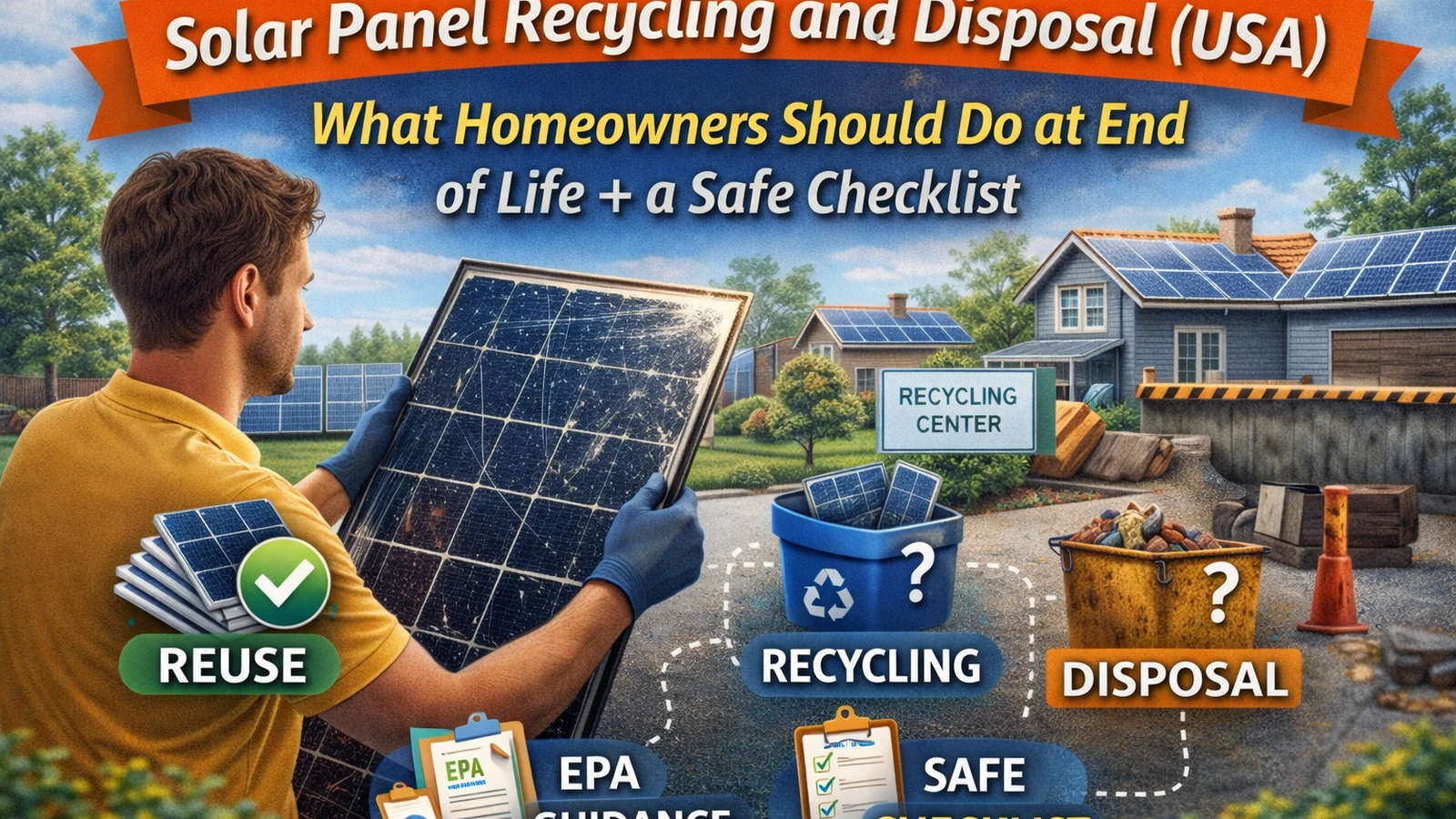
Bottom line: your best first step is to identify whether the panel is working (reuse options) or damaged (recycling/disposal rules), then contact your installer or local/state recycling agency for the correct path.
What solar panels are made of (and what typically gets recovered)
Most common residential panels (silicon PV modules) are made mostly of:
- Glass (front sheet)
- Aluminum (frame)
- Plastics/polymers (encapsulant and backsheet)
- Metals (wires, solder, small amounts of valuable materials)
In today’s US recycling ecosystem, the most common and consistent recoveries are often the aluminum frame, glass, and some metals. Other layers can be more challenging and can affect cost and availability.
Source: US EPA solar recycling background + MIT Climate “Ask MIT” overview (recycling is possible but economics and infrastructure vary).
Why “100% recycling” isn’t always realistic today
Even when a panel is “recycled,” some materials may be downcycled or become residual waste depending on the process and facility. That doesn’t mean recycling is pointless—just that you should ask recyclers what their process actually recovers.
The homeowner decision path (5 minutes)
Use this quick workflow to pick the right disposal path without guessing.
Step 1) Is the panel still working?
- If yes: consider reuse first (sell/donate/installer take-back) if it’s safe and permitted in your area.
- If no or unknown: treat it as end-of-life and continue to Step 2.
Step 2) Is the panel damaged (cracked glass, burn marks, water intrusion)?
- If damaged: avoid moving it unnecessarily and plan for specialized recycling or regulated disposal depending on local rules.
- If not damaged: you may have more options (PV recycler, e-waste facility, installer program).
Safety note: cracked panels can have sharp glass and may expose internal materials. Don’t attempt to disassemble panels.
Step 3) Is this a warranty or insurance replacement?
- Warranty replacement: the manufacturer/installer may have a return or replacement process. Start here: https://solarbasicshub.com/solar-panel-warranty-explained/
- Insurance claim (storm damage): document the damage and ask how disposal/recycling is handled in the claim: https://solarbasicshub.com/does-homeowners-insurance-cover-solar-panels/
- Roof replacement: many projects are removal/reinstall, not end-of-life. That’s a different process than disposal.
The safe checklist: what to do before you move a panel
This checklist is written for homeowners. It avoids risky electrical work and focuses on safe documentation and next steps.
What NOT to do
- Do not disconnect wiring, open junction boxes, or cut cables.
- Do not break panels to “make them fit” in a car or bin.
- Do not climb onto the roof to remove panels yourself.
- Do not throw panels into standard trash or scrap bins unless your local authority explicitly says it’s allowed.
What to photograph and save (takes 10 minutes)
- Wide photo of the array (or the removed panel)
- Close-up photo of damage (if any)
- Label/model number sticker photo
- Install paperwork: invoice, permits/PTO, warranty PDFs
Those documents also help if you’re coordinating with an installer, recycler, warranty provider, or insurance adjuster.
Related reading: PTO/permit documents to keep: https://solarbasicshub.com/solar-permits-inspection-interconnection-pto/
Where to recycle solar panels (USA): realistic options
There isn’t one universal drop-off method everywhere. Here are the most realistic homeowner paths.
1) Start with your installer or manufacturer
If a panel is being replaced, your installer may be able to handle logistics (pickup, palletizing, shipping to a recycler) or direct you to a program the manufacturer participates in.
2) Contact your state/local recycling agency (important)
The US EPA notes that some solar panels may be regulated as hazardous waste and some may not, even within similar product categories, and recommends homeowners contact their state/local recycling agencies for guidance.
Source: US EPA – End-of-Life Solar Panels: Regulations and Management.
3) Specialized PV recyclers and e-waste facilities
Some recyclers accept PV modules specifically. Others treat them as e-waste and recover limited components.
Questions to ask before you drive anywhere:
- Do you accept residential PV panels? (Quantity limits?)
- Do you require panels to be palletized?
- Do you provide a recycling certificate or receipt?
- What materials do you recover (glass/aluminum/metals), and what becomes waste?
- Do you handle damaged panels differently?
Solar panel recycling cost: what to expect (and what drives price)
Homeowner costs vary widely because the biggest cost drivers are often:
- Transportation to an accepting facility
- Handling (palletizing, packing, and safe loading)
- Damage status (cracked/burned panels can require special handling)
- Facility availability (limited options increases logistics costs)
Some expert summaries note that recycling can be relatively expensive compared with landfilling in many regions today, which is one reason recycling rates are still growing rather than “universal.”
Source: MIT Climate “Ask MIT” (recycling is possible but often not profitable yet); US EPA background pages on recycling infrastructure.
Tip: If disposal costs are a concern, ask your installer about end-of-life handling before you buy. It’s a fair “total cost of ownership” question: https://solarbasicshub.com/solar-cost-breakdown/
Special cases homeowners run into
Leases and PPAs (you may not own the panels)
If you have a lease or PPA, the solar company often owns the equipment. That can change who is responsible for removal, replacement, and disposal. Start by checking your contract and contacting the provider.
Related: https://solarbasicshub.com/solar-loan-vs-lease-vs-ppa/
Roof replacement: removal/reinstall vs end-of-life
Most roof projects are not “disposal.” They’re temporary removal and reinstall of the same panels. Disposal only applies if panels are broken, obsolete, or being permanently decommissioned.
Storm damage: document first, then coordinate
If panels are damaged by hail, wind, fallen branches, or fire, treat it like a safety and insurance event: document, contact your installer, and then coordinate with your insurer.
Related: https://solarbasicshub.com/does-homeowners-insurance-cover-solar-panels/
Table: the simple “what should I do with my panel?” guide
| Your situation | Best next step | Why | What to avoid |
|---|---|---|---|
| Panel still works, being replaced for an upgrade | Reuse/resell/donate (where allowed) or installer take-back | Keeps working equipment in use | Unverified “dumping” or unsafe transport |
| Panel is cracked or visibly damaged | Contact installer + local/state recycling agency; ask for PV recycler options | May require special handling; rules vary | DIY disassembly, breaking glass, standard trash |
| Warranty replacement | Follow manufacturer/installer return process | They may require returns for credit/replacement | Disposing before warranty instructions are clear |
| Lease/PPA system | Contact provider; check contract responsibilities | You may not own the equipment | Assuming you can dispose independently |
| Roof replacement (panels not end-of-life) | Removal/reinstall plan with licensed pros | Different process than disposal | DIY roof removal |
When to consult a professional
- Licensed solar contractor: for any panel removal, wiring/disconnects, inverter shutdowns, or safety evaluation.
- State/local recycling agency: to confirm the correct disposal category and permitted options in your area.
- Installer/manufacturer support: for warranty replacements or take-back programs.
- Insurance agent/claims adjuster: when storm damage is involved and disposal costs may be part of the claim.
Safety reminder: solar equipment involves electrical hazards. Don’t attempt electrical disconnection or rooftop work yourself.
FAQ
1) Can solar panels be recycled?
Often yes, especially common silicon PV modules, but recycling availability varies by location and facility. Source: US EPA Solar Panel Recycling page; MIT Climate overview.
2) Are solar panels hazardous waste?
Some panels may be regulated as hazardous waste and some may not—even within similar categories—so homeowners should contact state/local agencies for guidance. Source: US EPA end-of-life regulations and management page.
3) What should I do with cracked or storm-damaged panels?
Document the damage, avoid handling if possible, and contact your installer and insurer. Then ask about recycler options approved in your area. Source: US EPA guidance + insurance best practices.
4) How do I find “solar panel disposal near me” options?
Start with your installer/manufacturer, then your state/local recycling agency, then specialized PV recyclers or e-waste facilities that explicitly accept PV modules. Source: US EPA “Where to Recycle Solar Panels” guidance.
5) How much does solar panel recycling cost?
It varies by transport distance, handling requirements, panel condition, and local facility availability. Recycling can be more expensive than landfill disposal in many areas today. Source: MIT Climate overview; US EPA background pages.
6) If I have a solar lease/PPA, who handles disposal?
Often the provider owns the equipment and may control removal/disposal. Check your contract and contact the provider. Related: https://solarbasicshub.com/solar-loan-vs-lease-vs-ppa/
7) Should I keep any documents for end-of-life solar?
Yes: model/serial info, permits/PTO, warranty docs, and photos. These help with recyclers, warranty, and insurance claims.