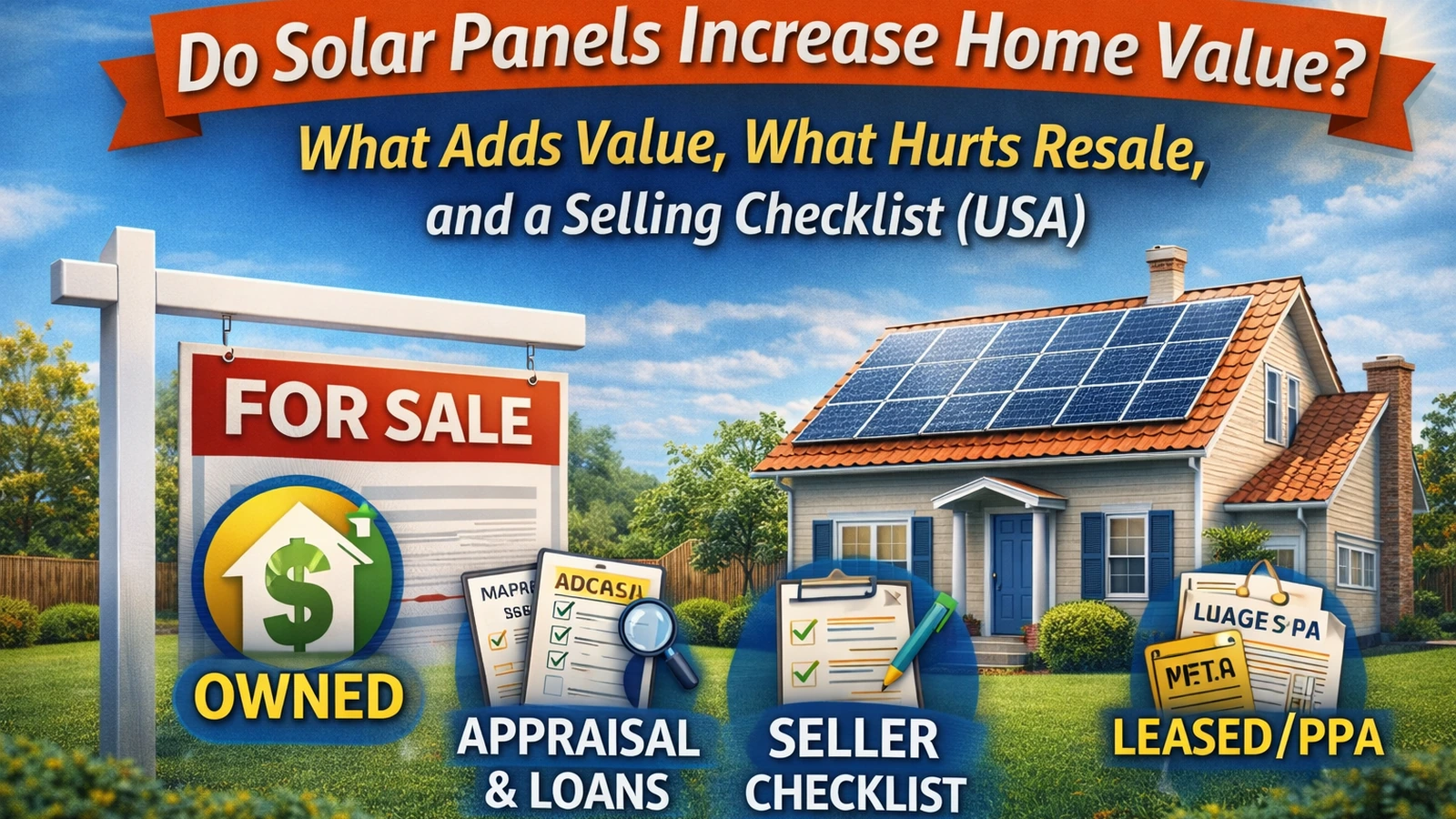

Quick answer: do solar panels increase home value?
Often, yes—especially when the system is owned and well-documented. But solar doesn’t automatically add value in every situation.
Here’s the homeowner version:
- Owned solar (paid off or financed as part of the home) is usually easier to value and sell.
- Leased/PPA solar can still be attractive, but it often adds friction: the buyer may need to qualify/assume the contract, and lenders may treat it differently than home improvements.
Source: Fannie Mae solar appraisal guidance discusses ownership/financing and when solar can be included in property value.
Important: Don’t confuse rooftop solar on your home with “solar farm nearby.” Those are different topics with different value dynamics.
What the best research says (plain English)
A widely cited study from Lawrence Berkeley National Laboratory (Berkeley Lab) analyzed thousands of home sales and found that homes with PV sold for a price premium on average compared to similar homes without PV.
Source: Berkeley Lab news release summarizing the study.
What that does (and doesn’t) mean for your home
It doesn’t mean every solar system adds the same dollar amount everywhere. It does suggest something practical:
Buyers can pay more when they trust the solar system will reliably reduce bills and won’t create legal/contract headaches.
That’s why ownership status, documentation, and local billing rules matter just as much as panel brand.
The 6 things that most increase resale value (the real value drivers)
1) You own the system (no lease/PPA)
If a buyer is comparing two homes and one has a clear, owned solar asset, it’s easier for everyone (buyer, agent, appraiser, lender) to treat solar as part of the property.
If the system is financed, it can still be “owned,” but paperwork must show the system can’t be repossessed in a way that surprises a mortgage lender.
Source: Fannie Mae guidance discusses separately financed panels and repossession/UCC considerations.
Related: https://solarbasicshub.com/solar-loan-vs-lease-vs-ppa/
2) You can prove production and savings (without exaggeration)
Buyers trust:
- a simple production report (last 12 months),
- a recent utility bill set showing before/after (or at least current bills),
- and a clear explanation of fixed charges/true-up if applicable.
If you’re in net billing or TOU, “my bill is zero” can be misleading—so show how your plan works and what the buyer should expect.
Helpful reading:
- https://solarbasicshub.com/how-to-read-your-electric-bill-for-solar-before-after-going-solar/
- https://solarbasicshub.com/solar-true-up-explained/
3) The system is newer—or still within strong warranty windows
A buyer cares about inverter age (often the first major replacement), warranty transfer terms, and whether the installer is still operating for service.
A 3–8-year-old system with clear documentation and transferable warranties tends to feel “safer” than an older system with unknown service history.
Related: https://solarbasicshub.com/solar-panel-warranty-explained/
4) Permits, inspection, and PTO are clean and easy to show
Solar that’s fully permitted and has documented PTO reduces buyer anxiety (“is this legal and approved?”).
Seller packet tip: Keep your permit final and PTO confirmation in a single PDF.
Related: https://solarbasicshub.com/solar-permits-inspection-interconnection-pto/
5) The local credit rules make solar valuable (net metering / export value)
The value of solar depends on what your utility credits for exports and what you pay for imports. Buyers ask (even if indirectly): “Will I actually save money with this system?”
Related:
- https://solarbasicshub.com/net-metering-explained-how-solar-credits-work-and-what-net-billing-changes/
- https://solarbasicshub.com/time-of-use-rates-solar/
- https://solarbasicshub.com/solar-self-consumption-explained/
6) Roof condition and curb appeal support the solar story
Buyers and inspectors think about roof age and remaining life, whether the array complicates future roof work, and whether the installation looks tidy.
You don’t need a perfect roof—just be prepared to answer roof age and future roof replacement planning.
The 5 things that can hurt resale (and how to prevent them)
1) Leases/PPAs that buyers can’t (or don’t want to) assume
Leased solar can be a deal-breaker when the buyer must qualify with the solar company, the payment doesn’t look competitive, or the contract has escalators/fees that scare buyers.
Prevent it: gather the full contract, payment schedule, transfer steps, and buyout options (if any) and disclose early.
Also read: https://solarbasicshub.com/solar-loan-vs-lease-vs-ppa/
2) Title/UCC surprises that slow the mortgage
Some solar financing involves filings that lenders want reviewed. Fannie Mae guidance discusses reviewing documentation and, in some cases, UCC/fixture filings and ensuring panels can’t be repossessed in a way that undermines the mortgage.
Source: Fannie Mae solar guidance.
Prevent it: ask your title company and lender early: “Do you need a UCC search or documentation related to solar financing?”
3) Old equipment with unclear service history
If a buyer expects near-term inverter replacement, unclear warranties, or a missing installer, they’ll discount the value.
Prevent it: provide warranty PDFs, service records, and the monitoring summary.
4) Roof replacement timing becomes a negotiation trap
If your roof is near end-of-life, buyers may worry about solar removal and reinstall costs and coordination.
Prevent it: be ready with roof age and a realistic plan or expectations.
5) The “solar promise” doesn’t match the bill
Confidence drops fast when someone claims “zero bill” but the buyer sees minimum bills, fixed charges, or true-up charges.
Prevent it: show real bills and explain fixed charges/minimum bills and true-up clearly.
Related:
Appraisals & mortgages: what lenders and appraisers usually need
Owned vs financed vs leased: what can be counted in value?
In plain language:
- Owned solar is typically easiest to treat as part of the home.
- Financed solar may be counted if documentation shows it functions like a property improvement (and not removable personal property).
- Leased/PPA solar often isn’t treated the same way as owned equipment in valuation because the homeowner may not own the asset outright.
Source: Fannie Mae solar appraisal/eligibility guidance highlights ownership/financing and repossession/UCC concepts.
The “seller packet” documents that make appraisal easier
Create a single folder (PDF + screenshots) with:
- Original contract (purchase/loan/lease/PPA)
- Invoice and system specs (kW size, equipment list, inverter model)
- Permit final + PTO confirmation
- Warranty PDFs and transfer steps
- Monitoring portal “last 12 months production” report
- Recent utility bills + a one-paragraph explanation of true-up/TOU if relevant
Selling checklist (copy/paste)
Use this as your “no-surprises” resale checklist.
A) What to gather (before listing)
- ☐ Proof of ownership (paid-off receipt OR loan terms OR lease/PPA transfer terms)
- ☐ Equipment list + system size (kW)
- ☐ Monitoring report (last 12 months)
- ☐ PTO documentation + permits
- ☐ Warranty PDFs + transfer rules
- ☐ Insurance note (confirm the system is disclosed to insurer) — https://solarbasicshub.com/does-homeowners-insurance-cover-solar-panels/
B) What to disclose (clearly, in writing)
- ☐ Is the system owned, financed, or leased/PPA?
- ☐ If financed/leased: transfer steps, credit requirements (if any), buyout options
- ☐ Any known issues (inverter replaced, monitoring downtime, repairs)
C) How to present savings honestly (build trust)
- ☐ Show real bills + explain fixed charges/true-up
- ☐ If on TOU: explain timing (midday exports vs evening imports)
- ☐ Avoid promising “zero bill” unless you can show it’s consistently true
Helpful buyer education links:
Table: Owned vs leased — resale impact quick view
| Situation | Usually best for resale? | Why | What to do now |
|---|---|---|---|
| Owned (paid off) | ✅ Yes | Simple story: asset transfers with home | Create seller packet + production proof |
| Owned (financed) | ✅ Often | Can add value if lender/title docs are clean | Confirm lender/title requirements; show loan terms clearly. Source: Fannie Mae guidance. |
| Lease / PPA | ⚠️ Depends | Buyer must assume contract; can add friction | Prepare transfer steps + buyout options; disclose early. Source: Fannie Mae guidance. |
| Old system near warranty end | ⚠️ Depends | Buyer expects future costs | Show service history; price accordingly |
| Roof near end-of-life | ⚠️ Depends | Removal/reinstall concern | Provide roof age + plan; set expectations |
When to consult a professional
Solar resale touches real estate contracts, lending, and sometimes title/UCC filings—so it’s worth using pros:
- Real estate agent experienced with solar (pricing + marketing ownership/production)
- Mortgage lender (how solar financing/leases affect underwriting)
- Title company (catch UCC/title issues early)
- Licensed solar contractor (performance/service needs)
- Appraiser (complex markets or pre-listing valuation)
FAQ
1) Do solar panels always increase home value?
No. They often can, but value depends on ownership, local electricity prices, and whether buyers trust the savings and paperwork. Source: Berkeley Lab research summary.
2) Is owned solar better than leased solar for selling?
Often yes—owned solar is simpler for appraisals and mortgages. Leases can still sell, but they add contract-transfer steps and buyer qualification requirements. Source: Fannie Mae guidance.
3) Can solar be included in the appraised value?
Often yes for owned systems; lender/appraisal requirements vary, and documentation matters—especially for financed/leased systems. Source: Fannie Mae guidance.
4) What documents should I give a buyer?
PTO + permits, equipment list, production report, warranties, and the ownership/financing contract terms (including transfer steps). Source: Fannie Mae guidance.
5) Will solar help my home sell faster?
It can in some markets, especially when the savings story is easy to understand and the system is owned. (Market-dependent.)
6) Does solar increase value the same in every state?
No—policy, net metering rules, and electricity prices vary by state/utility, so perceived value changes.
7) What if my buyer is worried about future roof work?
Be transparent about roof age and how removal/reinstall would be handled; avoid DIY discussion and point buyers to licensed pros.