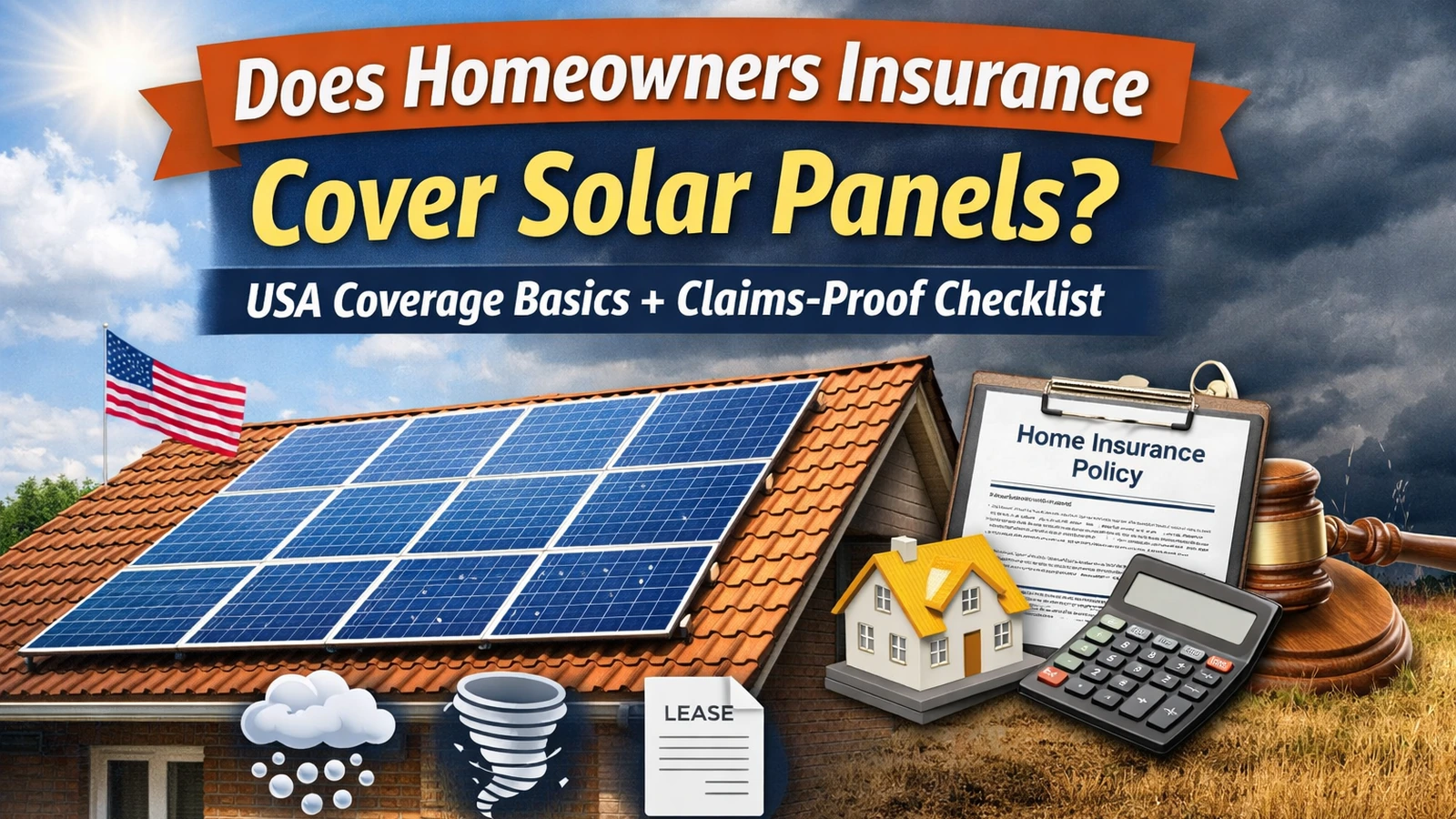

Quick answer (60 seconds): are solar panels covered by homeowners insurance?
Often, yes—but with important caveats.
Many insurers treat roof-mounted solar panels as a permanent part of the home, so they’re commonly covered under the dwelling portion of a homeowners policy—assuming the damage comes from a covered peril (like fire, some storms, or theft) and you have enough coverage limits. Source: Progressive (home insurance & solar panel coverage overview).
Two details decide almost everything:
- Where the system is installed (roof vs ground / detached structure)
- Who owns it (you vs a lease/PPA provider)
SolarBasicsHub mindset: treat this like quote comparison—don’t assume. Confirm in writing.
Roof-mounted vs ground-mounted: why it changes the coverage “bucket”
- Roof-mounted systems are commonly handled as part of the home’s structure (dwelling coverage). Source: Progressive.
- Ground-mounted systems may fall under “other structures” (like a shed/fence) depending on your policy definitions. Source: GEICO (home insurance & solar panel coverage explainer).
Owned vs leased/PPA: why responsibility can split
If you own the system, you’re usually responsible for insuring the equipment like any other home improvement.
If it’s leased (or a PPA), the solar company may insure the equipment, but your policy may still need to address liability, roof-damage coordination, and how claims work in practice. Source: Kin (solar panel insurance overview).
How homeowners insurance typically treats solar panels (plain English)
Homeowners policies are usually organized by what is being insured, not by “solar vs non-solar.”
Here’s the simple translation:
- Dwelling = your home itself (walls, roof—and often permanent attachments)
- Other Structures = detached structures on your property
- Personal Property = movable stuff inside (usually not where solar lands)
Solar panels can fit into different buckets depending on install type and policy wording. Source: GEICO.
Covered perils vs exclusions (why “usually covered” isn’t the same as “always paid”)
Even if your panels are “covered,” the claim depends on:
- Cause of loss (covered peril vs excluded)
- Deductible (what you pay first)
- Coverage limits (is there enough insured value?)
- Settlement type (replacement cost vs actual cash value)
Source: Allstate (solar panel insurance considerations, exclusions/coverage vary by policy).
The 5 most common coverage gaps (where homeowners get surprised)
1) Wind/hail deductibles and special deductibles
Many homeowners only notice special deductibles after a storm—like separate wind/hail deductibles or percentage deductibles. These can change what you pay out of pocket.
What to do: Ask your insurer: “Do I have a separate wind/hail deductible, and does it apply to solar panels too?”
2) Replacement cost vs actual cash value (ACV)
This is a big one.
- Replacement cost aims to pay what it costs to replace the damaged item with a similar new one (minus deductible).
- Actual cash value (ACV) typically factors depreciation, which can leave a gap for expensive equipment.
Action: Ask: “Are my solar panels settled at replacement cost or ACV?”
3) Roof repair = panel removal & re-install (the hidden cost)
Real-world scenario: A hailstorm damages your roof. To repair it properly, contractors may need to remove and reinstall the solar array (often called R&R: remove & reinstall).
This can be expensive—and homeowners sometimes discover arguments about whether R&R is covered, partially covered, or covered only under certain settlement terms. Source: consumer claim dispute examples (r/Insurance discussion).
Action: Ask: “If my roof needs repair or replacement, does my policy cover the labor to remove and reinstall solar panels as part of the claim?”
4) Coverage limits that are too low (you never updated rebuild value)
Insurance is based on replacement cost of the home, not the home’s market value. If you add a $20,000–$50,000 solar system and never update coverage, you could be underinsured for major losses. Source: homeowner discussion/insurer guidance trend (solar/homeowners insurance coverage discussions).
Action: Confirm your dwelling/other-structures limits still make sense after solar.
5) Leases/PPAs: who insures what (and who files the claim)
With leased/PPA solar, responsibilities can be split:
- The solar company might insure the equipment
- You insure the home
- The roof is yours—but the array might not be
Action: Get it in writing: who insures panels/equipment, who covers roof impacts related to solar, who coordinates repairs, and whether your policy needs changes. Source: Kin.
Related reading: https://solarbasicshub.com/solar-loan-vs-lease-vs-ppa/
Will solar panels increase homeowners insurance premiums?
Sometimes slightly—but the reason is usually simple: if solar increases your home’s replacement cost, you may need higher coverage limits, which can raise premiums. Source: industry insurance guidance on solar & homeowners policies.
When premiums don’t change much
- Your insurer already had enough cushion in your dwelling limit
- The system cost is small relative to insured dwelling value
- The limit change doesn’t move your premium much in your rating structure
When premiums are more likely to change
- You need a meaningful dwelling limit increase
- Your area is priced for higher storm risk
- You add a ground-mount and must raise “other structures” limits
- Rebuild complexity increases (more expensive roof/structural repair scenarios)
Practical rule: Underinsuring is usually more expensive than a modest premium increase—because underinsurance makes claims painful.
The claims-proof checklist (copy/paste)
This is the part most articles skip. Use it before you buy solar or right after installation.
10 questions to ask your insurance company
Copy/paste this into an email:
- “Are roof-mounted solar panels covered under my dwelling coverage on this policy?” Source: GEICO/Progressive coverage explainers.
- “If my system is ground-mounted, is it covered under ‘other structures,’ and do I need to increase that limit?” Source: GEICO.
- “Are claims for solar settled at replacement cost or actual cash value (ACV)?”
- “Do I have separate wind/hail deductibles—and do they apply to solar equipment?”
- “If my roof is damaged, does the policy cover solar removal and reinstall required to complete roof repairs?” Source: claim dispute examples (r/Insurance).
- “Are there any exclusions for improperly installed equipment, or requirements that installation be permitted/inspected?”
- “Do I need to list solar panels as scheduled equipment or add an endorsement?”
- “Are inverters, batteries, and related equipment (if installed) treated differently than panels?”
- “If I have a lease/PPA, how should coverage be handled and who is responsible for insuring the equipment?” Source: Kin.
- “Do you need updated replacement-cost info (system cost/invoice) to ensure my dwelling limit is adequate?”
Documents to keep (make a “Solar Insurance Folder”)
Save PDFs/photos of:
- Final paid invoice + itemized cost (panels, inverter, racking, battery if any)
- Equipment list (model numbers; if possible, serials)
- Permit approvals + inspection sign-off (where applicable)
- PTO / Permission to Operate documentation for grid-tied systems
- Source: NREL interconnection/financing guidance references PTO and documentation steps (homeowner guide).
- Photos: roof before/after, close-ups of array, inverter location, battery location
- Your warranty PDFs (panel + inverter + workmanship)
Helpful SolarBasicsHub reading for PTO docs:
https://solarbasicshub.com/solar-permits-inspection-interconnection-pto/
What to photograph (and when)
- Right after install: wide shots + close-ups of array edges, flashing areas (from safe vantage points), inverter/battery area
- After major storms: ground-level photos showing visible damage/debris; note dates; keep utility alerts if any
Safety note: Do not climb on the roof for photos. Use zoom from the ground or hire a pro if inspection is needed.
If you’re shopping solar: where insurance fits in your quote comparison
Insurance shouldn’t be an afterthought—because it connects to two big homeowner risks:
- Storm/roof events
- Contract/ownership structure
Tie-in: warranties vs insurance (don’t confuse them)
Warranties usually address manufacturing defects and workmanship terms. Weather events (hail, hurricanes, falling branches) are typically handled through insurance, depending on the policy and cause of loss.
Related reading: https://solarbasicshub.com/solar-panel-warranty-explained/
Tie-in: loan vs lease vs PPA (ownership drives responsibility)
Before you sign a lease/PPA, confirm who insures equipment, what happens if panels must be removed for roof work, and whether your homeowners policy needs updates.
Related reading: https://solarbasicshub.com/solar-loan-vs-lease-vs-ppa/
Tie-in: utilities sometimes ask for proof of insurance
Some interconnection processes may require documentation such as proof of homeowners insurance. Source: NREL homeowner guide mentions proof of sufficient homeowners’ insurance as part of the process in some cases.
Related SolarBasicsHub reading: https://solarbasicshub.com/how-to-compare-solar-quotes-line-by-line/
When to consult a professional
Because insurance and solar touch safety and high-dollar claims, involve pros when it matters:
- Insurance agent (or carrier underwriting): confirm coverage category, limits, deductibles, replacement cost vs ACV, and whether an endorsement is needed.
- Solar installer (service team): if the system is damaged or needs safe shutdown/repair coordination.
- Licensed roofer (solar-experienced): for roof damage assessments and any roof replacement planning with solar removal/reinstall.
- Public adjuster / attorney (rare cases): for serious claim disputes—start by escalating within the carrier first.
Electrical safety note: For anything involving wiring, inverters, disconnects, or batteries, treat it as professional-only work.
FAQ
1) Does homeowners insurance cover solar panels on the roof?
Often yes if panels are permanently attached and the damage comes from a covered peril—details depend on your specific policy. Source: Progressive coverage explainer.
2) Are ground-mounted solar panels covered?
They can be, but may fall under “other structures” rather than dwelling. Confirm category and limits with your insurer. Source: GEICO.
3) Will solar panels raise my homeowners insurance premium?
Sometimes slightly—usually because you increase insured replacement value, not because solar is “special.” Source: industry insurance guidance.
4) If hail damages my roof, does insurance pay to remove and reinstall solar panels?
This is policy-dependent and a common dispute scenario. Ask specifically whether solar removal/reinstall needed for roof repair is covered. Source: r/Insurance claim dispute example.
5) Are leased solar panels covered by my homeowners insurance?
Leased/PPA systems can split responsibilities. The solar company may insure equipment, but you must confirm roof impacts, liability, and claim coordination. Source: Kin.
6) Do I need separate “solar insurance”?
Many homeowners don’t need a standalone policy, but you may need updated limits or an endorsement depending on setup and insurer requirements. Source: Nationwide consumer guidance.
7) What documents help the most if I ever file a claim?
Invoice, equipment list, permit/inspection sign-offs, photos, warranty PDFs, and PTO documentation (for grid-tied systems). Source: SolarBasicsHub PTO guide + NREL homeowner documentation guidance.
Coverage mapping table (use this when emailing your insurer)
| Solar setup / situation | Where it’s often covered | What to verify in writing |
|---|---|---|
| Roof-mounted, you own it | Dwelling coverage (often) — Source: Progressive | Covered perils + deductibles + replacement cost vs ACV |
| Ground-mounted, you own it | Other structures (often) — Source: GEICO | Whether “other structures” limit is high enough |
| Leased/PPA roof-mounted | Split responsibility — Source: Kin | Who insures panels, who insures roof impacts, how claims coordinate |
| Storm damages roof under panels | Depends on policy language — Source: r/Insurance example | Whether removal/reinstall labor is covered |
| Total-loss event (fire, etc.) | Depends on insured limits | Whether dwelling limit reflects added system value |