
Quick answer: the fast “panel count” formula (USA homeowner-safe)
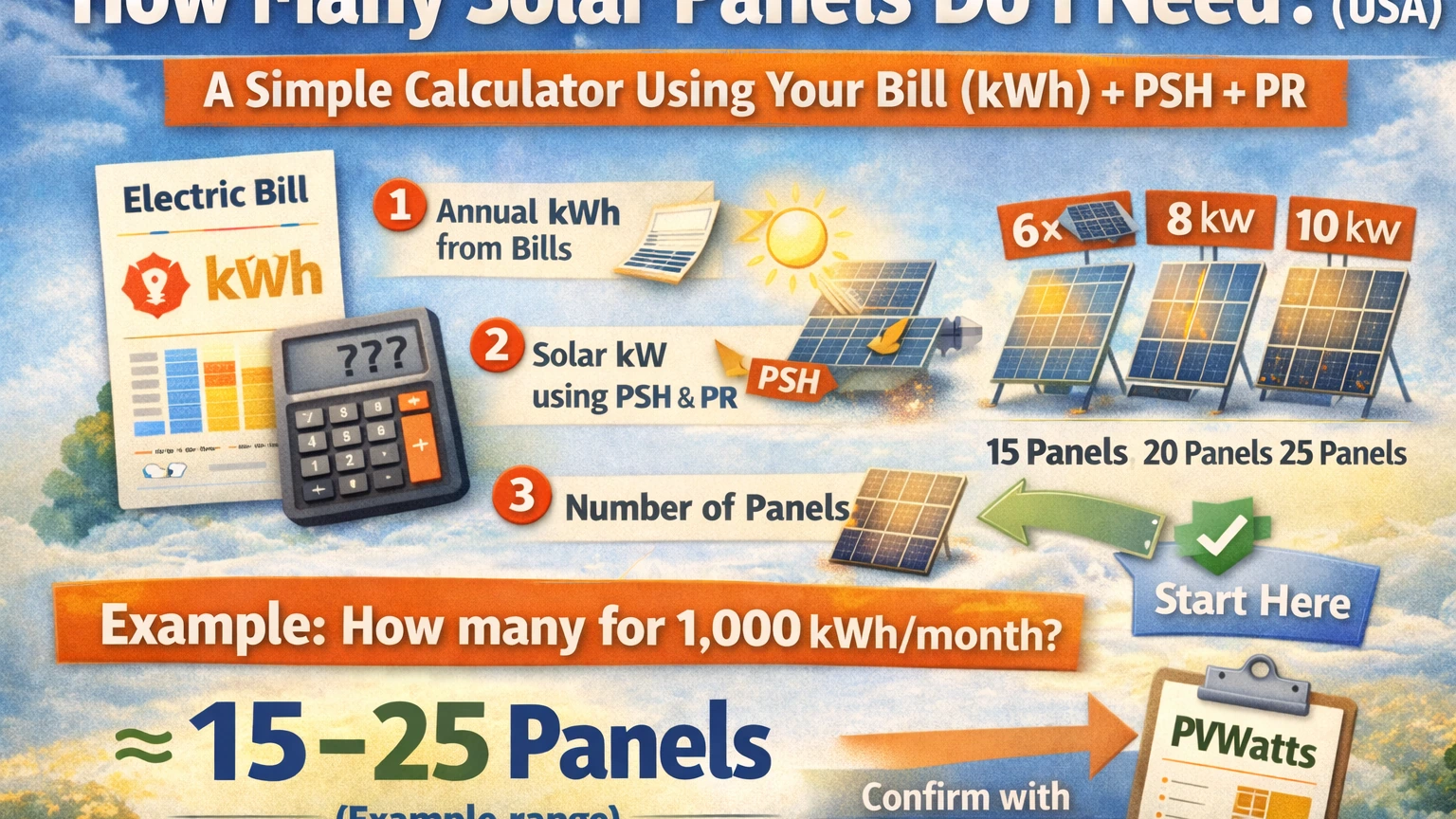
If you want a quick, realistic estimate of how many solar panels you need, use this 3-step flow:
- Get your annual usage (kWh/year) from your electric bills (12 months).
- Estimate required system size (kW) using peak sun hours (PSH) and performance ratio (PR).
- Convert kW into panels using the watt rating of the panels you’re considering (often ~350–450W each).
Core sizing idea:
Daily kWh needed ≈ (Annual kWh ÷ 365)
Solar kW needed ≈ (Daily kWh ÷ (PSH × PR))
Number of panels ≈ (Solar kW × 1000 ÷ Panel watts)
Before you do the math, make sure you’re clear on the two units solar quotes use most: kW vs kWh. Read: https://solarbasicshub.com/kw-vs-kwh-solar/
Step 1 — Pull the right number from your bill (kWh, not dollars)
Solar sizing works best when you size to energy (kWh), not “dollars spent,” because electric rates can change and bills contain fixed charges.
Use 12 months if you can
Most homes have big seasonal swings (AC in summer, heating in winter, holiday usage, etc.). A single month can mislead you. The most reliable DIY-friendly approach is:
- Write down the kWh used each month for the last 12 months
- Add them up for annual kWh
Your bill often already shows a 12-month bar chart. If you’re not sure where to find the numbers, use this guide: https://solarbasicshub.com/how-to-read-your-electric-bill-for-solar-before-after-going-solar/
If you only know “kWh per month”
No problem. Multiply by 12 to estimate annual usage. Example: 1,000 kWh/month ≈ 12,000 kWh/year.
Step 2 — Estimate your solar system size (kW) using PSH + PR
This step turns your “energy need” (kWh) into a “system size” (kW).
2A) Convert annual kWh to daily kWh
Daily kWh needed ≈ Annual kWh ÷ 365
Example: 12,000 kWh/year ÷ 365 ≈ 32.9 kWh/day
2B) Use Peak Sun Hours (PSH) for your location
Peak Sun Hours is a simple way to represent how much usable sun “fuel” your location gets. Your PSH guide explains how to use it safely and avoid “best day” thinking: https://solarbasicshub.com/peak-sun-hours-explained-a-simple-way-to-estimate-solar-output/
Typical homeowner planning PSH: Many US locations average roughly 3.5 to 6 peak sun hours depending on region and season, but your exact number varies. The best way to avoid guessing is to confirm with PVWatts (we’ll do that in Step 5). PVWatts is an NREL tool designed for planning-level production estimates. Source: NREL PVWatts documentation. :contentReference[oaicite:3]{index=3}
2C) Apply Performance Ratio (PR) so your estimate is realistic
PR is your “real-world loss factor” (heat, inverter conversion, wiring losses, soiling, mismatch, etc.). Your PR guide explains it in plain English and gives typical planning ranges: https://solarbasicshub.com/solar-performance-ratio-pr-explained/
Beginner-safe shortcut: For quick planning, many homeowners use PR around 0.75–0.85 as a rough range, then confirm with PVWatts and your roof specifics. (Your PSH guide uses this idea directly.) :contentReference[oaicite:4]{index=4}
2D) System size formula (kW)
Solar kW needed ≈ Daily kWh ÷ (PSH × PR)
Example (1,000 kWh/month):
- Annual usage ≈ 12,000 kWh/year
- Daily usage ≈ 32.9 kWh/day
- Assume PSH = 5.0 and PR = 0.80 (planning values)
Solar kW needed ≈ 32.9 ÷ (5.0 × 0.80) = 32.9 ÷ 4.0 = 8.2 kW
Important: This is a planning estimate. Your roof direction, shade, and utility export rules can shift the “best size.” We handle those in Step 4.
Step 3 — Convert system size (kW) into number of panels
Average solar panel wattage (what “400W panel” means)
Most modern residential panels are commonly in the 350W–450W range (nameplate DC watts). You’ll see “400W” and “410W” frequently in quotes. The panel count depends on the specific model you choose.
If you want to understand how panel wattage relates to efficiency and roof space, read: https://solarbasicshub.com/solar-panel-efficiency-explained/
Panel count formula
Number of panels ≈ (System size kW × 1000) ÷ Panel watts
Example continuation: If you need ~8.2 kW and you pick 410W panels:
Panels ≈ (8.2 × 1000) ÷ 410 ≈ 8200 ÷ 410 ≈ 20 panels
Quick panel-count examples
- 6.0 kW system with 400W panels → 6000 ÷ 400 = 15 panels
- 8.0 kW system with 400W panels → 8000 ÷ 400 = 20 panels
- 10.0 kW system with 400W panels → 10000 ÷ 400 = 25 panels
Step 4 — Adjust your panel count for roof direction, shade, and program rules
This is where online “solar panel calculator” results often fail: they assume a perfect roof with no shade and full-value exports.
Direction & tilt change production
A south-facing roof often maximizes yearly kWh, but west-facing can be valuable on TOU plans (more late-day production). Use your direction guide for homeowner-safe guidance and a fast PVWatts comparison method: https://solarbasicshub.com/best-direction-for-solar-panels-usa/
Shade can reduce output more than you think
Shade is one of the biggest real-world drivers of “why the estimate didn’t match reality.” Even small shade during prime hours can cause disproportionate losses depending on system design. Start here: https://solarbasicshub.com/solar-panel-shading/
Export limits and net billing can change the “best size”
In areas with export limits or low export credit value, oversizing may produce “extra midday energy” that you can’t export (or can export only for low value). That can change your best system size and even your best roof direction strategy.
- Export limits & curtailment: https://solarbasicshub.com/solar-export-limits-curtailment/
- Net metering vs net billing: https://solarbasicshub.com/net-metering-explained-how-solar-credits-work-and-what-net-billing-changes/
Rule of thumb: The right goal is not always “offset 100% of annual kWh.” The right goal is “maximize savings and resilience under your local credit rules and roof constraints.”
Step 5 — Confirm your number with PVWatts (best sanity check)
After you do the quick math, verify it with PVWatts. PVWatts (by NREL) is a fast planning tool that estimates monthly and annual kWh using your location, system size, tilt, azimuth, and losses. Source: NREL PVWatts guidance. :contentReference[oaicite:5]{index=5}
Use this step-by-step guide (built for SolarBasicsHub readers): https://solarbasicshub.com/pvwatts-solar-production-estimate/
What to enter (homeowner-safe)
- DC system size (kW) — your estimated size (or a couple of sizes to compare)
- Tilt & azimuth — approximate your roof
- Losses — keep realistic (this is PR-like reality)
Compare monthly kWh (not just annual)
This is the best check: compare PVWatts monthly output to your monthly bill kWh. Your PVWatts guide highlights that monthly kWh is the #1 output to compare for homeowner decisions. :contentReference[oaicite:6]{index=6}
Decision table: choose the right sizing approach for your situation
| Your situation | What to prioritize | What to do next |
|---|---|---|
| You want a quick panel estimate before quotes | Bill kWh + PSH + PR math | Use this guide, then confirm with PVWatts monthly table |
| Your roof is space-limited | W/ft² (panel efficiency) + layout | Consider higher-watt panels; review efficiency basics |
| You have shade during prime hours | Shading strategy > extra panels | Identify shade windows; review shading guide and inverter choices |
| Your area has net billing or low export value | Self-consumption + TOU timing | Validate export value; avoid oversizing; consider load shifting |
| You may have export limits/curtailment | Export cap constraints | Confirm export limit; size/design to reduce wasted midday energy |
FAQ
1) How many panels for 1,000 kWh per month?
It depends on your location (PSH), losses (PR), and panel wattage. A common planning outcome is often somewhere around 15–25 panels, but you should run PVWatts for your ZIP code and compare monthly kWh to your bills. Start with: https://solarbasicshub.com/pvwatts-solar-production-estimate/
2) What “average solar panel wattage” should I use?
Many residential quotes today use panels in the 350W–450W range. If you don’t know, use 400W as a reasonable planning default, then adjust once you see real equipment models in quotes.
3) Why do two installers give different panel counts for the same home?
Common reasons: different roof sections/tilt, different shade assumptions, different “losses” assumptions, different export credit rules modeled, or different panel wattage models.
4) Should I size solar to 100% of my annual kWh?
Not always. If exports are credited poorly (net billing) or capped (export limits), oversizing can reduce ROI. Use these to understand the rules: https://solarbasicshub.com/net-metering-explained-how-solar-credits-work-and-what-net-billing-changes/
5) What is PR and why does it matter for panel count?
PR is the real-world loss factor that turns ideal output into realistic output (heat, inverter conversion, wiring, soiling, etc.). If you ignore PR, calculators usually oversize savings expectations. Read: https://solarbasicshub.com/solar-performance-ratio-pr-explained/
6) What if my roof direction is not ideal?
You can still go solar. Direction affects annual kWh and time-of-day value. Use this guide and compare options in PVWatts: https://solarbasicshub.com/best-direction-for-solar-panels-usa/
7) Is this safe to do myself?
Yes—because this is planning math and tool usage, not electrical work. For any wiring, roof work, or panel/service equipment changes, use licensed professionals.
Next to Read (internal links)
- How to Read Your Electric Bill for Solar (Before & After Going Solar)
- kW vs kWh in Solar: What They Mean (With Simple Examples)
- Peak Sun Hours Explained: A Simple Way to Estimate Solar Output
- Solar Performance Ratio (PR) Explained (USA)
- How to Use NREL PVWatts to Estimate Solar Production (USA)
- Best Direction for Solar Panels (USA): South vs West vs East
- Solar Panel Shading Explained
- Solar Export Limits & Curtailment (USA)
- Net Metering Explained: How Solar Credits Work (and What Net Billing Changes)