
Quick answer: when panel upgrades are common
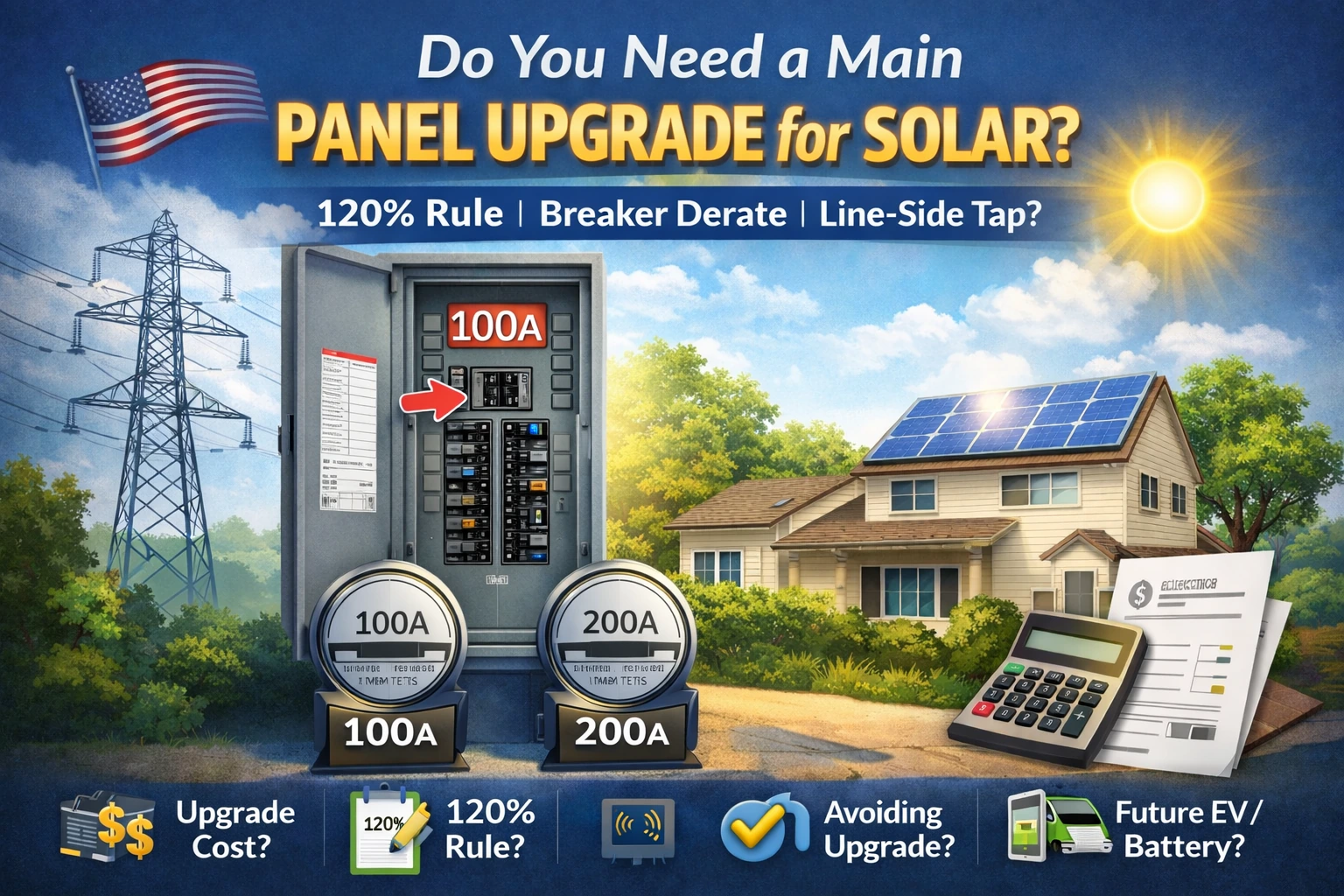
You might need a main panel upgrade for solar if your home has:
- An older or undersized service (often 60A–100A) and you want a larger solar system, an EV charger, or a future heat pump.
- A main panel that can’t safely accept a solar backfeed breaker at the size needed for your inverter (the “120% rule” issue).
- A panel in poor condition (corrosion, recalled brands, overheating signs) where upgrading is a safety decision, not a “solar” decision.
The important part: a “panel upgrade” is not the only solution. Depending on your equipment and local rules, an installer may be able to use alternatives like a main breaker derate or a supply-side connection (line-side tap).
Safety note (USA): don’t DIY panel decisions from an article
This guide is for planning and quote comparison only. Anything involving a meter, service conductors, main panel busbars, or breaker changes must be designed and installed by licensed professionals and approved by your local AHJ (Authority Having Jurisdiction) and utility.
Why solar can trigger panel work (in plain English)
Three panel numbers that matter
Solar interconnection at your main panel usually comes down to three ratings:
- Bus rating (how much current the panel bus is designed to handle)
- Main breaker rating (how much the utility can feed into the panel through the main disconnect)
- Solar backfeed breaker rating (how much the inverter can push into the panel)
What people mean by the “solar 120% rule”
Many residential solar systems connect on the load side of the main service disconnect (in the breaker panel). In those common layouts, a well-known NEC condition often summarized as the “120% rule” limits the combination of the main breaker and the solar breaker relative to the panel bus rating. The intent is preventing busbar overload in certain configurations.
Source: Industry explanations and examples of the 120% rule and residential interconnection layouts.
- Example walkthrough and math: Mayfield Energy code corner article. (Source: Mayfield Energy)
- Residential example and framing: Solar Builder Mag NEC 705 discussion. (Source: Solar Builder Mag)
The common solutions installers use (and what each means for you)
If a quote says “panel upgrade required,” ask which of these options they considered and why they chose the one in your proposal.
Option A — Use a smaller PV breaker (smaller inverter output)
This isn’t a “panel upgrade” at all. It’s a design choice: keep the electrical work simple by using a smaller inverter output / smaller backfeed breaker so the panel stays within limits.
Tradeoff: You may cap system AC output. That can affect peak production and could reduce total annual kWh depending on your design goals.
Planning tip: understand kW vs kWh so you don’t confuse “instant power cap” with “annual energy.”
Option B — Main breaker derate (example: 200A panel, 200A main → 175A or 150A main)
A “main breaker derate” means replacing the main breaker with a lower rating so the combined sources stay within allowed limits. You’re not upgrading the panel; you’re reducing the utility feed rating.
- When it can make sense: You have a large bus rating panel and your home loads are modest, so a lower main still meets your needs.
- When it can be risky: You already have high loads (EV charging, electric range, electric dryer, future heat pump) and a derate could create nuisance trips or limit future upgrades.
Source: Residential interconnection example discussions often show derating as one common workaround when the bus rating allows it. (Source: Mayfield Energy; Solar Builder Mag)
Option C — Supply-side connection (line-side tap)
A supply-side connection (sometimes called a “line-side tap”) ties the PV system into the service conductors on the supply side of the main breaker, using approved equipment and disconnecting means.
- Why installers use it: It can avoid the load-side busbar limitation that triggers many upgrades.
- Why it varies: Utilities and AHJs may have stricter requirements, and it’s not always allowed for every situation.
Source: NREL training materials explain that residential PV can use load-side or supply-side connections, and permitting/interconnection requirements must comply with NEC connection methods and local review. (Source: NREL residential rooftop PV permitting training materials)
Option D — Panel upgrade (or service upgrade)
This is the “big one.” It can mean:
- Panel swap (replace the panelboard with a higher bus rating / better layout / modern equipment), or
- Service upgrade (increase service capacity from the utility, which can involve meter equipment and utility coordination)
When it’s truly worth it:
- Your panel is obsolete, damaged, recalled, or dangerously crowded.
- You want to electrify: EV charger + heat pump + induction + solar + battery, and the existing service is a bottleneck.
- You want future-proofing and cleaner electrical scope (especially for backup-ready systems).
When it might be overkill:
- The proposal doesn’t clearly justify why simpler options (derate, supply-side, smaller PV breaker, PCS) weren’t possible.
- The upgrade scope is vague (“if needed”) without a written plan.
Cost-comparison help: use How to Compare Solar Quotes (Line by Line) and always require the electrical scope in writing.
Option E — Power Control System (PCS) / export limiting (where permitted)
Some modern designs can limit power exported to the panel or grid using control systems (often discussed as energy management / power control approaches). Whether this is allowed and how it must be documented depends on local rules.
Source: NEC interconnection discussions increasingly reference PCS as a method alongside supply-side and load-side connections, but it’s jurisdiction-dependent. (Source: ExpertCE NEC 705 overview)
Decision table: which option usually fits which homeowner?
| Option | Best when… | Common downside | What to ask your installer |
|---|---|---|---|
| Smaller PV breaker / smaller inverter output | You want lower cost + simpler install and your goals don’t require max AC output | May cap peak output; may reduce annual kWh depending on design | “How many kWh/year do I lose vs the larger design?” |
| Main breaker derate | Your home loads are modest and you’re not planning big electrification | Can limit future EV/heat pump; may increase chance of main trips | “What load assumptions support the derate?” |
| Supply-side (line-side tap) | Load-side interconnection is limited but AHJ/utility allow supply-side method | More utility/AHJ constraints; must be done perfectly and permitted | “Is supply-side allowed here, and what approvals are required?” |
| Panel/service upgrade | Panel is old/unsafe, or you want future-proof electrification + backup | Higher cost and more coordination | “Is this a panel swap or full service upgrade? What exactly is included?” |
| PCS / export limiting | Your market allows it and you need a compliant workaround without big hardware changes | Jurisdiction-specific; must be documented and supported | “Is PCS permitted by AHJ/utility and included in the permit set?” |
How to compare quotes when one includes a panel upgrade
1) Make the electrical scope explicit (no vague wording)
In your proposal, require written answers to:
- Is this a panel swap or a service upgrade?
- Does it include permit fees, utility coordination, and inspection?
- Does it include a new main breaker, new grounding/bonding work, or a new meter/main combo if required?
- What is excluded? (drywall patching, stucco repair, trenching, etc.)
This aligns with your site’s scope-first approach in How to Compare Solar Quotes.
2) Normalize the comparison
Compare:
- Cash price (before incentives) for solar + the exact electrical scope
- Estimated annual production (kWh/year) with stated assumptions
- Warranty + service responsibilities (who owns the panel upgrade warranty?)
Cost context reading: Solar Cost Breakdown: What You’re Really Paying For
Homeowner checklist: 12 questions to ask (copy/paste)
- “What is my panel’s bus rating and main breaker rating?”
- “What PV breaker size does this design require, and why?”
- “Is the ‘120% rule’ the reason you’re calling for an upgrade, or is it panel condition/space?”
- “Did you consider a main breaker derate? If not, why?”
- “Did you consider a supply-side connection (line-side tap)? Is it allowed here?”
- “Is this a panel swap or a service upgrade (utility involvement)?”
- “What electrical work is included in writing (disconnects, conduit, labeling, grounding)?”
- “If I add an EV charger or heat pump later, will this plan still work?”
- “If I add a battery later, will this panel choice help or hurt?”
- “Will you handle all permits, AHJ inspection, and utility paperwork?”
- “What is the expected timeline impact (inspection, PTO steps)?” (See Solar PTO Meaning)
- “If the AHJ requires something extra, how are change orders handled?”
FAQ
1) Do I need a panel upgrade for solar if I have 100A service?
Not always. Some 100A homes can install solar without a service upgrade, depending on panel bus rating, interconnection method, and system size. But upgrades are more common when loads are high or the panel can’t accept the needed PV breaker safely.
2) What is the solar 120% rule in simple terms?
It’s a common NEC-based condition used for many load-side solar connections that limits how the main breaker and PV backfeed can be combined relative to the panel bus rating to prevent overload risk. Source: Residential example explanations and math walkthroughs in industry references.
3) Is a main breaker derate safe?
It can be safe when designed by a licensed professional and supported by load assumptions. The risk is lifestyle changes: EV charging, electrification, or higher usage can make a derated main feel restrictive later.
4) What is a line-side tap (supply-side connection)?
It connects solar on the supply side of the main disconnect using approved equipment and permits. Whether it’s allowed and how it’s done depends on your utility and AHJ. Source: NREL permitting/interconnection training materials describe load-side vs supply-side connection paths.
5) Is a panel upgrade worth it if I plan to add an EV or heat pump?
Often yes, because you’re buying flexibility and reducing future “surprise electrical” work. If you’re planning electrification, it can be smarter to treat the panel as part of the long-term home energy plan.
6) How do I make sure I’m not getting overcharged for a panel upgrade?
Make the scope explicit, compare at least 2–4 quotes, and use a structured checklist like How to Compare Solar Quotes. Require the installer to state which alternatives were considered and why they were rejected.
Next to Read
- How to Compare Solar Quotes (Line by Line)
- Solar Cost Breakdown: What You’re Really Paying For
- Solar System Components & Sizing Basics
- Solar PTO Meaning (Permits, Inspection, Interconnection)
- kW vs kWh in Solar
- Solar Basics: How Solar Power Works
- Net Metering Explained (and what net billing changes)