
The 60-second answer
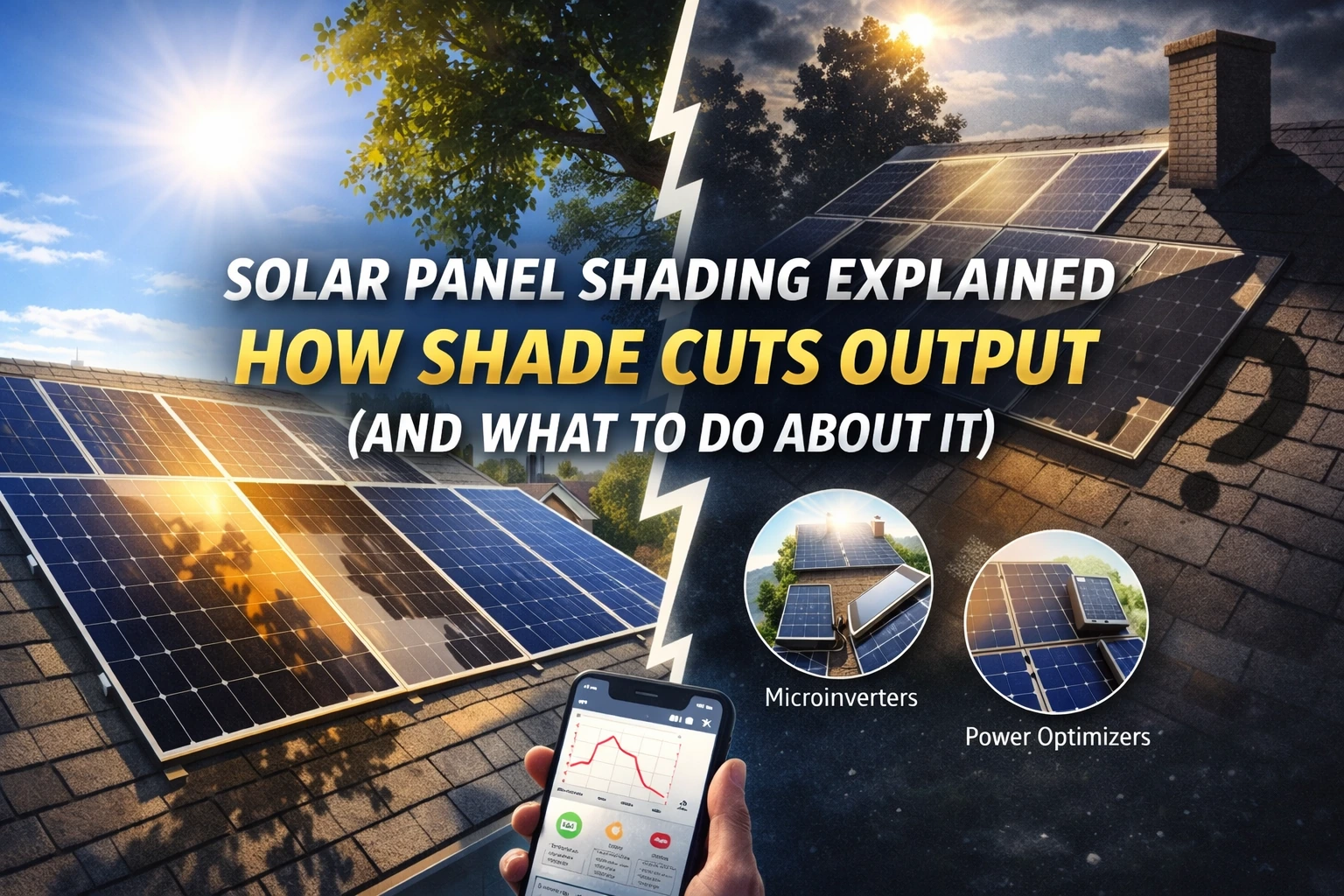
Solar panel shading can reduce output more than you’d expect—sometimes far more than the shaded area—because panels and cells are electrically connected in ways that make “partial shade” a special kind of problem.
- If shade is rare and only early/late in the day: it may be a small annual impact.
- If shade hits during peak hours (often ~10am–3pm): it can meaningfully reduce annual energy and savings.
- If one or two panels get recurring shade: system design and inverter architecture (string vs MLPE) can determine how much that shade drags down the whole array.
In this guide, you’ll learn (1) why partial shade hits hard, (2) how to spot shade patterns safely using monitoring, and (3) what solutions actually work for US homes—without risky DIY roof or electrical work.
Related reading you may already know:
- Best Direction for Solar Panels (USA)
- String Inverter vs Microinverter
- Power Optimizer vs Microinverter
- Why Is My Solar Production Low? (Safe Checks)
Why shading can reduce output more than the shaded area
1) The “weakest link” effect (plain English)
Most residential solar arrays connect multiple panels together (especially in string-inverter designs). In a series-like chain, current tends to be limited by the most constrained part—so a shaded section can restrict how much power flows through that part of the circuit.
This is why small shade can sometimes create disproportionately large losses compared to “percent of panel covered.”
2) What bypass diodes do (and what they don’t)
Modern panels include bypass diodes. Their job is safety and damage reduction: they help prevent severe hotspot conditions when cells in part of a panel are shaded and operating unevenly.
Key homeowner takeaway: bypass diodes can keep a shaded panel from becoming a bigger problem—but they don’t magically “erase” shade losses. In many cases, the shaded portion is effectively “skipped,” which reduces power.
Source: SolarEdge technical note on bypass diodes and shaded conditions: https://knowledge-center.solaredge.com/sites/kc/files/se_technical_bypass_diode_effect_in_shading.pdf
Source: NREL report on partially shaded PV operation: https://docs.nrel.gov/docs/fy09osti/46001.pdf
3) Why “shade tolerant solar panels” is often marketing
Some marketing implies panels “work in shade.” It’s true that panels can still produce some energy with partial or diffuse light—but recurring hard shade (chimneys, trees, dormers, nearby buildings) is a design issue, not a feature.
The best “shade tolerance” usually comes from good design (panel placement) and/or inverter architecture (MLPE) rather than a single panel spec.
Shade types that matter most on homes
Hard shade vs soft shade
- Hard shade: sharp-edged shadows from chimneys, vents, trees, nearby structures, and roof features. This is the classic “partial shading” problem.
- Soft shade / diffuse light: haze, thin clouds, smoke, or overcast conditions. This usually lowers the whole array more evenly.
Time-of-day matters: why midday shade hurts most
Midday hours often align with the highest irradiance (the “best sun”). If shade occurs during peak production windows, it can reduce both daily kWh and annual total more than shade that only happens at sunrise/sunset angles.
If you want the “roof basics” context, this pairs well with: Best Direction for Solar Panels (USA).
Seasonal shade changes (leaf-on vs leaf-off)
Trees and sun angle change across the year. A roof might look “mostly unshaded” in winter (leaf-off), but suffer recurring shade in summer (leaf-on), or vice versa depending on sun path and tree location. A good shade assessment models the whole year—not one sunny day.
How to tell if shading is your issue (safe, monitoring-based checks)
You don’t need to climb on the roof or open electrical equipment to spot shade patterns. Your monitoring app (or inverter portal) often shows enough clues.
1) Look for “notches” or repeating dips at the same times
Shading often creates a repeatable pattern:
- Morning-only dips: likely east-side shading (trees/buildings) that clears later.
- Afternoon-only dips: likely west-side shading or late-day obstructions.
- Sharp dips around the same time every clear day: chimney/vent/branch shadow moving across the array.
2) Shade vs clipping vs season: don’t confuse these
Common confusion: a flat top at midday may be inverter clipping, not shade. Shade dips often look like jagged “cuts” or “steps,” while clipping is often a smooth plateau near a maximum output level.
Use these guides together:
3) A quick sanity-check: compare similar days
- Compare clear day to clear day (not cloudy to sunny).
- Compare month-to-month seasonally (winter vs summer is normal).
- If your app supports it, compare year-over-year for the same month.
Related routine: Solar Panel Maintenance Checklist
How much can shading matter? (a realistic, research-grounded frame)
Every roof is unique, so avoid one-size “shade = X% loss” claims. But we can say two evidence-based things:
- Partial shading is a common, measurable loss category in real-world PV performance.
- MLPE (module-level electronics) can reduce some mismatch losses in shaded conditions, depending on the shade pattern and system design.
Source: NREL analysis of partial shading across many systems (research report): https://docs.nrel.gov/docs/fy15osti/63765.pdf
Source: IEA PVPS Task 13 report on optimizers and partially shaded operation: https://www.csp.fraunhofer.de/content/dam/imws/csp/de/documents/task-13-reports/modul/IEA%20PVPS%20T13-27-2024%20REPORT%20Performance%20Optimisers.pdf
Homeowner way to think about it: shading losses can be small (occasional early/late shade) or material (recurring midday hard shade). Your installer should be able to show you modeled shade losses and explain assumptions.
What you can do about shading (solutions ranked by practicality)
Option A: Design/layout fixes (often the best first move)
If you’re still in the quote stage, the cleanest “fix” is often simply placing panels where they get consistent sun and avoiding roof planes that get recurring hard shade during peak hours.
- Move panels away from chimney/vent shadow paths.
- Use fewer panels on the shaded plane and more on the unshaded plane.
- Split the array across roof faces strategically (ties to direction/value timing).
This connects directly with: Best Direction for Solar Panels (USA).
Option B: Microinverters vs optimizers (MLPE) when shade is unavoidable
MLPE (module-level power electronics) can help reduce losses from mismatch and partial shading by letting each panel operate more independently (instead of one shaded panel dragging down a whole string).
- Microinverters: one inverter per panel; often strong for complex roofs and recurring partial shading.
- Power optimizers + string inverter: panel-level optimization plus a central inverter; often a “middle option.”
Start here:
Important: MLPE helps most when shade is partial and uneven across the array. If the whole roof plane is shaded (or it’s overcast), MLPE can’t create sunlight.
Option C: Tree strategy (professional + long-term thinking)
Trees are one of the biggest long-term shade risks—because they grow. If shading is significant:
- Ask your installer to model shade across the year (not just one month).
- Consider professional pruning by a qualified arborist (especially near power lines).
- Plan for future growth: what’s “fine today” may not be fine in 5 years.
Safety note: Avoid DIY tree work near roofs or electrical service lines.
Option D: Do nothing (sometimes the correct answer)
If shade is minor or only at low-sun hours, spending thousands to “solve” it can have a poor payback. The right decision is often made with a simple comparison:
- Annual kWh lost (from your model or monitoring)
- × Your value per kWh (use your bill’s effective rates/credits)
- = Annual $ impact
If you want a bill-based method to estimate value per kWh, use: How to Read Your Electric Bill for Solar.
Table 1: Shading symptom → likely cause → best next step
| What you see | Likely cause | Best next step (safe) |
|---|---|---|
| Repeated dips at the same time on clear days | Hard shade (chimney/tree/roof feature) | Document times + screenshots; ask installer for shade analysis & redesign options |
| Morning-only weakness; afternoons look normal | East-side shading | Check shade from the ground at that time; evaluate panel placement on that roof plane |
| Afternoon-only weakness; mornings look normal | West-side shading | Compare with TOU value; consider shifting array or using MLPE if shade unavoidable |
| Smooth flat-top plateau near midday | Often inverter clipping (not shade) | Read: Inverter clipping explained |
| Lower production for weeks in winter | Seasonal sun angle + weather | Compare to last winter; use: Why production is low |
Table 2: Shading solutions comparison (what they’re best for)
| Solution | Best for | Pros | Limitations |
|---|---|---|---|
| Layout/design changes (move panels) | Quote stage; avoid chimney/tree shadow paths | Often highest ROI; reduces problem at the source | Roof constraints may limit options |
| Microinverters | Complex roofs; recurring partial shading on some panels | Panel-level operation + strong monitoring visibility | Higher upfront cost; more roof electronics |
| Optimizers + string inverter | Some shading + desire for panel-level optimization | Can reduce mismatch losses; common “middle option” | Still a central inverter; benefits depend on shade pattern |
| Tree strategy (professional pruning) | Tree-caused hard shade that will worsen over time | Can restore sun access across the array | Ongoing maintenance; safety and property considerations |
| Do nothing | Minor early/late shade with small annual impact | No cost; avoids over-optimizing | You accept some lost kWh |
Installer questions (copy/paste)
- Shade modeling: “How did you model shade across the year? Can you show the assumed annual shading loss?”
- Timing: “Does the shade occur during peak hours (often ~10am–3pm), or mainly early/late?”
- Design alternatives: “Can you propose a layout that avoids the shaded roof plane?”
- Architecture choice: “Given my shade pattern, why are you recommending string vs microinverters vs optimizers?”
- Production transparency: “Can you show monthly production and the assumptions (tilt/azimuth/losses)?”
- Monitoring detail: “Will I have panel-level monitoring? If a section underperforms, how will we find it?”
- Warranty and service: “Who services MLPE components if one fails, and what’s the labor coverage?”
Safety + warranty notes
- Avoid risky DIY: Don’t climb on roofs or open electrical enclosures to “chase shade problems.” Use monitoring and professional assessment.
- Document changes: If panels are moved or tree work is performed, keep before/after photos and service invoices for warranty and future troubleshooting.
- If you suspect a safety issue (burning smell, repeated breaker trips, water intrusion), stop and contact a qualified professional.
Quick recap
- Partial shade can reduce output more than the shaded area because of how panels/cells are electrically connected.
- Bypass diodes help protect modules, but shade still costs energy.
- The best solutions are often (1) better layout, (2) MLPE where shade is unavoidable, and (3) professional tree strategy when it makes sense.
- Use your monitoring curve patterns to identify shading safely—then bring screenshots to your installer.
FAQ
1) Do solar panels work in the shade?
They can still produce some energy in diffuse light, but hard shade (tree/chimney shadows) can significantly reduce output—especially when it hits during peak sun hours.
2) Why can a small shadow cause a big drop?
Because of series wiring behavior and how bypass diodes “skip” shaded substrings. The electrical impact is not always proportional to shaded area.
Source: https://docs.nrel.gov/docs/fy09osti/46001.pdf
3) What are bypass diodes in a solar panel?
They are protective diodes that reduce hotspot risk and allow current to bypass shaded portions of a module—but that bypass also reduces power from the bypassed section.
Source: https://knowledge-center.solaredge.com/sites/kc/files/se_technical_bypass_diode_effect_in_shading.pdf
4) Are microinverters better than optimizers for shading?
It depends on your roof and shade pattern. Both are forms of MLPE and can reduce mismatch losses when some panels are shaded while others are not. Compare equipment, monitoring, warranties, and installer service capability.
Start here: Power Optimizer vs Microinverter
5) How can I tell if shading is the problem?
Look for repeating dips at the same times on clear days, or morning-only/afternoon-only weakness. Compare similar weather days and check if the pattern repeats.
Related: Why Is My Solar Production Low?
6) Is a flat top at noon always shading?
No. A smooth midday plateau is often inverter clipping. Shading tends to create dips or jagged reductions at specific times.
See: Solar Inverter Clipping Explained
7) Should I remove a tree for solar?
That’s a cost/benefit decision and should be evaluated professionally. Ask for a shade model and compare the annual $ impact of shading to the long-term cost and practicality of tree management.
8) Can shading void my solar warranty?
Shading itself usually doesn’t “void” a warranty, but unauthorized modifications or unsafe DIY repairs can create issues. Use qualified professionals for changes and keep documentation.