
If you’re asking “what’s the best direction for solar panels?” you’re already ahead. Roof direction (orientation) changes how much solar you make and when you make it—which can change your bill savings in the USA.
This guide is written for US homeowners comparing quotes (or wondering if their roof is “good enough”). It stays beginner-friendly and focuses on safe planning—not DIY electrical or roof work.
Quick answer: south is usually best for total kWh, but west can be best for late-day value
Most of the time, a roof facing true south produces the most total solar energy over the year (in the Northern Hemisphere). But “best” depends on your goal:
- Maximize yearly production (kWh): South-facing is usually best.
- Maximize bill savings (value timing): West-facing can be better on time-of-use (TOU) plans because it shifts production later in the day.
- Balanced daily coverage: East/west split arrays can produce a flatter curve—often helpful when you’re trying to match household usage or reduce export.
Before we go deeper, make sure you’re clear on the two basic units most solar estimates use: kW vs kWh in solar.
A simple “direction” cheat table (USA homeowner view)
| Roof direction | Typical strength | Typical downside | Best fit for |
|---|---|---|---|
| South | Highest annual energy (most locations) | Midday-heavy production (may export more at noon) | Classic net metering, maximizing total kWh |
| West / Southwest | More late-afternoon production | Slightly less annual kWh than south (often) | TOU rates, net billing, higher late-day value |
| East / Southeast | More morning production | Less late-day production | Morning-heavy usage, flatter daily coverage when paired with west |
| East + West split | Flatter production curve across the day | Usually less total kWh than ideal south | Matching usage, export limits, reducing midday spikes |
| North (most US homes) | Sometimes workable at low tilt or specific constraints | Often the lowest production direction | Only when roof constraints leave no better option |
Important: Direction is only one input. Shade, tilt, and realistic losses can matter just as much (or more). If you haven’t read these yet, they pair perfectly with this topic:
Orientation vs tilt vs azimuth (plain English)
People use these words interchangeably, but they’re different:
- Orientation (direction): which way your panels face (south, west, etc.).
- Azimuth: the direction expressed as an angle around the compass.
- Tilt: how steep the panels are (flat vs angled).
Solar panel azimuth: the “number version” of direction
Many solar tools (including PVWatts) use azimuth degrees like this:
- 0° = North
- 90° = East
- 180° = South
- 270° = West
Source: NREL PVWatts Calculator (pvwatts.nrel.gov) input definitions and PVWatts guidance used by state/agency documentation.
Roof pitch vs panel tilt (not always identical)
On many homes, panels are mounted close to the roof pitch. But tilt can differ if your installer uses specific racking (for example, on low-slope roofs). For planning, your quote should clearly state:
- the roof plane used (which section of roof),
- the assumed tilt (degrees), and
- the assumed azimuth (degrees).
If a quote doesn’t state these, it’s harder to compare estimates fairly.
Why “best direction” depends on your billing: net metering vs TOU vs net billing
Two homes can have the same roof and the same solar size—and still get different “best direction” answers—because the best direction can depend on when electricity is most valuable.
If you have classic net metering, total kWh usually matters most
With generous net metering, exported midday energy can often be credited near retail rates. In that case, maximizing annual kWh (often south-facing) is usually the top goal.
To understand how credits really work in your area, read: Net Metering Explained (and what net billing changes).
If you have TOU rates or net billing, west-facing can increase value
TOU plans often charge more in late afternoon/early evening. West-facing arrays tend to shift production later, which can better match high-price hours. The US EIA has discussed how west-facing PV has an advantage late in the day (and why that matters more with TOU pricing).
Source: US EIA “Today in Energy” discussion of PV output timing and west-facing advantage for late-day production.
Practical tip: the best planning move is to compare your usage pattern with your expected production pattern. This guide helps with the usage side: How to Read Your Electric Bill for Solar.
South vs west vs east: what actually changes on your production curve
Homeowners often focus only on “annual kWh.” But direction also changes the shape of production across the day:
- South-facing: tends to peak closer to midday.
- West-facing: tends to peak later (late afternoon).
- East-facing: tends to peak earlier (morning).
This is why east vs west solar production isn’t just about “more or less”—it’s also about when you get it.
Real-life example (planning-level, not a promise)
Imagine two equal-size arrays on the same home:
- Array A: south-facing
- Array B: west-facing
Array A might produce slightly more total energy over the year, but Array B may produce more during late-day hours. If your rates spike late in the day, the west-facing system can sometimes deliver higher bill value even with a bit less total kWh.
Key idea: In the USA, “best” is often about value timing, not only total kWh.
Tilt angle basics (and when tilt matters more than direction)
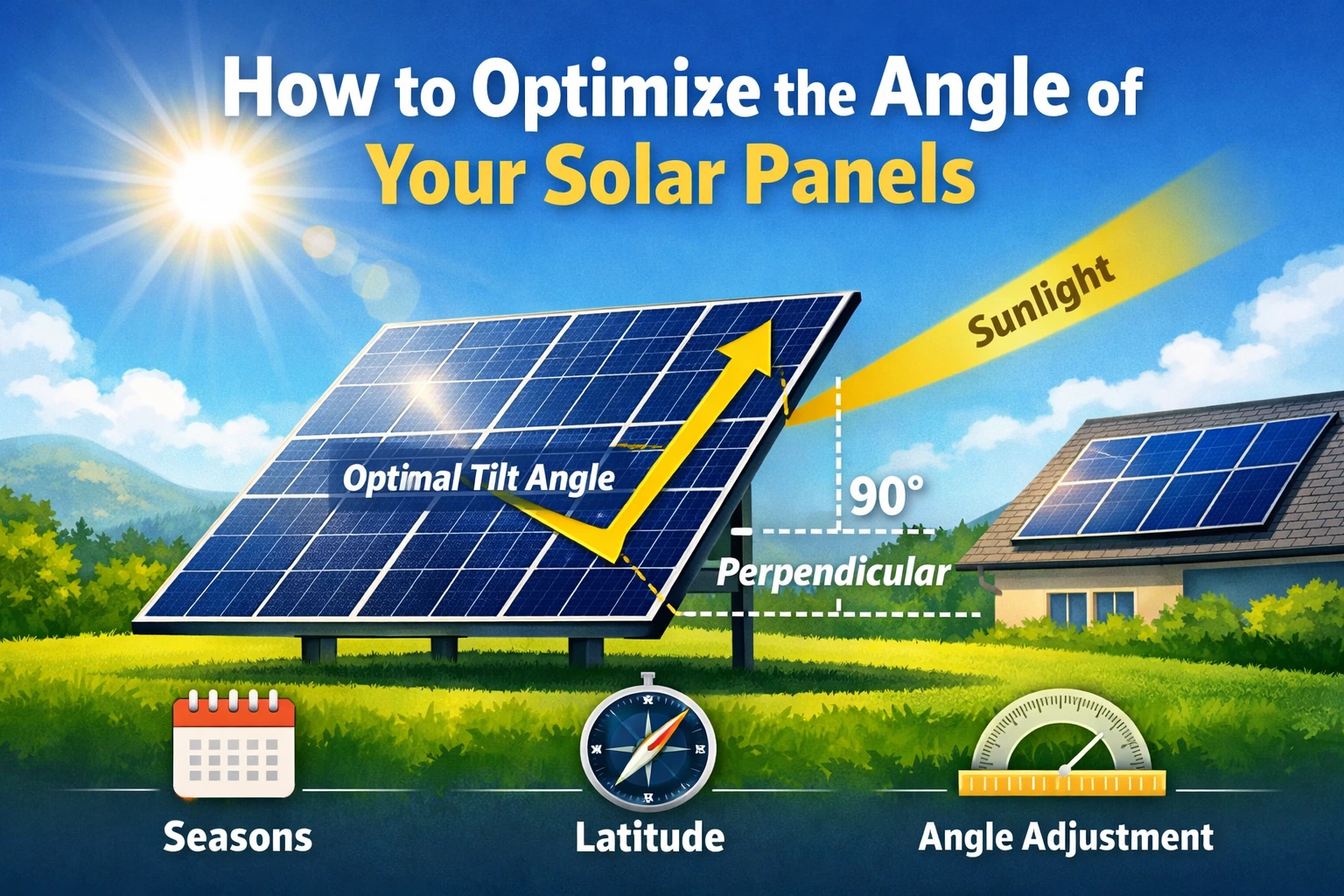
solar panel tilt angle influences how directly sunlight hits your panels across seasons. Two common homeowner realities:
- Many roofs have fixed pitch (your tilt is “what your roof is”).
- Low-slope roofs (common in some regions) can have tilt adjusted with racking.
What tilt “does” across the year
- Lower tilt tends to favor summer sun (higher sun angle) and can reduce wind loading, but may be more sensitive to soiling if very flat.
- Higher tilt can help winter performance (lower sun angle) and shed snow better in snowy climates.
If your roof has heavy winter snow, tilt and layout decisions should be made with a qualified installer for safe loading and roof protection.
Planning tip: Don’t guess. Use PVWatts (below) to compare tilt scenarios quickly.
Shade beats direction (the #1 reality check)
If you only remember one thing, remember this: a perfectly south-facing roof with serious midday shade can lose more energy than a slightly off-south roof with clean sun.
Shade timing matters (10am–3pm is the danger zone)
Shade early or late in the day is usually less damaging than shade during peak production hours. Ask your installer how shading was modeled and whether the estimate includes it.
If you’re troubleshooting an existing system, this guide helps you separate “normal seasonal changes” from real problems: Why Is My Solar Production Low?
Trees change across seasons
In many US regions, winter sun is lower in the sky and trees may be leaf-off. Summer sun is higher but trees are leaf-on. A good shade assessment considers the whole year, not just one sunny day.
Multi-orientation roofs: when east/west split arrays are a smart design
Some homes simply don’t have one perfect roof plane. In that case, splitting panels across multiple orientations can be a smart design—especially when:
- you want a flatter production curve (less “noon spike”),
- you have TOU rates and want more late-day output,
- you face export limits or low export credit (net billing).
Orientation affects inverter and architecture decisions
Multiple roof directions can increase mismatch (different sun angles hitting different panels). That’s one reason some quotes recommend MLPE (microinverters or optimizers).
- Start with: String Inverter vs Microinverter
- Then read: Power Optimizer vs Microinverter
Orientation can also influence clipping behavior and DC/AC ratio choices, especially when an array is designed to push later-day production: Solar Inverter Clipping Explained (DC-to-AC Ratio).
The fastest way to know what’s “best” for your roof: a 10-minute PVWatts comparison
You don’t need to guess. NREL’s PVWatts tool lets you compare output across different tilt and azimuth assumptions quickly.
Source: NREL PVWatts Calculator (pvwatts.nrel.gov) and PVWatts technical reference documentation.
Run these 3 scenarios (copy/paste method)
- Your actual roof plane (use your best estimate of tilt + azimuth).
- Same tilt, due south (azimuth 180°) as a “best-case direction” comparison.
- Same tilt, due west (azimuth 270°) if you’re on TOU or care about late-day value.
Write down the monthly kWh results for each scenario. Don’t rely only on the annual total—monthly differences help you see winter vs summer impacts.
PVWatts inputs to capture (so quotes are comparable)
| Input | What it means | Why it matters |
|---|---|---|
| Tilt | Panel angle (degrees) | Changes seasonal production; affects winter performance |
| Azimuth | Direction angle (0/90/180/270) | Shifts production timing (midday vs afternoon) |
| System losses / PR | Real-world loss factor | Prevents “too optimistic” estimates |
| DC-to-AC size ratio | DC array size vs inverter AC size | Influences clipping and curve shape |
| Shading assumption | How shade is included (if at all) | Can dominate direction effects |
If you want a simple planning foundation for these inputs, read: Solar System Components & Sizing Basics.
Installer questions (copy/paste checklist)
Use this checklist to keep quotes honest and comparable:
Model assumptions (tilt/azimuth/shade/losses)
- “What tilt and azimuth did you model for each roof plane?”
- “Is shade included? If yes, what method was used?”
- “What loss factor / performance ratio did you assume (and what does it include)?”
- “What DC/AC ratio are you designing for, and why?”
- “Can you show monthly production (not only annual)?”
Value timing (TOU / net billing / export limits)
- “Is this estimate optimized for total kWh or for TOU savings?”
- “What export credit assumptions are used (net metering vs net billing)?”
- “If my utility has export limits or low export value, how does orientation choice change?”
For bill-side clarity, these two guides help you ask better questions:
Safety note (USA): don’t DIY roof or electrical decisions from an article
This guide is for planning and comparing quotes. For safety and code compliance, use a licensed solar installer/electrician for any design changes involving roof work, wiring, main panels, or service upgrades.
Quick recap
- South-facing is often best for total annual kWh.
- West-facing can be best for late-day value on TOU plans (and can matter more under net billing).
- Tilt and shade can matter as much as direction—sometimes more.
- The smartest move is a quick PVWatts comparison using your actual tilt/azimuth vs south vs west.