
What is a throughput warranty (MWh limit) in plain English?
A throughput warranty is a limit on how much total energy can pass through your battery over its warranty life.
Think of it like a car warranty that includes a miles limit:
- Time = “10 years”
- Throughput (MWh) = “up to X total energy processed”
If you use your battery only for rare outages, you’ll probably never hit the MWh limit. If you use it daily (load shifting, time-of-use optimization, or maximizing self-consumption), you might hit the throughput limit before the calendar runs out.
Why it matters: two “10-year warranties” can behave very differently depending on how you use the battery.
The 4 battery warranty limits you’ll see (and which one ends first)
Most home storage warranties are a combination of these limits:
1) Time (years)
Example: “10 years” coverage.
2) Throughput (MWh)
Example: “X MWh total energy throughput.” This is the one that surprises people most.
3) Cycles (sometimes stated, sometimes implied)
Some warranties mention cycles directly; others don’t, but throughput effectively behaves like a “cycle cap” once you do the math.
4) Capacity retention threshold
Many warranties promise that after the warranty period the battery will still have at least a certain percentage of original capacity (often ~70%, but it varies by product and terms).
Key rule (the one competitors often don’t say clearly):
In practice, coverage ends when you hit the first limiting condition (time OR throughput OR exclusions/terms). That’s why you should estimate which one you’re likely to reach first.
Where the MWh limit shows up in real warranties (examples)
Different brands structure these clauses differently. For example:
- Some warranties apply a throughput limit based on application or usage profile.
Source: Manufacturer warranty documentation (example throughput limits by application/use case). - Some brands publish explicit throughput numbers (MWh) tied to the battery model.
Source: Manufacturer warranty documentation examples. - Industry explainers note throughput is used to keep aggressive daily cycling from being treated like commercial/high-duty use under a residential warranty.
Source: Battery warranty explainer from an industry resource.
Important: Always confirm terms in the exact warranty PDF for the model you’re buying (and your intended application).
The simple math: convert MWh → “years of typical use”
You do not need electrical knowledge to do this safely. You only need three ideas:
- Usable energy per cycle (kWh) — strongly influenced by Depth of Discharge (DoD) and any reserve the system holds back.
Helpful primer: https://solarbasicshub.com/solar-battery-depth-of-discharge/ - Round-trip efficiency (RTE) — energy losses during charge/discharge mean you won’t get 100% back out.
Helpful primer: https://solarbasicshub.com/solar-battery-round-trip-efficiency/ - How often you cycle — outage-only vs daily shifting.
Step 1: Find usable kWh per full cycle (your “real” battery size)
Your quote might say “13.5 kWh battery,” but the usable amount could be lower because of:
- DoD limits (some batteries are designed for high DoD; others keep more buffer)
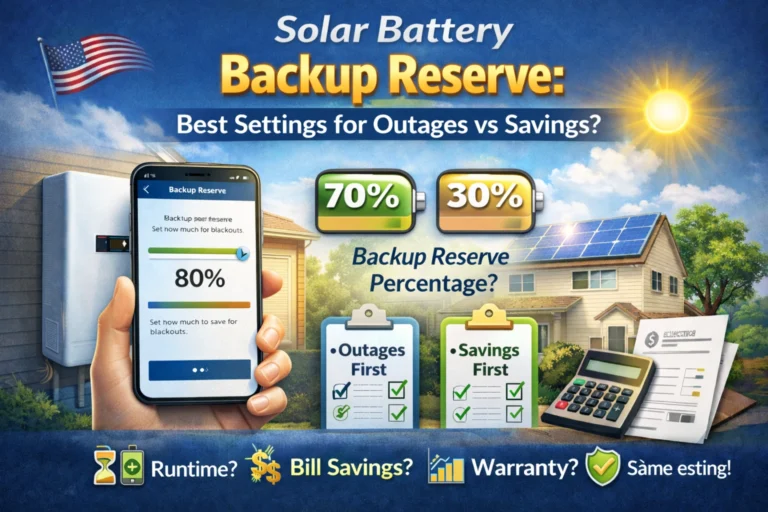
- Reserve settings (many backup systems hold back energy so you’re not at 0% during an outage)
A simple approximation:
Usable kWh ≈ Nameplate kWh × usable %
If you’re unsure, your installer should tell you the usable kWh.
Step 2: Adjust for efficiency (RTE)
If RTE is 90%, that means:
- Put in 10 kWh → get ~9 kWh out (over a full charge/discharge cycle)
So the battery “processes” more energy than it delivers.
A homeowner-friendly way to think about throughput:
Throughput counts energy through the battery (charging/discharging), not just what your house receives.
(Exact definitions vary by warranty; read the PDF.)
Step 3: Estimate your cycling pattern
Most homeowners fall into one of these patterns:
A) Backup-only (rare outages):
- You might do only a handful of meaningful cycles per year.
- You likely won’t hit the throughput limit.
B) Hybrid + daily shifting (self-consumption / TOU):
- You might cycle partially daily (e.g., 30–80%).
- You could hit throughput depending on the MWh cap.
A practical calculator (simple version)
Let’s define:
- Warranty throughput limit =
TMWh - Convert to kWh:
T_kWh = T × 1,000 - Average daily discharged energy from battery =
DkWh/day (what your home actually uses from the battery) - RTE =
η(e.g., 0.90)
A rough estimate of days until you hit throughput:
Days ≈ T_kWh × η / D
Then:
Years ≈ Days / 365
Example (illustrative, not a promise)
- Throughput limit: 40 MWh → 40,000 kWh
- RTE: 90% (0.90)
- You use 8 kWh/day from the battery on average
Days ≈ 40,000 × 0.90 / 8 = 4,500 days
Years ≈ 4,500 / 365 ≈ 12.3 years
In this scenario, time might end the warranty before throughput does (if it’s a 10-year time warranty). But if you used 12–14 kWh/day on average, throughput could get closer.
Want to sanity-check kW vs kWh while doing these estimates?
https://solarbasicshub.com/solar-battery-kw-vs-kwh/
What counts toward throughput (and what doesn’t)
This is where reading the warranty PDF matters.
Often, throughput relates to:
- Total energy charged into the battery
- Total energy discharged from the battery
- Or both (depending on definitions and metering)
Your usage pattern affects it:
- Backup-only: low throughput accumulation
- Daily shifting: faster throughput accumulation
- Oversized PV + frequent deep cycling: even faster
If your utility has time-of-use rates or your compensation uses net billing (instead of classic net metering), daily shifting becomes more common—so throughput matters more.
The “which clause triggers first?” rule (what competitors miss)
When comparing batteries, don’t stop at “10-year warranty.”
Ask:
- Will I hit the throughput cap before 10 years?
- What capacity retention is promised at the end (e.g., 70%)?
- Are there exclusions for my usage pattern or operating conditions?
If you plan daily cycling, throughput becomes the key differentiator. If you plan backup only, installation quality, safety design, and service support may matter more than throughput.
How to compare two battery quotes using warranties (homeowner checklist)
Use this checklist when comparing models or installer quotes:
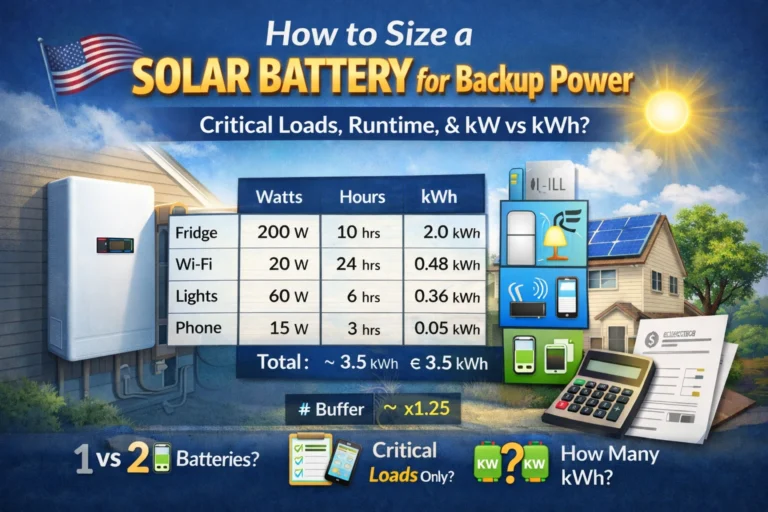
1) Confirm the battery’s usable kWh and usable kW
- Usable kWh affects runtime.
- Usable kW affects what it can run at once.
Start here: https://solarbasicshub.com/solar-battery-kw-vs-kwh/
2) Confirm coupling type (AC vs DC) and what that means for losses
Coupling can influence efficiency and retrofit complexity.
https://solarbasicshub.com/ac-coupled-vs-dc-coupled-solar-batteries/
3) Find the warranty limits in writing (not marketing bullets)
Ask for the warranty PDF for the exact model.
Look for:
- Time coverage (years)
- Throughput cap (MWh)
- Capacity retention promise
- What’s excluded (flood, fire, improper installation, etc.)
4) Do the “years of use” estimate for your intended pattern
- Backup-only: assume very low
D(kWh/day average) - Daily shifting: estimate
Dbased on what you want to offset at night
If you already know your evening usage from your bill, even better:
https://solarbasicshub.com/how-to-read-your-electric-bill-for-solar-before-after-going-solar/
5) Evaluate chemistry and duty cycle fit
Most modern home batteries are lithium-based; LiFePO4 is often discussed for longevity and safety characteristics, while lead-acid is still used in some off-grid contexts.
https://solarbasicshub.com/lifepo4-vs-lead-acid-solar-batteries/
6) Compare quotes apples-to-apples (warranties + assumptions)
Use the site’s quote checklist and add a battery section:
https://solarbasicshub.com/how-to-compare-solar-quotes/
Red flags + questions to ask your installer
Red flags
- “10-year warranty” stated, but no mention of throughput/capacity terms
- No warranty PDF provided
- Battery sized without discussing what loads you want backed up
- No clarity on critical components: gateway/ATS/backup panel, permitting, and service
Questions to ask
- What is the warranty throughput limit (MWh) for this exact model and configuration?
- Is my expected use pattern (backup-only vs daily cycling) covered the same way?
- What capacity retention is warranted at year 10 (or end of warranty)?
- What’s the expected RTE in my system (not just marketing spec)?
- What maintenance/monitoring is required to keep warranty valid?
Battery warranty terms: quick decoding table
| Warranty term | What it means (plain English) | Why you care | Where to verify |
|---|---|---|---|
| Time (years) | Calendar coverage length | Might end before you reach throughput | Warranty PDF |
| Throughput (MWh) | Total lifetime energy processed | Daily cycling can end warranty early | Warranty PDF / spec sheet |
| Capacity retention | Minimum capacity at end of warranty | Affects long-term backup and value | Warranty PDF |
| Exclusions | Conditions not covered | Poor install/unsupported use can void coverage | Warranty PDF + installer contract |
| RTE (efficiency) | % of energy you get back | Impacts savings + throughput pace | Spec sheet + system design |
FAQ
1) Is throughput warranty the same as cycle life?
Not exactly. Cycle life counts cycles; throughput counts total lifetime energy processed. They’re related, but throughput is often easier to translate into “years of typical use.”
2) Will I hit the MWh limit if I only want backup for outages?
Usually unlikely, because you don’t cycle often. But confirm your warranty terms.
3) If I do daily time-of-use shifting, should I prioritize a higher throughput limit?
Yes—if daily cycling is part of your plan, the throughput limit becomes a major value factor.
4) Does AC-coupled vs DC-coupled change throughput?
It can change efficiency and how energy is measured through conversions, which can influence how quickly you accumulate throughput depending on definitions. Start here: https://solarbasicshub.com/ac-coupled-vs-dc-coupled-solar-batteries/
5) What capacity retention should I expect?
Many warranties reference a capacity threshold around the end of warranty life (often ~70%, but it varies). Always check the PDF for the model you’re buying.
6) Can my settings (reserve level) affect warranty?
Reserve settings affect how much you use daily, which can affect throughput accumulation. Warranty validity conditions can also include proper configuration—ask your installer.
7) What’s the safest way to compare storage quotes?
Use a consistent method: same usage goal, compare usable kWh/kW, read warranty PDFs, and run a throughput “years-of-use” estimate. Then use: https://solarbasicshub.com/how-to-compare-solar-quotes/
Next to Read
- https://solarbasicshub.com/solar-battery-kw-vs-kwh/
- https://solarbasicshub.com/solar-battery-depth-of-discharge/
- https://solarbasicshub.com/solar-battery-round-trip-efficiency/
- https://solarbasicshub.com/ac-coupled-vs-dc-coupled-solar-batteries/
- https://solarbasicshub.com/how-to-compare-solar-quotes/
- https://solarbasicshub.com/solar-loan-vs-lease-vs-ppa/
- https://solarbasicshub.com/net-metering-explained-how-solar-credits-work-and-what-net-billing-changes/
- https://solarbasicshub.com/solar-basics-how-solar-power-works/