
If you’ve gotten more than one solar quote, you’ve probably seen three payment paths:
- Loan (you finance and own the system)
- Lease (a company owns the system; you pay a monthly fee)
- PPA (a company owns the system; you pay per kWh the system produces)
They can all reduce your bill—but they work very differently, especially when it comes to ownership, tax incentives, contract terms, and what happens when you sell your home.
Quick answer: which option is best for you?
Use this quick rule of thumb first—then we’ll prove it with a clear comparison table and a contract checklist.
- Best long-term savings (most homeowners): a loan (or cash) because you typically own the system and capture the main incentives.
- Best for “low hassle / low upfront”: a lease or PPA can work if you want immediate savings and don’t want system ownership responsibilities—but contract details matter a lot.
- Best if you might move soon (3–7 years): depends. Leases/PPAs can be transferable, but they can also complicate a sale. A loan can also complicate a sale if it must be paid off or assumed.
Key idea: the “best” option isn’t the one with the lowest monthly payment. It’s the one that fits your timeline, credit, roof, utility rates, and risk tolerance.
The one thing that changes everything: who owns the system
Here’s the simplest way to understand solar financing:
- If you own the solar system (cash or loan), you’re generally the one positioned to claim homeowner incentives like the federal residential credit (when eligible), and you benefit most from long-term value.
- If a third party owns the system (lease or PPA), the solar company typically claims incentives tied to ownership, and you get savings through the contract pricing.
Source: U.S. DOE solar financing guide (leases, loans, and PPAs). https://www.energy.gov/eere/solar/articles/homeowners-guide-solar-financing-leases-loans-and-ppas
Solar loan vs lease vs PPA (plain-English definitions)
Option 1) Solar loan (you own the system)
A solar loan is like financing any large home improvement. You (or your lender) pay the installer, and you repay the loan over time.
Pros:
- You typically own the system, which usually means maximum long-term value.
- Fixed payments are common (depending on lender).
- You can often choose equipment freely (panels, inverters, batteries).
Cons:
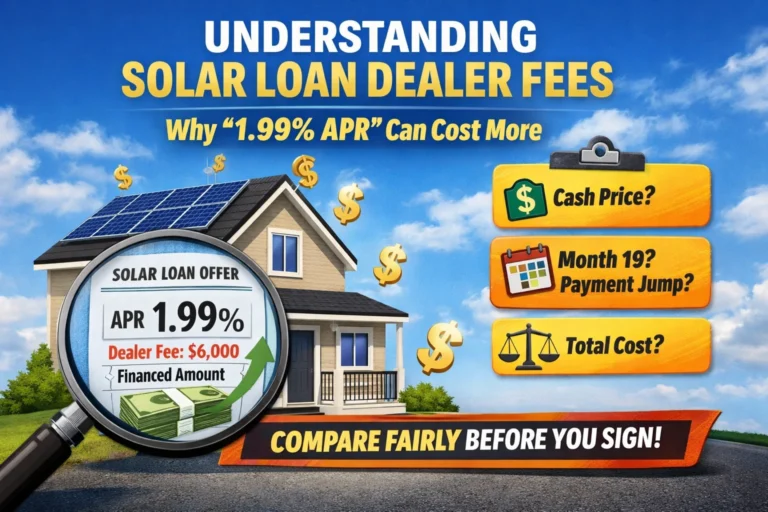
- Some “solar-specific” loans can include large upfront fees (often called dealer fees) that increase the total cost.
- Some loans are structured so payments jump if an expected tax-credit-style prepayment isn’t made.
Source: CFPB Issue Spotlight on solar financing and consumer risks. https://www.consumerfinance.gov/data-research/research-reports/issue-spotlight-solar-financing/
Option 2) Solar lease (a company owns the system)
With a solar lease, a company installs and owns the system on your roof. You pay a monthly lease payment (often with $0 down options).
Pros:
- Low upfront cost is common.
- Maintenance responsibilities may be reduced (depending on contract).
Cons:
- You typically do not own the system.
- Many leases include annual price escalators that can reduce savings if utility rates don’t rise as expected.
Source: NREL homeowner guide to solar leasing (questions to ask before signing). https://docs.nrel.gov/docs/fy14osti/60972.pdf
Option 3) Solar PPA (power purchase agreement)
A solar PPA is similar to a lease in that a company owns the system, but instead of paying a flat monthly amount, you pay for the electricity it produces at a set $/kWh (often lower than your utility rate).
Pros:
- Often low or $0 upfront cost.
- Pricing is tied to production (you pay for energy, not the equipment).
Cons:
- You typically don’t own the system and generally don’t claim ownership-based incentives.
- Contract terms (escalators, buyout schedules, transfer rules) can matter more than the advertised rate.
Source: U.S. DOE solar financing guide. https://www.energy.gov/eere/solar/articles/homeowners-guide-solar-financing-leases-loans-and-ppas
Comparison table: loan vs lease vs PPA (what actually changes)
This table is the “cheat sheet” most homeowners wish they had before talking to sales reps.
| Feature | Solar Loan (Own) | Solar Lease (3rd-party owned) | Solar PPA (3rd-party owned) |
|---|---|---|---|
| Who owns the system? | You | Solar company | Solar company |
| How you pay | Monthly loan payment (often fixed) | Monthly lease payment (often escalator) | Pay per kWh produced (often escalator) |
| Incentives/tax credit positioning | Owner is positioned to claim when eligible | Company typically claims (you benefit indirectly via pricing) | Company typically claims (you benefit indirectly via pricing) |
| Maintenance & repairs | Usually your responsibility (warranty applies) | Often included, check contract | Often included, check contract |
| Home sale impact | May need payoff or buyer assumption | Transfer/buyout terms can complicate sale | Transfer/buyout terms can complicate sale |
| Best fit | Max long-term savings + ownership control | Low upfront + “hands-off” preference | Low upfront + pay-for-production structure |
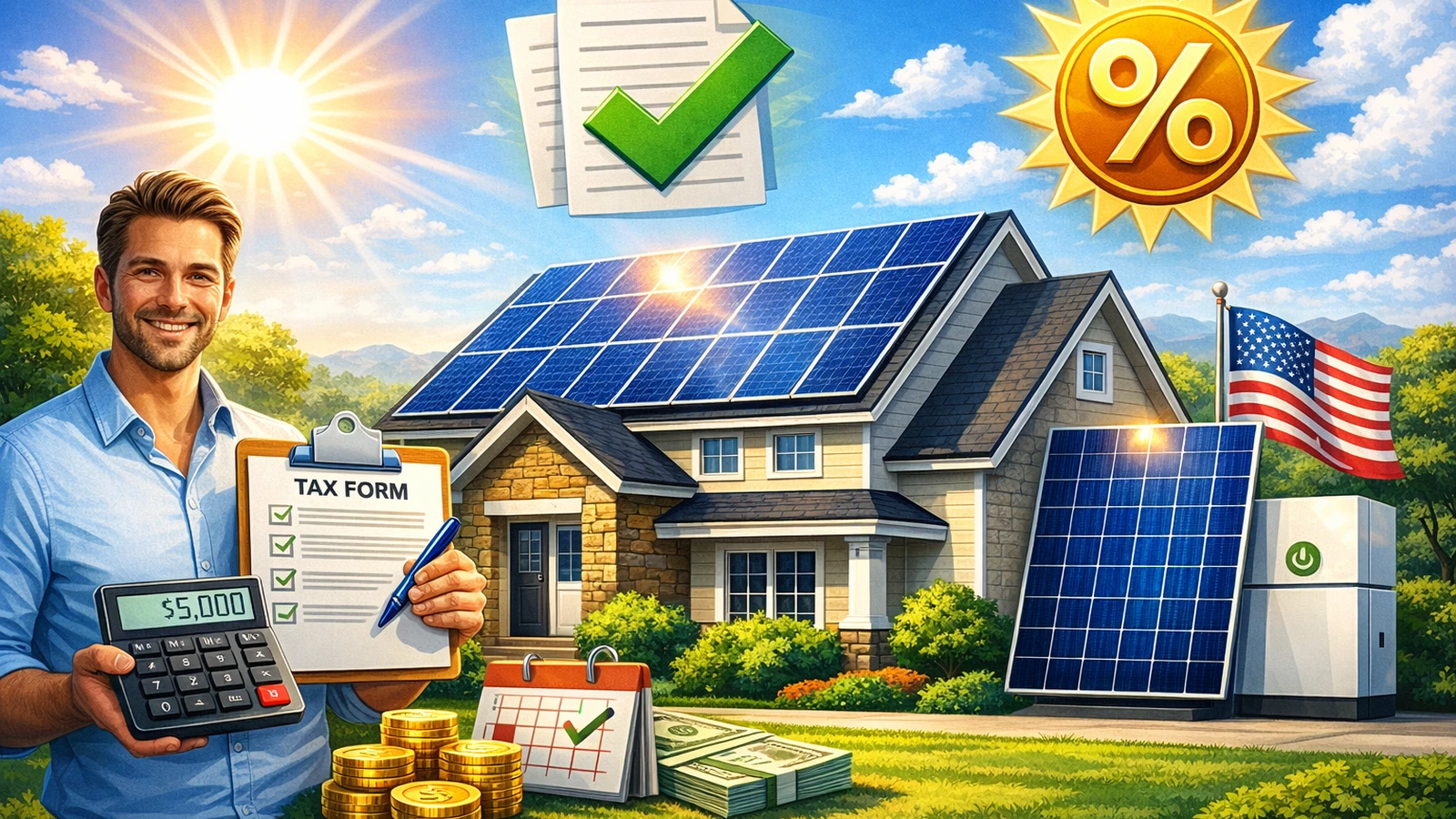
Incentives & tax credits: the safe way to think about it
In general, incentives depend on rules that can change over time and vary by program. The safest homeowner framing is:
- Ownership matters. Many homeowner-focused incentives are designed around who owns the system.
- Timing matters. Some benefits depend on when a system is placed in service.
If you want the clean “how it works” version for your site’s current credit framing, read:
Monthly payments: fixed vs escalator vs per-kWh pricing
Be careful comparing “monthly payment” numbers across financing types:
- Loan: payment is for the equipment financing (not tied to production).
- Lease: payment is for the right to use the system; many contracts include annual escalators.
- PPA: payment depends on production (kWh) times a rate; contracts may also include escalators.
The contract-traps checklist (what to review before signing)
If you only read one section, read this one. Solar is a 20–25 year decision; the contract matters as much as the equipment.
1) Loan “dealer fees” and true system price
Some solar-specific loans advertise low APRs but bake large fees into the project cost. That can inflate the financed amount and reduce your real ROI.
Source: CFPB advisory on costly/complex solar loans. https://www.consumerfinance.gov/about-us/newsroom/consumer-advisory-steer-clear-of-costly-and-complex-loans-for-solar-energy-installation/
2) “Payment re-amortization” surprises
Some loans assume you’ll make a large prepayment later (often tied to an expected credit). If you don’t, the monthly payment may jump.
Source: CFPB solar financing spotlight. https://www.consumerfinance.gov/data-research/research-reports/issue-spotlight-solar-financing/
3) Lease/PPA escalator clauses
An escalator is a scheduled yearly price increase. If your lease/PPA rises faster than utility prices, savings can shrink.
What to do: ask for a “no escalator” option price and compare the 20-year total cost.
4) Production assumptions and shade risk
Savings depend on production. If production estimates are inflated, your payback estimate is inflated too.
Use SolarBasicsHub’s planning fundamentals to sanity-check:
- https://solarbasicshub.com/how-to-read-your-electric-bill-for-solar-before-after-going-solar/
- https://solarbasicshub.com/net-metering-explained-how-solar-credits-work-and-what-net-billing-changes/
5) Liens and special financing (PACE)
Some solar financing structures can create property-related obligations that may affect refinancing or sale.
Source: U.S. Treasury consumer guide (“Before You Purchase and Finance Solar Panels”). https://home.treasury.gov/system/files/136/Guide-Before-You-Buy-Solar-Panels-eng.pdf
What happens when you sell your home?
This is where many homeowners get surprised. The safest mindset is: assume your future buyer will ask, “What exactly am I taking over?”
If you have a loan
- You may need to pay off the loan at closing, or
- The buyer may need to assume the loan (if allowed), or
- The loan may be structured in a way that requires lender approval.
Source: U.S. Treasury consumer guide. https://home.treasury.gov/system/files/136/Guide-Before-You-Buy-Solar-Panels-eng.pdf
If you have a lease or PPA
- Many agreements can be transferred, but the new buyer may need to qualify.
- If the buyer doesn’t want it (or can’t qualify), you may face a buyout or removal decision.
Source: NREL guides discuss lease/PPA transfer and contract considerations. https://docs.nrel.gov/docs/fy14osti/60972.pdf
How to decide in 15 minutes (simple decision tree)
- How long will you stay in the home?
- < 5 years: focus on transfer/buyout rules and buyer friction.
- 5–10 years: financing structure matters a lot; model conservative savings.
- 10+ years: ownership tends to win on lifetime value (all else equal).
- Do you want ownership control?
- If yes → loan (or cash) is usually the cleanest fit.
- If no → lease/PPA can work, but scrutinize escalators and buyout terms.
- Can you clearly verify the savings math?
- If not, pause. Use your bill and net metering rules to validate assumptions.
Questions to ask (copy/paste for any installer or provider)
- Who owns the system on day 1 and in year 10?
- Is there an escalator? What’s the 20-year total cost with and without it?
- If this is a loan: what fees are included in the financed amount (dealer fees)?
- What happens if I sell my home—transfer requirements, buyout schedule, and costs?
- What production assumptions were used (shade, orientation, degradation)?
- What maintenance is included and what is excluded?
- What happens if the system underproduces—any guarantees and remedies?
FAQ
1) Solar lease vs PPA: what’s the difference?
A lease is usually a flat monthly payment. A PPA usually charges per kWh produced. Ownership is typically third-party in both cases.
Source: U.S. DOE solar financing guide. https://www.energy.gov/eere/solar/articles/homeowners-guide-solar-financing-leases-loans-and-ppas
2) Is a solar PPA worth it?
It can be if you want low upfront cost and your contract offers clear, durable savings without aggressive escalators or restrictive transfer rules.
3) What are the biggest solar loan pros and cons?
Pros: ownership control and often better lifetime value. Cons: some solar-specific loans can hide large fees or future payment changes.
Source: CFPB solar financing spotlight. https://www.consumerfinance.gov/data-research/research-reports/issue-spotlight-solar-financing/
4) Does solar financing affect net metering savings?
Net metering rules affect value regardless of financing, but financing affects who captures the value and how quickly you break even.
5) Will a lease or PPA make it harder to sell my home?
Sometimes. Transfer rules and buyer qualification requirements can add friction. Always read the transfer and buyout sections before signing.
Source: NREL lease guide. https://docs.nrel.gov/docs/fy14osti/60972.pdf
6) What should I read next to validate my solar savings?
- https://solarbasicshub.com/how-to-read-your-electric-bill-for-solar-before-after-going-solar/
- https://solarbasicshub.com/solar-cost-breakdown/
Next to Read
- https://solarbasicshub.com/solar-cost-breakdown/
- https://solarbasicshub.com/solar-tax-credit-2026/
- https://solarbasicshub.com/how-to-read-your-electric-bill-for-solar-before-after-going-solar/
- https://solarbasicshub.com/net-metering-explained-how-solar-credits-work-and-what-net-billing-changes/
- https://solarbasicshub.com/solar-components-and-sizing-basics/