
Last updated: February 15, 2026
If you’re adding a battery to solar, you’ll hear two terms that sound technical but are actually simple:
- AC-coupled battery systems connect on the AC side (after a solar inverter).
- DC-coupled battery systems connect on the DC side (before AC conversion), usually through a hybrid inverter or DC-coupled architecture.
In plain English: the difference is where and how many times electricity is converted between DC and AC. That’s why coupling affects efficiency, retrofit ease, and what hardware you need.
Start here (pillar): Solar Basics (Start Here)
Who this is for
- You already have solar and want to add a battery (retrofit decision).
- You’re installing solar + battery together and want the cleanest architecture.
- You’re comparing quotes and want to avoid apples-to-oranges efficiency claims.
Quick definitions (no jargon)
AC-coupled battery (common retrofit option)
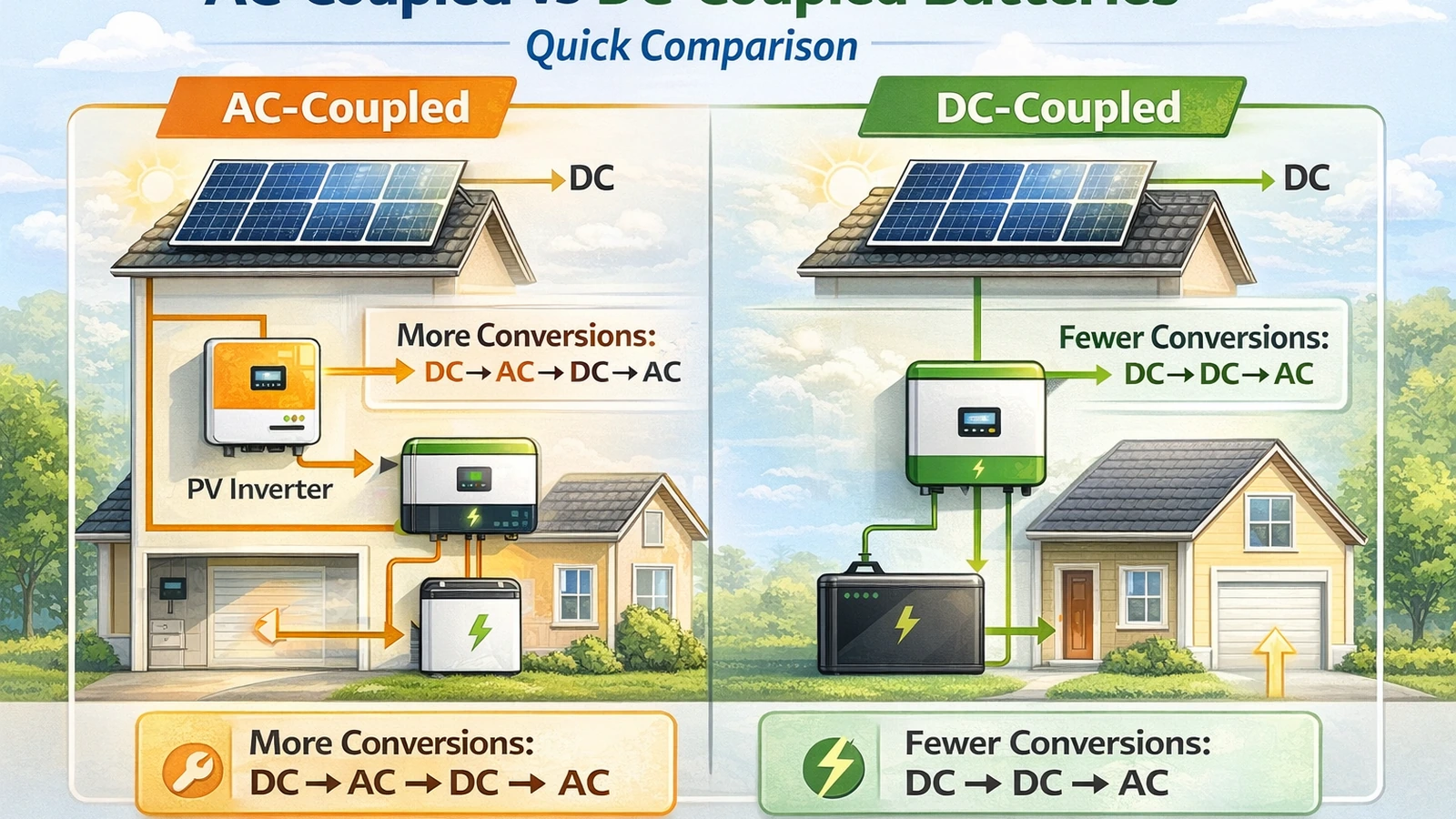
Your solar panels produce DC. A solar inverter converts DC to AC for your home. An AC-coupled battery then uses a separate battery inverter (or integrated storage inverter) to convert AC back to DC for charging, then back to AC when powering your home.
Key idea: AC-coupled often means more conversion steps, but it can be very flexible when you already have a working solar inverter.
DC-coupled battery (common “new build” option)
With DC coupling, solar DC can charge the battery before converting to AC, typically using a hybrid inverter or DC-coupled storage design. When the home needs power, the system converts DC to AC through the inverter.
Key idea: DC coupling often means fewer conversions when storing solar energy, which can improve efficiency for “store-now, use-later” behavior.
Why coupling affects efficiency (the conversion-count concept)
Solar panels produce DC, batteries store DC, and your home uses AC. Every time electricity is converted between DC and AC, a small amount of energy is lost as heat.
Typical pattern:
- AC-coupled storage path: DC (solar) → AC (solar inverter) → DC (battery charging) → AC (battery powering home)
- DC-coupled storage path: DC (solar) → DC (battery charging) → AC (inverter to home)
Practical takeaway: If your main goal is to store a lot of solar energy for later use (evening/night), the “fewer conversions” logic can favor DC coupling. But the best choice still depends on your situation and pricing.
Related (and important): Efficiency comes in different “measurement boundaries.” Learn what it means here: Solar Battery Round-Trip Efficiency (RTE)
Original value: the 60-second decision table
| Your situation | Often the best fit | Why |
|---|---|---|
| You already have solar and your inverter is in good shape | AC-coupled | Usually easiest retrofit: add storage without replacing the existing solar inverter. |
| You’re installing solar + battery at the same time | DC-coupled (hybrid inverter) | Cleaner architecture; can reduce conversion steps when charging from solar. |
| You want to expand solar later or mix equipment | Often AC-coupled | Can be more flexible with existing PV inverter compatibility (depends on brand and rules). |
| You care about capturing every possible kWh for later use | Often DC-coupled | Potential efficiency advantage for “store now, use later” energy flows. |
| You want detailed monitoring and module-level control | Depends on inverter/MLPE choices | Coupling doesn’t decide monitoring alone—your inverter/MLPE ecosystem does. |
Real-world nuance: sometimes the efficiency difference is small
It’s tempting to choose solely on “DC-coupled is more efficient.” In many cases, that’s directionally true for storage-heavy usage because of fewer conversion steps. But the real dollar value of a few percent depends on:
- how often you cycle the battery,
- how much surplus solar you have,
- your utility export credit / feed-in rate, and
- whether you’re hitting export limits.
In other words: if surplus solar is low-value in your area, a small efficiency edge may not be the deciding factor. Price, warranty, and retrofit complexity can dominate.
Useful pair to understand before you compare quotes: Battery kW vs kWh and Depth of Discharge (DoD).
Hardware differences you should expect in quotes
AC-coupled setups often include
- Your existing solar inverter (kept in place), plus
- A battery inverter (or “storage inverter”), plus
- The battery itself.
DC-coupled setups often include
- A hybrid inverter (PV + battery in one system), plus
- The battery itself (and sometimes additional DC equipment depending on design).
Tip: If a DC-coupled quote requires replacing a perfectly good inverter, it can erase the “efficiency advantage” financially. This is why retrofit scenarios often lean AC-coupled.
How to compare two quotes fairly (copy/paste questions)
- 1) Is the battery AC-coupled or DC-coupled? (Explain where it connects.)
- 2) What is the system’s round-trip efficiency, and is it AC-to-AC?
- 3) What is usable capacity (kWh) after DoD limits and reserve settings?
- 4) What is continuous power (kW) and surge/peak power?
- 5) If this is a retrofit, what happens to my existing solar inverter? Keep vs replace, and why.
- 6) What monitoring do I get (app, circuits, export limits, outage behavior)?
- 7) What does the warranty limit: time only, or throughput/energy cycled too? (This is often overlooked.)
Planned next: Solar Battery Throughput Warranty (planned)
Where MLPE fits (microinverters, optimizers) — quick note
Coupling is about where the battery connects. MLPE is about how solar production is managed at the panel level. Your system can involve both decisions.
If you’re comparing inverter ecosystems, this guide helps: Power Optimizer vs Microinverter.
When to consult a professional
- If your project involves changes to your main panel, adding subpanels, or backup circuits, use a licensed solar + electrical professional for safe code-compliant design.
- If you want whole-home backup or plan to run HVAC/pumps/motor loads, ask for a professional “critical loads” plan and verified surge capability.
- If your installer can’t clearly explain coupling type, measurement boundary for efficiency (AC-to-AC vs DC-to-DC), or warranty limits, get a second quote before signing.
Quick recap
- AC-coupled is often the easiest path for retrofits because it can work alongside an existing solar inverter.
- DC-coupled often reduces conversion steps when storing solar energy, which can improve efficiency for “store now, use later” use.
- The best choice depends on your retrofit situation, pricing, export credits, and how you’ll actually use the battery day-to-day.