
Last updated: February 13, 2026
If you’re comparing solar quotes, you’ll see three common inverter “architectures”:
- String inverter (one central inverter for a group of panels)
- Power optimizers + string inverter (small devices on each panel + central inverter)
- Microinverters (a small inverter on each panel)
Microinverters and power optimizers are both examples of module-level power electronics (MLPE)—they help reduce losses from shading and panel mismatch and improve monitoring detail. But they solve the problem in different ways, and the “best” choice depends on your roof layout, shading, budget, and how you want maintenance to work over time.
Start here: Solar Basics (Start Here)
Who this is for
- You’re choosing between quotes that use microinverters vs optimizers.
- Your roof has shade, multiple orientations (east/west), or complex planes.
- You want to understand warranties, monitoring, and maintenance before you commit.
Quick definitions (what each one actually does)
1) String inverter (baseline)
A traditional string inverter converts DC from the array into AC in one central unit. Panels are wired in “strings,” and the string’s performance can be limited by the weakest panel (for example, a shaded or dirty module).
2) Power optimizers + string inverter (hybrid MLPE)
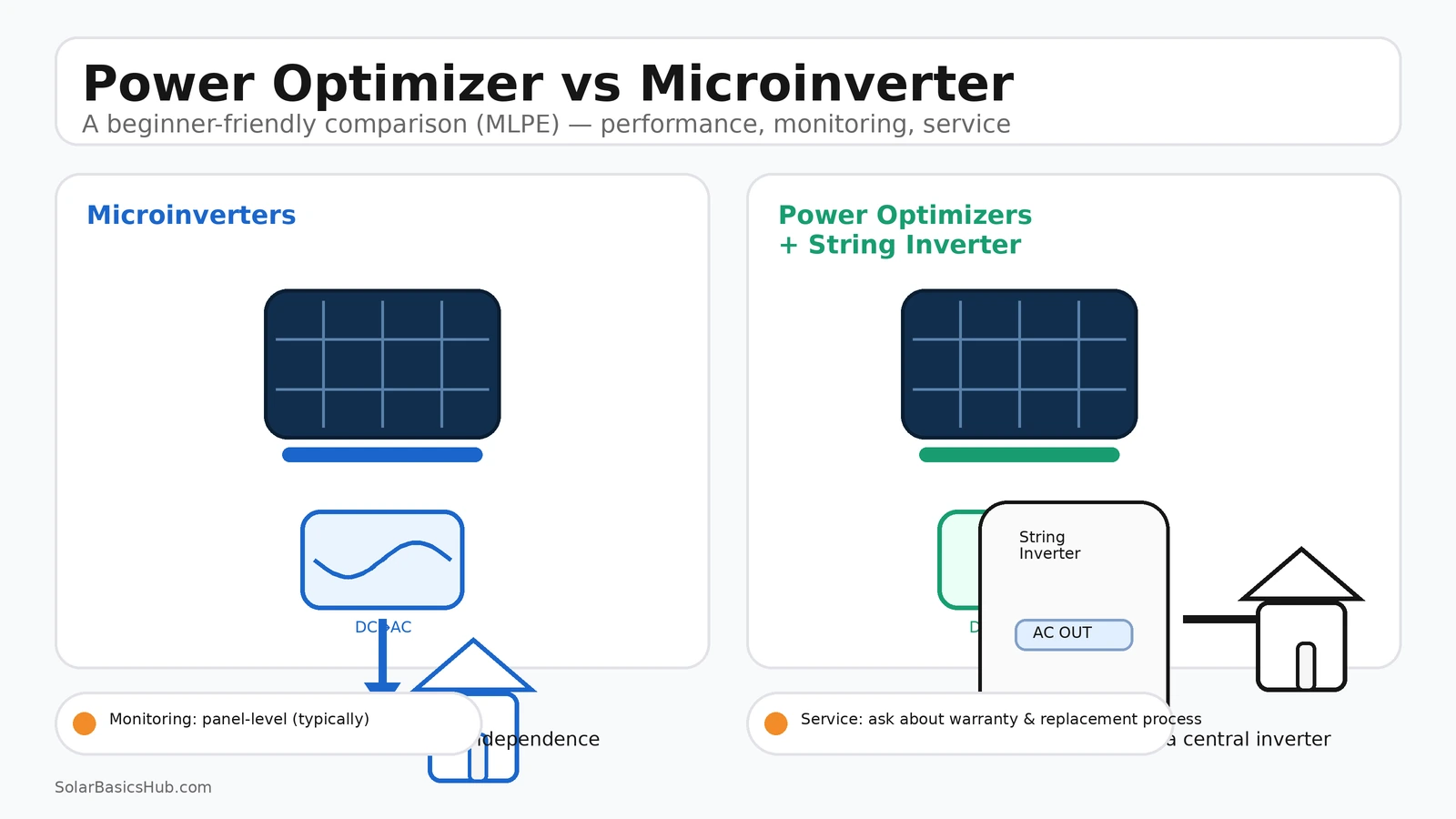
A power optimizer sits at each panel and performs panel-level optimization (DC-to-DC conditioning and MPPT). The optimized DC power then goes to a central string inverter for DC-to-AC conversion. This keeps a single central inverter, while improving panel-level control and monitoring.
3) Microinverters (full panel-level inversion)
A microinverter converts DC-to-AC directly at each panel. Each panel operates more independently, and the system produces AC right on the roof (then combines into an AC circuit).
Related inverter basics: String Inverter vs Microinverter
The biggest difference in one sentence
Microinverters do the DC-to-AC conversion at each panel.
Optimizers improve DC at each panel but still rely on a central inverter for DC-to-AC conversion.
How shading and roof complexity affect the decision
Shading and mismatch are where MLPE shines. When panels in the same string receive different sunlight (shade from a tree, chimney, or even dirt), the string can lose energy because panels share current/voltage constraints.
Research and modeling work from NREL discusses MLPE (including microinverters and DC optimizers) as tools to reduce mismatch losses and improve performance under certain shading conditions. In general terms: MLPE can make shaded arrays behave “more like” independent panels rather than one constrained chain.
What this means for you:
- Little to no shade + simple roof plane: a string inverter can be cost-effective and perfectly fine.
- Moderate shade or multiple roof planes/orientations: optimizers or microinverters often help recover energy and simplify design.
- Heavy shade: MLPE can help, but it won’t magically fix a bad site. The best “performance upgrade” may be trimming/removing shade or choosing a different array location.
Useful concept: “Realistic losses” matter more than perfect numbers. Use this to sanity-check production assumptions: Solar Performance Ratio (PR) Explained
Warranties and long-term maintenance (where optimizers differ)
In many markets, microinverters and power optimizers often carry long warranties, but optimizer systems still include a central inverter that may have a shorter warranty unless upgraded. This matters because over a 20–25 year system life, you want to know what is covered and what replacement costs might look like.
Practical takeaway: when comparing two quotes, don’t compare only “25-year coverage” at the headline level. Confirm whether that applies to:
- the panel-level devices (microinverter or optimizer), and
- the central inverter (only present in optimizer + string systems, and in pure string-inverter systems).
Monitoring: what you can see (and how fast you can troubleshoot)
Both MLPE approaches commonly offer panel-level monitoring, which helps you spot an underperforming module (shade, soiling, or a device problem) faster than system-level monitoring alone.
Rule of thumb:
- If you want the most granular visibility and easy identification of a single weak panel, MLPE is often the better fit.
- If you prefer simpler electronics on the roof and a single point of conversion, a string inverter can still work—especially on a clean, unshaded roof.
Safety & shutdown notes (keep it simple)
Some MLPE systems support rapid-shutdown / safety features depending on local code requirements and product design. Instead of trying to “DIY interpret” compliance, ask each installer to confirm in writing that the system design meets your local electrical code and utility interconnection requirements.
Original value: decision table (pick the best fit in 60 seconds)
| Your situation | Usually best fit | Why |
|---|---|---|
| Simple roof, little/no shade, budget-focused | String inverter | Lower upfront cost; fewer roof-level electronics |
| Moderate shade OR multiple roof planes/orientations | Optimizers or microinverters | Panel-level control reduces mismatch losses and improves visibility |
| You want panel-level DC-to-AC conversion + granular monitoring | Microinverters | Independent conversion per module; easy per-panel troubleshooting |
| You want MLPE benefits but prefer a central inverter for conversion | Optimizers + string inverter | Panel-level DC optimization with a central inverter architecture |
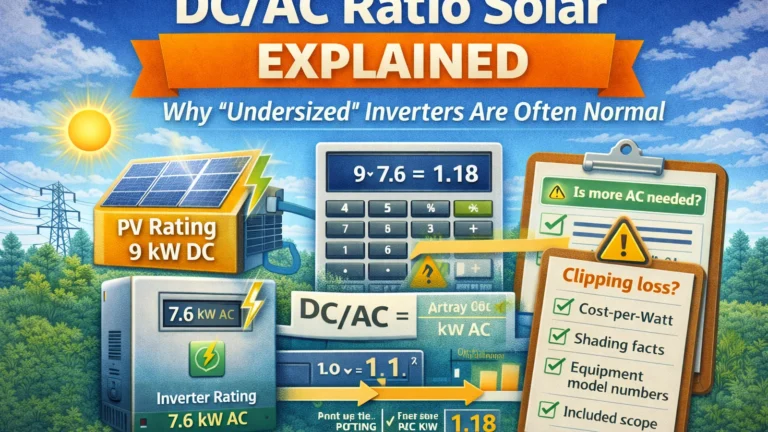
| You’re worried about “clipping” and DC/AC sizing | Depends on design | Compare DC/AC ratio, clipping assumptions, and equipment limits |
Related (planned): DC/AC Ratio Solar (planned)
Quote checklist (copy/paste questions)
- 1) What is my roof’s shading/orientation assumption? Show the shade analysis or model inputs.
- 2) What’s the exact inverter architecture? String vs optimizers vs microinverters.
- 3) What are the exact model numbers? Panels + inverter(s) + optimizers (if used).
- 4) What monitoring do I get? System-level or panel-level?
- 5) What are the warranty terms for every power-conversion component? (especially the central inverter in optimizer systems)
- 6) What is the DC/AC ratio and expected clipping loss? Ask for the modeled clipping %.
- 7) What happens if one device fails? Service process, response time, and who handles warranty claims.
- 8) How does the design comply with local code + utility interconnection rules?
Helpful sizing basics: Solar Components & Sizing Basics
When to consult a professional
- If your roof has complicated shading, many planes, or structural concerns, consult a qualified solar designer and (if needed) a roofing/structural professional.
- If any quote includes changes near your meter, main panel, or service equipment, use licensed professionals for safety and code compliance.
- If an installer can’t provide equipment datasheets and written warranty terms, get a second quote—this is a long-term asset.