
Last updated: February 11, 2026
If you want accurate solar savings, start with your electric bill—not the sales pitch. The bill tells you (1) how much energy you actually use in kWh, (2) what you pay per kWh (and when), and (3) which charges solar usually can’t remove.
This guide shows what to extract from your bill before solar (to size and compare quotes) and what to watch after solar (to understand credits, “net usage,” and annual true-up statements).
Start Here (pillar): Solar Basics (Start Here)
Who this is for
- You’re planning solar and want to pull the right numbers from your last 12 bills.
- You already have solar and your statement shows exports, credits, carry-forward, or true-up.
- You’re on (or considering) Time-of-Use (TOU) and want to see how timing changes savings.
Quick glossary (so the bill makes sense)
- kWh: energy used over time (what you’re billed for).
- kW: power at an instant (size of loads and solar system).
- Import / delivered: energy you take from the grid.
- Export / received: energy your solar sends to the grid.
- Fixed charges: customer/meter/minimum bill charges that often remain even with solar.
- True-up: a periodic settlement (often annual) that reconciles credits and charges.
Related: kW vs kWh in Solar
The 5 bill sections to look for (almost every utility)
- Billing period & meter reads (start/end dates, number of days)
- Total usage (kWh) and sometimes a 12-month usage chart
- Rate plan details (flat rate or TOU periods)
- Itemized charges (energy charges vs fixed charges, taxes/fees)
- Solar / net metering section (imports, exports, credit balance, carry-forward, true-up)
Before solar: pull the numbers that drive system size & savings
Step 1) Collect 12 months of kWh (not dollars)
Write down the kWh used each month for the last year (your bill often includes a bar chart). Add them up to get annual kWh. This is the best starting point for sizing because both usage and solar production vary seasonally.
Step 2) Identify your pricing structure (flat rate vs TOU)
If your bill shows “Peak / Off-Peak” (or similar buckets), you’re likely on TOU. Under TOU, your savings depend on when you use energy, not just how much you use.
Step 3) Separate variable charges from fixed charges
Many bills separate “energy” charges (kWh × rate) from fixed charges (customer/meter/minimum bill). Solar typically reduces the energy portion most, while fixed charges often remain.
Original value: the Bill-to-Solar worksheet (copy/paste)
Use this table to standardize your data before comparing quotes.
| What to extract | Where it appears on most bills | Fill in |
|---|---|---|
| Annual usage (kWh) | 12-month history chart or “usage” line | _____ kWh/year |
| Highest-month usage (kWh) | Summer/winter peak month in the history chart | _____ kWh/month |
| Rate plan name | Account summary / rate schedule | ____________ |
| Energy rate(s) | Pricing details (flat or TOU peak/off-peak) | $______/kWh (or list TOU) |
| Fixed monthly charges | Customer/meter/minimum bill line items | $______/month |
| Any demand charge? | Sometimes shown as $/kW with a “max demand” value | Yes / No |
Next step reading: Solar Components & Sizing Basics
A safe “ballpark” savings reality check (no risky math)
When you see a quote, sanity-check it with your bill data:
- If your annual usage is 9,000 kWh and your average energy rate is $0.20/kWh, then your energy portion of the bill is roughly $1,800/year.
- Your actual bill may be higher because fixed charges, taxes, and fees can remain.
Installers should explain what portion of your bill their “offset” estimate is targeting and what charges likely remain.
Useful reads:
• Solar Cost Breakdown
• Solar Performance Ratio (PR) Explained
• Peak Sun Hours Explained
After solar: how to read imports, exports, credits, and true-up
1) Find the import/export summary
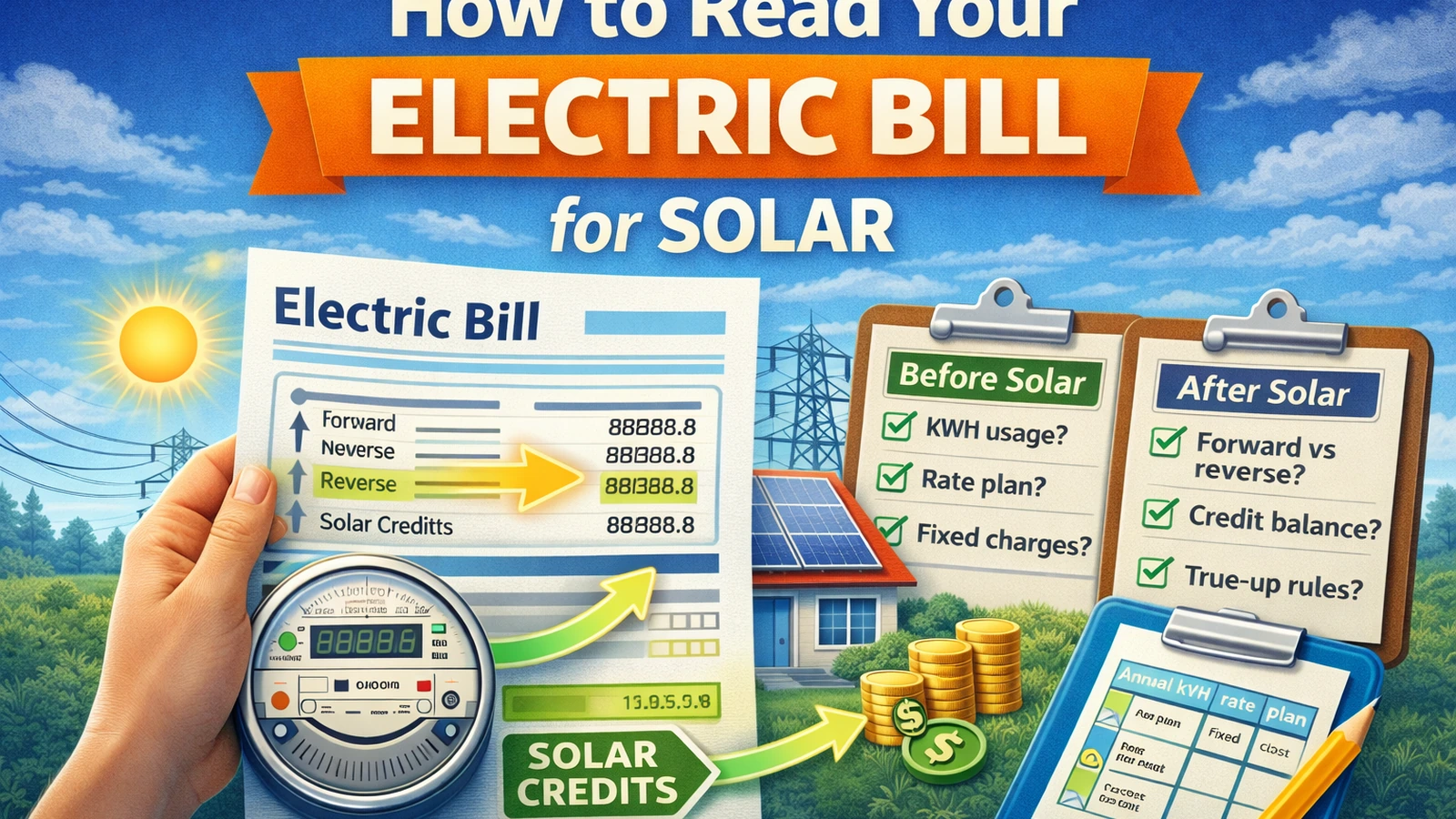
Many net metering bills show kWh delivered to you (imports) and kWh received from you (exports). Some utilities label these as “Forward kWh” and “Reverse kWh,” or use register numbers.
2) Locate the net usage line
Net usage is usually imports minus exports for the billing period. If it’s negative, you exported more than you imported and may add to a credit balance (depending on your program).
3) Check the credit balance / carry-forward
Look for a running balance of credits (kWh or $). Some utilities show a “carry-forward” amount that rolls into the next month.
4) Understand minimum bills and fixed charges
Even with lots of credits, you may still owe a minimum monthly charge or fixed customer/meter fees. This is a common “why do I still have a bill?” moment for new solar owners.
5) True-up statement (if your utility uses one)
Some utilities reconcile credits and charges on a schedule (often annually). A true-up statement can show what you owe (or what happens to leftover credits) for the settlement period.
Related: Net Metering Explained
TOU tip: why solar owners can still pay “peak” prices
Solar often produces most around midday. In many TOU plans, the highest prices occur in the late afternoon/evening—when solar is dropping. That mismatch can reduce savings compared to a flat-rate plan, and it’s one reason some homeowners consider load shifting (running appliances earlier) or batteries.
Common reasons your post-solar bill looks “wrong”
- Seasonal swing: winter production is lower; summer cooling loads may be higher.
- Fixed charges: customer/meter/minimum bills remain even if net kWh is low.
- Export rate is lower: under net billing, exporting a lot may be worth less than importing.
- Billing cycle mismatch: your monitoring app’s dates may not match the utility billing dates.
If production itself looks unusually low, start with safe checks first: Why Is My Solar Production Low? (planned)
When to consult a professional
- If your bill includes TOU riders, demand charges, or complex credits, ask a qualified solar advisor to model savings under your exact tariff.
- If any solar proposal includes work near the main panel, meter, or service equipment, use licensed professionals for safety and code compliance.
- If your utility statement seems inconsistent, contact the utility for a written explanation of the credit calculation and true-up rules.