
Last updated: February 11, 2026
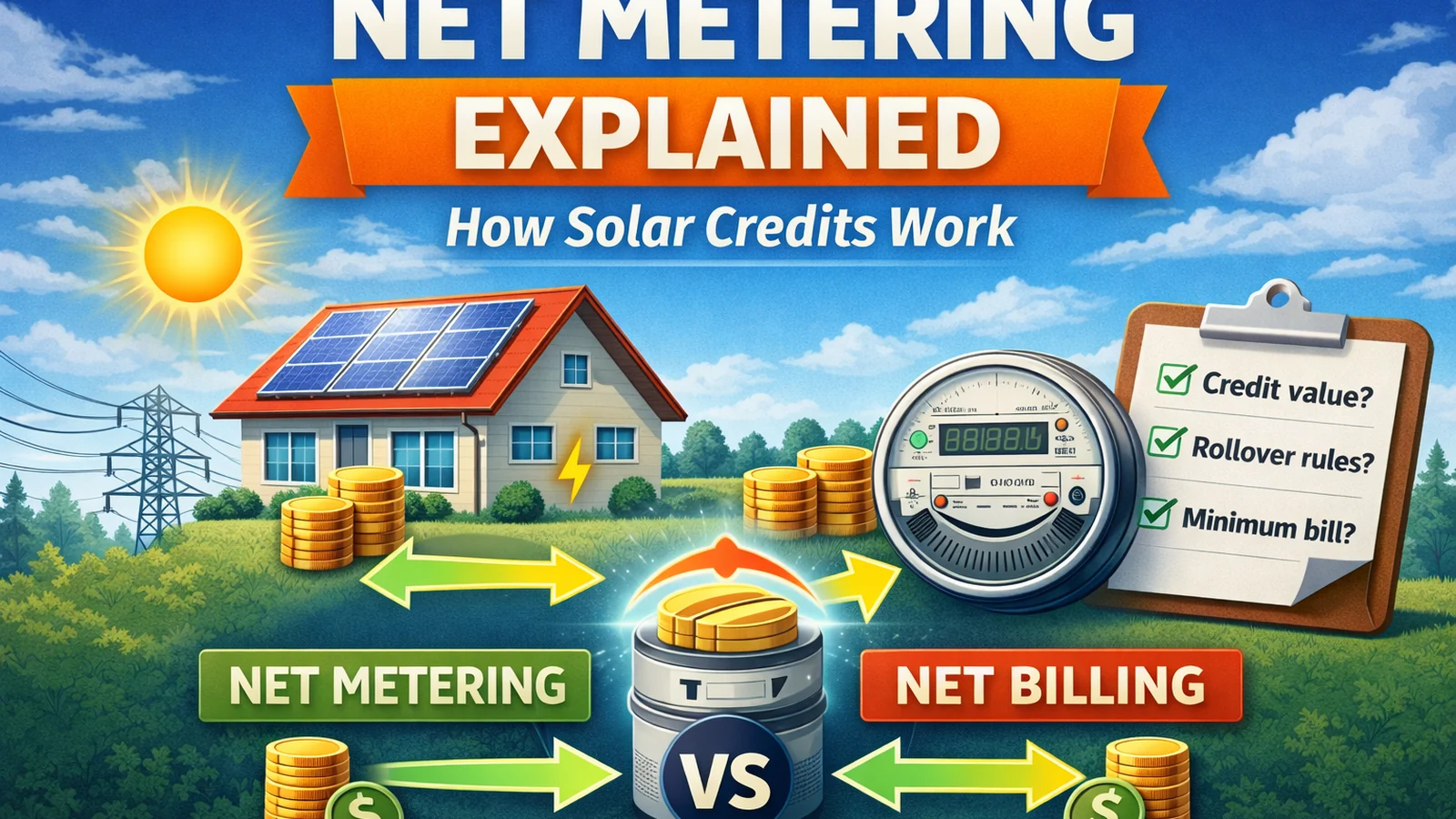
Net metering is a billing mechanism that credits you for excess solar electricity you send to the grid. Those credits can offset electricity you import later (often at night). The details vary by utility and rate plan—so your savings depend on credit value and credit rules, not just panel size.
Start Here (pillar): Solar Basics (Start Here)
Who this is for
- You’re planning a grid-tied solar system and want to understand “bill credits.”
- Your quote mentions net metering, export credits, or net billing.
- You want to avoid oversizing a system that earns low-value credits.
The 60-second model (imports, exports, credits)
- When solar production is higher than your home’s demand, the extra energy is exported to the grid.
- Your utility records those exports and applies an export credit (either as kWh credits, dollar credits, or both).
- When solar is low, your home imports energy from the grid—and credits can offset part of the bill.
Related: kW vs kWh in Solar
How credits are tracked (kWh bank vs $ credits)
| Credit style | What you’ll see on the bill | Why it matters |
|---|---|---|
| kWh “bank” | A running balance of exported kWh (often shown as a credit/negative balance) | Great for understanding seasonal carryover, but true-up rules can change the value |
| $ bill credit | Exports converted into a dollar credit at an export rate | If the export rate is low, exporting a lot may not offset expensive imports |
Rollover and “true-up” (the hidden value drivers)
Most programs include rules for what happens to credits over time:
- Rollover: unused credits may carry to the next month.
- True-up / settlement: many programs settle on a schedule (often annually). Remaining credits may roll forward, expire, or be paid out at a different rate.
- Minimum bill / fixed charges: some charges stay even if you have lots of credits.
Bottom line: if credits don’t roll over fairly (or the export rate is much lower than your import rate), “extra” solar production can be worth far less than most people assume.
Net metering vs net billing vs buy-all/sell-all
| Model | How exports are valued | Best for |
|---|---|---|
| Net metering | Exports offset imports using credits that are often close to the retail rate | Maximizing bill offset when export value is high |
| Net billing | Exports credited separately, often at a lower export rate | Homes that can use more solar directly (daytime loads) or time-shift with storage |
| Buy-all / sell-all | Solar sold under a separate rate; all home use purchased normally | Specific programs where the sell rate is attractive |
Original value: a “same panels, different savings” table
Assume you import 400 kWh and export 300 kWh in a month.
| Scenario | Import rate | Export credit | Typical outcome |
|---|---|---|---|
| Net metering (near 1:1) | $0.20/kWh | ~$0.20/kWh equivalent | You usually pay for ~100 kWh net imports (plus fixed charges) |
| Net billing | $0.20/kWh | $0.08/kWh export | Exports don’t offset imports 1:1; savings depend more on self-consumption |
| TOU rates | Higher at peak | Varies by time | Timing can matter as much as total kWh (midday exports vs evening imports) |
How this changes system sizing (safe planning)
- High export value: sizing closer to annual usage can make sense.
- Low export value: avoid big overproduction; prioritize self-consumption and realistic estimates.
Use realistic production assumptions (losses, heat, inverter conversion). This helps avoid quotes that look great on paper but underdeliver in real life.
Related: Solar Performance Ratio (PR) Explained
Related: Solar Components & Sizing Basics
Quote checklist: 8 questions to ask (copy/paste)
- 1) What is the exact rate plan name?
- 2) What is the export credit rate? (and does it change by time-of-use?)
- 3) Are credits tracked as kWh, dollars, or both?
- 4) Do credits roll over monthly? If yes, do they expire?
- 5) Is there an annual true-up? What happens to remaining credits?
- 6) What fixed charges/minimum bills remain?
- 7) Is system size capped relative to my historical usage?
- 8) What assumptions power the savings estimate? (losses/PR, shading, degradation, rate escalation)
Cost context: Solar Cost Breakdown
When to consult a professional
- If your quote includes work near the meter, main panel, or service equipment, use licensed professionals for safety and code compliance.
- If your rate plan is complex (TOU, riders, demand charges), ask a qualified solar pro to model savings under your exact tariff.
- If you’re considering batteries for backup/time-shifting, consult a qualified installer for a safe, code-compliant design.