
If you’ve ever used a quick solar formula like:
Daily energy (kWh) ≈ system size (kW) × peak sun hours × PR
…that PR is doing a lot of heavy lifting.
PR is basically your system’s “real world factor”—a way to account for losses from heat, conversion, wiring, dirt, and more. In professional monitoring standards, PR is commonly defined as the final yield divided by reference yield (a normalized performance metric).
This article explains PR in a beginner-friendly way—so your estimates (and quote comparisons) stay realistic.
Who this is for
This is for you if you:
- want a realistic production estimate (not marketing numbers)
- are comparing installer quotes with different “assumptions”
- saw PR/derate/loss factor and want to understand what changes it
If you’re still mixing up kW and kWh, read this first:
https://solarbasicshub.com/kw-vs-kwh-solar/
What is Performance Ratio (PR) in plain English?
Think of PR as:
How much of the “ideal” solar energy you actually get in the real world.
The ideal case assumes perfect lab conditions. Real systems lose energy for predictable reasons. PR bundles those losses into one number so estimates aren’t fantasy.
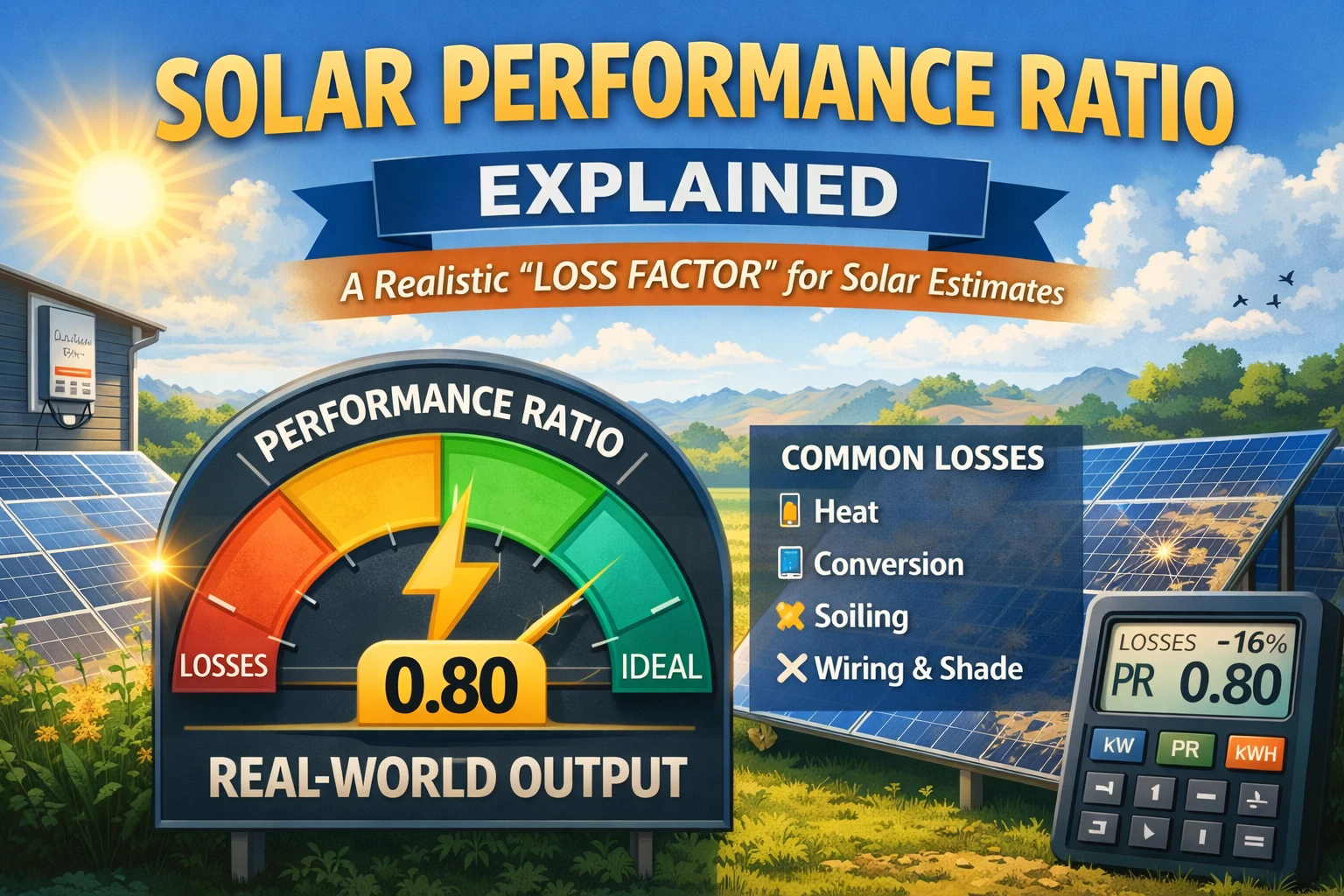
A PR of 0.80 means you’re getting about 80% of the ideal output after real-world losses.
PR vs efficiency vs “derate factor” (don’t mix these up)
- Panel efficiency = how well a panel converts sunlight to DC electricity (lab-style spec).
- Inverter efficiency = how well DC becomes AC.
- PR / derate = a planning + performance metric that reflects everything that reduces output in the real world.
Beginner shortcut:
If you’re doing planning math, PR is the simplest way to avoid overestimating.
What lowers PR? (the common loss buckets)
Here are the usual suspects:
- Heat (temperature losses)
Panels produce less power when they get hot—especially in strong summer sun. - Inverter + conversion losses
Even good inverters lose a small percentage during conversion. - Soiling (dust, pollen, bird droppings)
Often small… until it’s not. - Wiring and connection losses
Normal, but should be controlled by good design. - Mismatch + real-world operation
Modules never match perfectly; shading or different orientations can also reduce output. - Downtime / faults (rare but real)
A tripped breaker, failed component, or monitoring issue can reduce annual output.
In industry monitoring and evaluation, PR is used specifically because it reflects the combined effect of these losses on production.
What PR number should you use for planning?
For home-solar planning math, most people use:
- 0.75 to 0.85 as a reasonable “planning PR” range
(0.80 is a common middle-of-the-road assumption.)
If you want a grounded reference point: PVWatts (a widely used NREL calculator) uses default system losses of 14% (derate ≈ 0.86) and treats inverter efficiency separately (example nominal 0.96), which multiplies to about 0.825 in their example.
Quick decision table: pick a PR assumption safely
| Your situation | Safe planning PR |
|---|---|
| Cool climate, clean panels, minimal shading, solid equipment | 0.82–0.86 |
| Typical home system (normal heat + normal losses) | 0.78–0.83 |
| Hot roof, dusty area, some shade, complex roof | 0.72–0.78 |
| You have no info yet (early planning) | 0.80 |
Why PR is so useful when comparing quotes
Two quotes can show different “expected production” simply because they assumed different losses.
Use this checklist to compare apples-to-apples:
- What PR/derate or loss % did they assume?
- Did they model shading (or assume none)?
- Are the inverter assumptions realistic for your system type?
- Are they using annual averages or showing month-by-month production?
Your quote comparison will be much easier if you anchor it to your sizing pillar:
https://solarbasicshub.com/solar-components-and-sizing-basics/
PR and troubleshooting: when low production might be “normal”
PR isn’t a single fixed number all year:
- PR often dips in very hot months (temperature losses)
- it can dip during dusty seasons
- it can dip with snow, pollen, storms, or partial shading
If your production seems low, start with safe checks (no electrical work):
https://solarbasicshub.com/why-solar-production-low/
A simple framework: Use PR in 30 seconds
When doing quick estimates:
- Start with system size (kW)
- Use a realistic sunlight assumption (monthly is best)
- Multiply by PR (0.78–0.83 typical)
That’s it. You’ll be closer to reality than most “perfect world” calculators.
When to consult a professional
Talk to a qualified installer/solar engineer if:
- you need accurate modeling with shading analysis and roof layout constraints
- you’re planning battery backup/critical loads (PR interacts with system design)
- you suspect faults or safety issues (don’t DIY electrical troubleshooting)
This guide is for planning and understanding, not wiring or installation instructions.
Summary
- PR = realism factor that accounts for real-world solar losses.
- For planning, 0.75–0.85 is a common safe range (often ~0.80).
- PVWatts defaults (losses + inverter example) land around ~0.825 in their manual example.
- Using PR helps you compare quotes fairly and avoid inflated expectations.