
Peak Sun Hours (PSH) is one of the most useful “solar beginner” concepts—because it turns complicated sunlight patterns into one simple number you can use for rough planning.
It’s also commonly misunderstood.
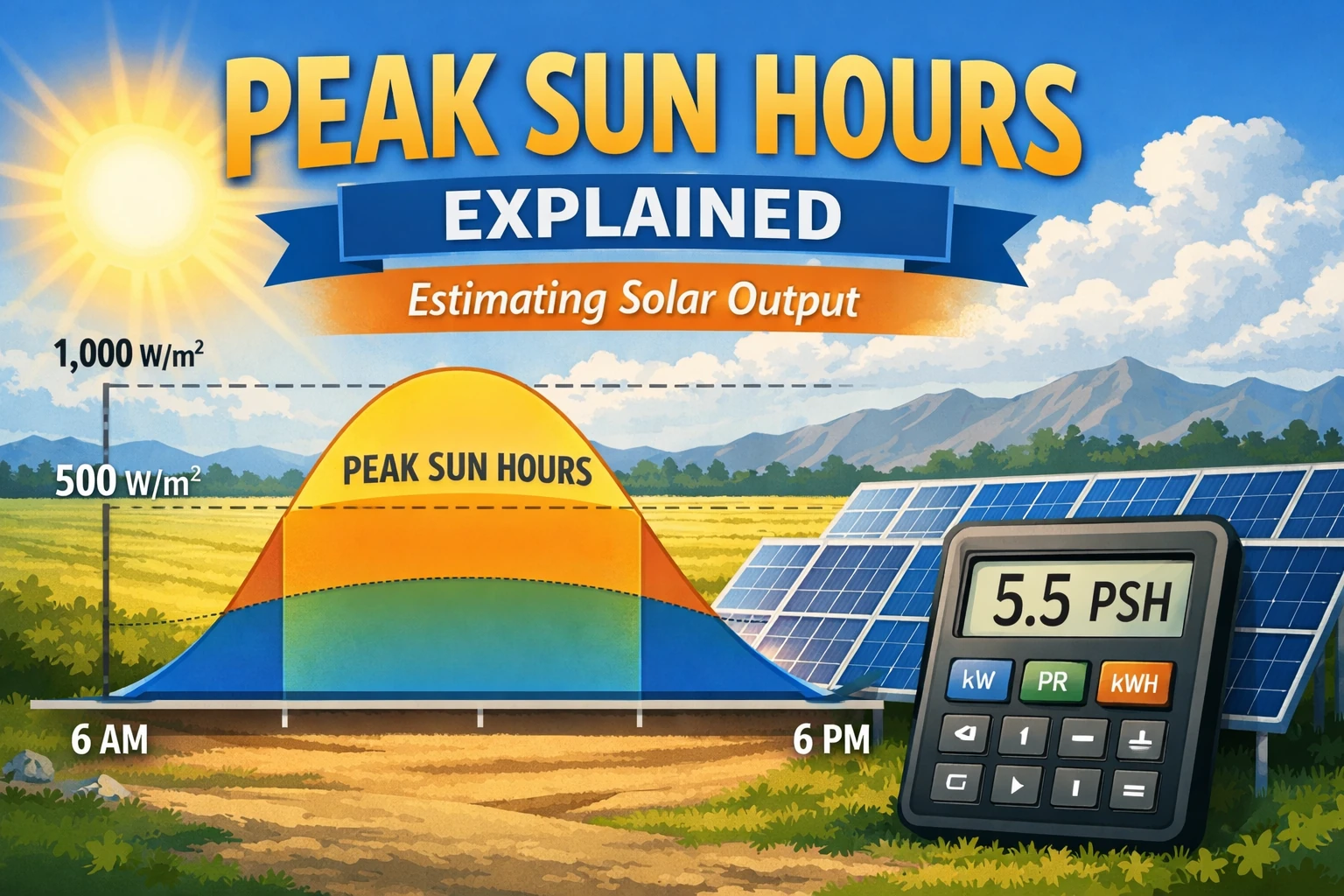
Peak sun hours are not the number of hours the sun is in the sky. Instead, PSH is a way of “adding up” sunlight intensity across the day into equivalent hours at peak strength.
Who this is for
This guide is for you if you:
- want a quick, safe way to estimate solar production (no electrical DIY)
- keep seeing “4–6 peak sun hours” and want to understand what it means
- want to sanity-check a solar quote or calculator result
If you’re brand new to how solar systems work, start here first: Solar Basics: How Solar Power Works https://solarbasicshub.com/solar-basics-how-solar-power-works/
What is a “peak sun hour” (simple definition)
A peak sun hour is the amount of sunlight energy equal to 1 hour at 1,000 W/m² (often described as “full sun” intensity).
So these two examples are roughly equivalent:
- 1 hour at 1,000 W/m² = 1 PSH
- 2 hours at 500 W/m² = 1 PSH
This is why PSH is helpful: it converts the real world (sunlight that ramps up, peaks, and falls) into a single daily total.
Peak sun hours vs daylight hours
Daylight hours = “the sun is up.”
Peak sun hours = “how much usable solar energy hit the surface.”
A winter day can have decent daylight but low solar intensity (sun angle, clouds, atmosphere). Season and sun angle matter a lot in how much solar radiation reaches a location.
The key unit behind PSH (the cheat code)
In many solar tools, daily solar energy is expressed like this:
kWh/m²/day (insolation)
Here’s the cheat code:
PSH ≈ daily insolation (kWh/m²/day)
Because “1 PSH” corresponds to 1 kWh/m² (1,000 W/m² for 1 hour).
So if your location averages 5.2 kWh/m²/day, that’s about 5.2 peak sun hours.
How peak sun hours help estimate solar production (safe beginner formula)
To estimate daily energy production, you only need three numbers:
- System size (kW)
- Peak Sun Hours (PSH)
- Performance ratio (PR) — a realistic “loss factor” for heat, inverter conversion, wiring, dust, etc.
A common rough-planning formula:
Daily energy (kWh/day) ≈ System size (kW) × PSH × PR
Typical PR for a quick estimate: 0.75 to 0.85 (varies by system and conditions).
If you’re confused by kW vs kWh, read this first: https://solarbasicshub.com/kw-vs-kwh-solar/
Example (simple)
- System: 6 kW
- PSH: 5
- PR: 0.80
Daily energy ≈ 6 × 5 × 0.80 = 24 kWh/day
That’s a rough average-style estimate—not a promise of daily output.
Quick decision table: what changes your estimate the most?
| Factor | What it affects | “Bigger impact” when… |
|---|---|---|
| Peak sun hours (location + season) | The fuel your panels receive | You’re comparing cities, climates, or winter vs summer |
| Shading | Production drops (sometimes dramatically) | Trees/buildings shade panels during prime hours |
| Performance ratio (losses) | Real output vs “ideal” output | Hot climates, dirty panels, mismatched equipment |
| System size (kW) | Your production ceiling | You’re sizing to match higher household use |
If your real production is lower than expected, use this troubleshooting guide (safe checks only): https://solarbasicshub.com/why-solar-production-low/
How to find your peak sun hours (2 safe options)
Option A: Use a solar calculator that already includes location data
Tools like PV output estimators typically use solar radiation datasets and your location to estimate monthly production. (Many installers and online tools do this behind the scenes.)
Option B: Use your area’s average insolation (kWh/m²/day)
If you find a solar resource value expressed in kWh/m²/day, you can treat it as PSH for planning.
Tip: Don’t obsess over a single number. What matters most is monthly variation (winter vs summer), because that’s where surprises happen.
A “sanity range” for peak sun hours
In many regions, average daily PSH often falls somewhere around 2 to 7, depending on latitude, season, and cloud patterns. (Deserts and sunny regions trend higher; cloudy/high-latitude winters trend lower.)
If you see a result way outside that range, double-check:
- the units (kWh/m²/day vs something else)
- whether it’s annual average vs a winter month
- whether it’s tilted surface vs flat surface assumptions
Mini checklist: use PSH without getting misled
Use this before trusting any “estimated solar output” number:
PSH & output checklist
- ✅ Is the estimate monthly (better) or just annual average (less useful)?
- ✅ Does it assume no shade (many tools do)?
- ✅ Does it include a realistic PR/loss factor (0.75–0.85-ish)?
- ✅ Does your roof face a non-ideal direction or have a low tilt? (That can reduce output.)
- ✅ Are you comparing “best day” output to “average day” output? (Common mistake.)
For a bigger-picture sizing walk-through, link this pillar:
https://solarbasicshub.com/solar-components-and-sizing-basics/
When to consult a professional
Talk to a qualified installer/electrician if:
- you’re planning any electrical work (inverter, breaker panel, wiring, grounding)
- you need accurate production modeling with shading analysis
- you’re considering backup power, critical loads, or battery sizing
- you want to confirm local grid rules (export limits, net metering, interconnection)
This article is for planning and understanding—not DIY electrical instructions.
Summary (the 10-second takeaway)
- Peak sun hours convert sunlight intensity into a simple daily number.
- PSH is not daylight hours. It’s “equivalent full-sun hours.”
- A safe estimate is: kWh/day ≈ kW × PSH × PR.
- Use monthly values when possible, and always sanity-check shading and losses.